


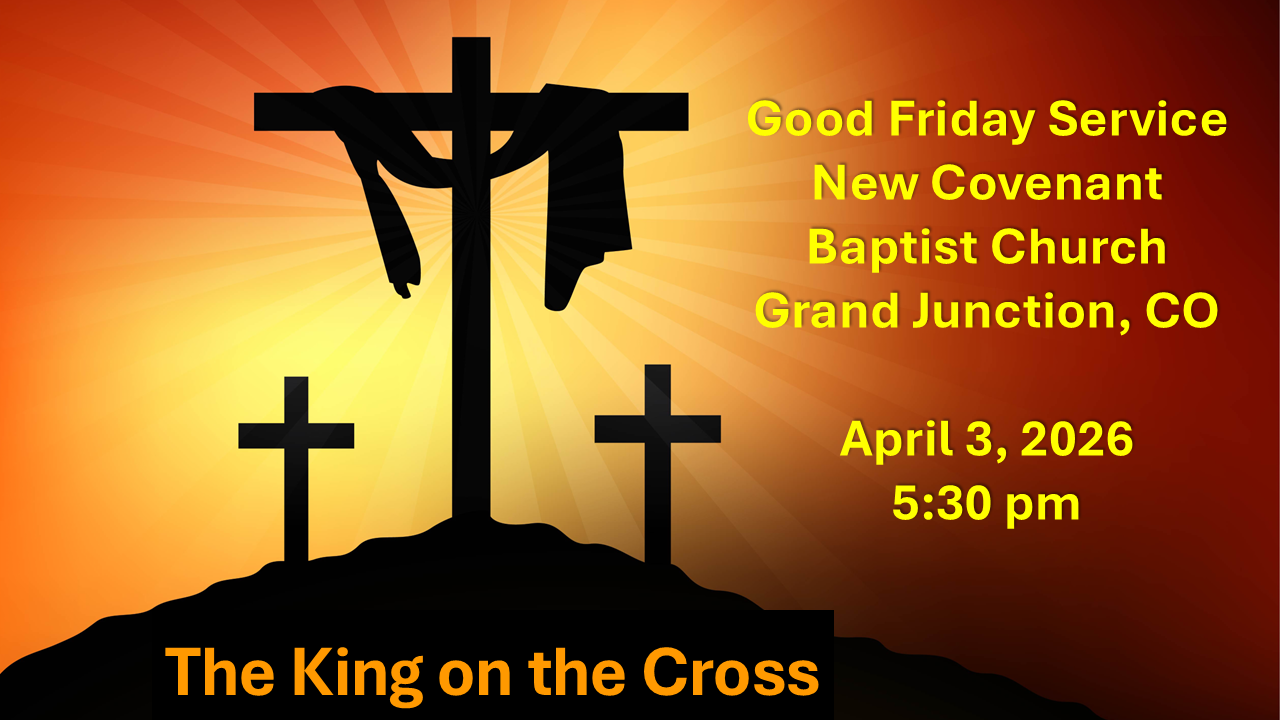
Christ’s Death and Burial
John 19:31-37
31 Therefore, because it was the Preparation Day, that the bodies should not remain on the cross on the Sabbath (for that Sabbath was a high day), the Jews asked Pilate that their legs might be broken, and that they might be taken away. 32 Then the soldiers came and broke the legs of the first and of the other who was crucified with Him. 33 But when they came to Jesus and saw that He was already dead, they did not break His legs. 34 But one of the soldiers pierced His side with a spear, and immediately blood and water came out. 35 And he who has seen has testified, and his testimony is true; and he knows that he is telling the truth, so that you may believe. 36 For these things were done that the Scripture should be fulfilled, “Not one of His bones shall be broken.” 37 And again another Scripture says, “They shall look on Him whom they pierced.”
The point of this text (John 19:31-37) is very simple. It is that Jesus of Nazareth died as the lamb of God for the forgiveness of our sins. Our response must be to repent and believe in Him. Jesus really died. He breathed His last breath. His side was pierced through. All for us.
This fact is essential because Jesus’ death and burial are at the very heart of the gospel message by which we are saved. As Paul summarized the gospel by writing (1 Cor. 15:3-4), “For I delivered to you first of all that which I also received: that Christ died for our sins according to the Scriptures, and that He was buried, and that He rose again the third day according to the Scriptures.”
In John 19:31-37, we have the final scene at the cross. Jesus has been crucified. John 19:30 told how Jesus died, “So when Jesus had received the sour wine, He said, “It is finished!” And bowing His head, He gave up His spirit.” When Jesus died He “bowed His head”. His body gave out. His heart stopped beating; His lungs stopped processing air; His brain ceased functioning. But more than that, John tells us “He gave up His spirit.” As Jesus said in John 10,
17 “Therefore My Father loves Me, because I lay down My life that I may take it again. 18 No one takes it from Me, but I lay it down of Myself. I have power to lay it down, and I have power to take it again. This command I have received from My Father.” (John 10:17-18).
Jesus gave His life on the cross for us. The chief priests had condemned Jesus to death, but He gave His life. Pilate sentenced Him to be crucified, but Jesus gave His life. The soldiers nailed Him to the cross, but Jesus gave His life. No one took His life. When Jesus died, He bowed His head and “gave up His spirit.” Jesus died by giving up His life on the cross.
Maybe you’re thinking, “Well, that’s obvious. Of course He died!” But many people down through the centuries have denied that seemingly obvious fact. Late in the first century, heretical Docetists denied that Jesus was truly a man. They claimed that He only seemed to be a man and thus He only seemed to die. Over a billion Muslims today believe something similar to that error because Mohammed, whose knowledge of Christianity came through Docetist sources, wrote in the Quran (Sura 4.156), “They did not kill him, neither did they crucify him; it only seemed to be so.”[1]
One reason that John wrote his epistle of 1 John was to refute an early form of this heresy. There, John wrote about Jesus Christ:
1 That which was from the beginning, which we have heard, which we have seen with our eyes, which we have looked upon, and our hands have handled, concerning the Word of life– 2 the life was manifested, and we have seen, and bear witness, and declare to you that eternal life which was with the Father and was manifested to us– (1 John 1:1-3).
John testified that Jesus did not just seem to be a man, He was truly a man of flesh and blood. Again, John writes in 1 John 4,
By this you know the Spirit of God: Every spirit that confesses that Jesus Christ has come in the flesh is of God, and every spirit that does not confess that Jesus Christ has come in the flesh is not of God.” (1 John 4:2-3).
As John wrote at the beginning of his Gospel (John 1:14), “And the Word became flesh and dwelt among us.”
Jesus of Nazareth experienced death in full for us, and in our passage John presents three witnesses to testify to it.
1. The soldiers certify His death (John 19:31-34)
John presents the Roman soldiers to us as witnesses to the death of Christ. In John 19:31, we read, “Therefore, because it was the Preparation Day, that the bodies should not remain on the cross on the Sabbath (for that Sabbath was a high day), the Jews asked Pilate that their legs might be broken, and that they might be taken away.”
The “Preparation Day” was Friday, the day before the Jewish Sabbath. Since the Jews could not work on the Sabbath, they had to prepare all the meals for the Sabbath the day before. John points out that this was no ordinary Sabbath, it was “a high day”. Because this Sabbath fell during the Passover week, it was extra special. Therefore the Jews did not want their land defiled with the bodies of crucified men on this Sabbath. Perhaps they were thinking of Deuteronomy 21:22-23 which says,
“If a man has committed a sin deserving of death, and he is put to death, and you hang him on a tree, his body shall not remain overnight on the tree, but you shall surely bury him that day, so that you do not defile the land which the LORD your God is giving you as an inheritance; for he who is hanged is accursed of God.” (Deut. 21:22-23).
Notice the hypocrisy of the Jewish authorities. They have just murdered an innocent man, and their concern is not to defile themselves for the Sabbath day. So, the Jewish authorities go to Pilate and request that the three who were crucified that day have their legs broken and their bodies removed from the crosses. Breaking of the legs of the criminals would make death come quickly since it would make it nearly impossible for them to breathe. John describes the scene in John 19:32-34:
Then the soldiers came and broke the legs of the first and of the other who was crucified with Him. But when they came to Jesus and saw that He was already dead, they did not break His legs. But one of the soldiers pierced His side with a spear, and immediately blood and water came out. (John 19:32-34
The point is that the soldiers knew that Jesus was dead. That is why they did not break His legs. And so that there would be no doubt, one soldier thrust a spear into His side. If Jesus had still been alive, He would have certainly reacted to this, but instead, John tells us that from the side of Jesus’ slumped body flowed blood and water.
Medical experts disagree on exactly what happened, but it’s obvious from the flow of blood and water that Jesus was dead before the spear thrust. But even if He hadn’t already died, this spear thrust would have finished the job. It wasn’t a minor puncture wound—it left a scar large enough to put your hand into (John 20:27).
The blood and water point to the incarnation of Christ, His atoning death, and the cleansing from sin that it accomplishes. John writes in his first epistle about the Lord,
6 This is the One who came by water and blood, Jesus Christ; not with the water only, but with the water and with the blood. It is the Spirit who bears witness, because the Spirit is the truth. 7 For there are three that bear witness: 8 the Spirit and the water and the blood; and the three are in agreement. (1 John 5:6-8 LSB).
In the Old Testament, the sacrifices were cleansed with water and the blood was sprinkled with water for cleansing (cf. Lev. 14). John may have had Zechariah 13:1 in mind. There, the Lord says through the prophet, “In that day a fountain shall be opened for the house of David and for the inhabitants of Jerusalem, for sin and for uncleanness.” That verse occurs just five verses after Zechariah 12:10, which John quotes, referring to the piercing of Jesus’ side (John 19:37). So, the blood and water symbolize Christ’s atoning death and cleansing from sin (1 John 1:7).
The blood atones and the water cleanses. August Toplady’s hymn, “Rock of Ages”, speaks about the blood and water that way.
Rock of Ages, cleft for me,
let me hide myself in thee;
let the water and the blood,
from thy wounded side which flowed,
be of sin the double cure;
save from wrath and make me pure.
We also sing of that cleansing in William Cowper’s hymn,
There is a fountain filled with blood,
Drawn from Immanuel’s veins;
And sinners plunged beneath that flood,
Lose all their guilty stains.
What is unmistakably clear is that Jesus really died. Blood and water flowed from His side. The Romans soldiers – the professional executioners – were sure of it, and so John presents them to us as witnesses.
2. John gives eyewitness testimony (John 19:35)
Notice, secondly, that John himself is also a witness. John writes, “And he who has seen has testified, and his testimony is true; and he knows that he is telling the truth, so that you may believe,” (John 19:35).
To whom is John referring here? It is most natural, I think, and most in keeping with the way that John refers to himself throughout his Gospel, to understand John writes here about himself. Remember, John was at the cross with Jesus’ mother (John 19:26). He bears witness to Christ’s death. He promises to be telling the truth. Why? “so that you may believe.” That is the whole point of the Gospel of John isn’t it? “…these are written that you may believe that Jesus is the Christ, the Son of God, and that believing you may have life in His name,” (John 20:31).
So, the soldiers actions testify to Christ’s death, and John’s eyewitness testifies to Jesus’ death. And thirdly we have,
3. God testifies by the fulfillment of scripture (John 19:36-37)
John sets the Old Testament scriptures before us as evidence. Jesus’ death was foreordained, prophesied, and prefigured. Even the small details were in fulfillment of prophesy. First, he writes in John 19:36, “For these things were done that the Scripture should be fulfilled, ‘Not one of His bones shall be broken.’”
John is probably referring to three Old Testament Scriptures. Exodus 12:46 and Numbers 9:12 both prohibit breaking the bones of the Passover lamb. They were to slaughter the lamb, but not break any of its bones. Then they were to put the blood of the lamb on the doorposts and lentils of their houses so they would be saved from the plague of the death of the firstborn.
John wants us to see that Jesus is the fulfillment of the Passover. His Gospel emphasizes that the day of Christ’s death was not just during the Passover feast, but that Jesus died at the very day and hour when the Passover lambs were being slain late Friday afternoon. Remember that at the beginning of the Gospel, John the Baptist saw Jesus coming toward him, and said, “Behold! The Lamb of God who takes away the sin of the world!” Jesus is our Passover lamb who was slain for our sins.
In Psalm 34, David speaks about the Lord delivering the righteous man from afflictions (Ps. 34:15, 19) saying, “He guards all his bones; Not one of them is broken.” (Psalm 34:20). Jesus is the righteous one whose bones were not broken in fulfillment of scripture.
Jesus died on the cross between two criminals. The soldiers came and broke the legs of the first criminal. They broke the legs of the second. Then they came to Jesus and did not break His legs because He had already died. Jesus died as the true Passover lamb, the righteous Son of God whose death saves us from sin, condemnation, and death.
But not only did Christ die with no bone broken, He also was pierced in His side in fulfillment of scripture. Charles Spurgeon, commenting on Jesus being pierced, says,
And what was that which came into that Roman soldier’s mind when, in a hasty moment, he resolved to make sure that the apparent death of Jesus was a real one? Why did he open that sacred side with his lance? He knew nothing of the prophecy. He had no dreams of Eve being taken from the side of the man, and the church from the side of Jesus. He had never heard that ancient notion of the side of Jesus being like the door of the ark, through which an entrance to safety is opened. Why, then, does he fulfill the prediction of the prophet?[2]
He did it by God’s providence in fulfillment of the scripture. It was God’s predetermined plan and purpose to provide for the forgiveness of sins. Jesus of Nazareth died on the cross, not because He failed His mission, but because He accomplished it. He cried out the victory, “It is finished!” (John 19:30). The death of Jesus Christ was not man’s idea, it was God’s. His death fulfilled scriptures written long ago. The scriptures testify to the necessity of the death of the Christ.
John points out the fulfillment of scripture in John 19:37, “And again another Scripture says, ‘They shall look on Him whom they pierced.’” John refers to Zechariah 12:10 which says,
And I will pour on the house of David and on the inhabitants of Jerusalem the Spirit of grace and supplication; then they will look on Me whom they pierced. Yes, they will mourn for Him as one mourns for his only son, and grieve for Him as one grieves for a firstborn. (Zech. 12:10).
The Lord Himself speaks through the prophet Zechariah saying that the inhabitants of Jerusalem “will look on Me whom they pierced.” They will pierce the Lord Himself, and they will mourn for Him. That prophecy will have its final fulfillment when Jesus returns (Rev. 1:7), but it had its initial fulfillment here. It also fulfills Isaiah 53:5, which says that the Suffering Servant “was wounded (literally, pierced through) for our transgressions.” Although as the Lamb of God, Jesus’ bones would be unbroken And as the only righteous servant of Yahweh, He must be pierced. Therefore, John 19:34 says, “But one of the soldiers pierced His side with a spear, and immediately blood and water came out.” Thus, in fulfillment of scripture, “They shall look on Him whom they pierced.” Jesus is the only begotten Son of God who was pierced for our sins. And our response should be what the Zechariah prophesied, “they will mourn for Him as one mourns for his only son, and grieve for Him as one grieves for a firstborn” (Zech. 12:10).
And isn’t this what happens to every person who’s born again? We look on Jesus whom we pierced, who was wounded for our transgressions, and we mourn, realizing it was my sin that nailed Him there. It was for my sin He was pierced. We repent of our sin, and we believe in Jesus who died for us, trusting in His death and resurrection.
Jesus came to die as the Lamb of God who takes away the sin of the world. He came to atone for our sins with His blood and cleanse us from sin by His life.
Our response is to repent and believe. In John 19:35, John says he testifies to what he saw, “so that you may believe.”
What does the death of Jesus Christ mean? Everything, if we believe on Him. As the modern hymn (by Keith Getty and Stuart Townend) says so beautifully,
Oh, to see my name
Written in the wounds,
For through Your suffering I am free.
Death is crushed to death,
Life is mine to live,
Won through Your selfless love.
This, the power of the cross:
Son of God, slain for us.
What a love! What a cost!
We stand forgiven at the cross.
Do you believe? Come then, feed upon Christ. The New Testament says, “Christ, our Passover, is sacrificed for us.” (1 Cor. 5:7 KJV). Jesus, the Lamb of God has become your food, your very life. “Therefore let us keep the feast … with … sincerity and truth” (1 Cor. 5:8). Keep the feast in your own souls today. Feast on Christ today by faith. Believe in Him. By Christ’s blood shed on the cross, receive the forgiveness for your sins. By Christ’s body given for you, receive cleansing to make you pure.
[1] D. A. Carson, The Gospel According to John [Eerdmans/Apollos], pp. 623-624, footnote 3.
[2] Charles H. Spurgeon, ON THE CROSS AFTER DEATH NO. 1956, https://spurgeongems.org/sermon/chs1956.pdf


