


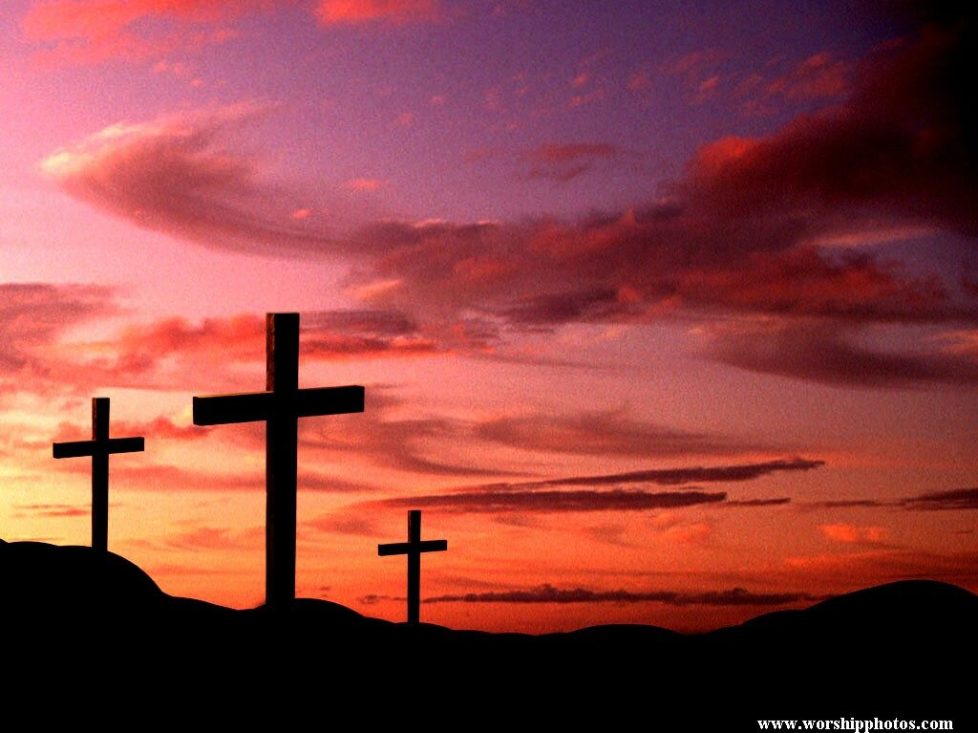
The King on the Cross
Matthew 27:27-44
How many times have we sung the beautiful, yet haunting words that George Bennard penned more than a hundred years ago?
On a hill far away stood an old rugged cross,
The emblem of suff’ring and shame;
And I love that old cross where the dearest and best
For a world of lost sinners was slain.[1]
As the hymn says, the cross is an emblem of suffering and shame—a strange thing to love so much that we sing about it and rejoice in it. The cross was the means of the one of the most brutal means of execution ever devised: crucifixion. Unlike modern methods of capital punishment that are designed to produce a quick, painless death, crucifixion was intended to guarantee that the condemned person would die a slow, agonizing death. Crucifixion was a common method of execution in the first century, used by the Romans on some 20,000 people in Judea and Galilee alone. Why do we remember the name of only one of those crucified men? Why do we lift our voices to sing about Him?
We’ll have to wait for next Sunday to get the full answer to that question as we study the death of Christ. But just looking at Jesus’ suffering and crucifixion itself this week, we will what the hymn reminds us, that it was on “that old cross where the dearest and best, for a world of lost sinners was slain.”
Throughout our study of the Gospel of Matthew, we’ve seen that Matthew has emphasized that Jesus is the Christ, the King of the Jews. Jesus is the divinely promised, long awaited Messianic King. And in this morning’s passage, we see what appeared to the Jews as unthinkable, what they stumbled over: the King on a cross. Paul writes in 1 Corinthians,
23 but we preach Christ crucified, to the Jews a stumbling block and to the Greeks foolishness, 24 but to those who are called, both Jews and Greeks, Christ the power of God and the wisdom of God. (1 Cor. 1:23-24).
Christ on the cross is something that Mathew knew was scandalous, a “stumbling block,” to the Jewish mind. Even for Gentiles of the first century and also to our modern minds, the cross is often ridiculed as “foolishness”. But for those of us whom God has called and saved, we sing about the cross because Christ crucified for sinners is the most life-changing, world-transforming message that could ever be proclaimed. The cross is the ultimate climax of redemptive history, the perfect revelation of God’s grace, love, and mercy for sinful mankind. At the cross we see mankind’s lowest sinful depravity and God’s highest justice. We see the darkest hour of man’s sinfulness in contrast with brightest hour of God’s love and mercy.
So, in our passage today, Matthew presents Jesus as the King on the cross. We will see the humiliation of the king, the crucifixion of the king, and the denunciation of the king. Against the darkness of evil men in their depraved cruelty, King Jesus shines forth as the gloriously humble King who suffers on our behalf for our salvation. First, we see …
I. The Humiliation of the King (Matt. 27:27-31)
As we saw last time, the Roman governor, Pontius Pilate gave in to the demands of the chief priests and elders who brought Jesus to him to be executed. Even though Pilate knew Jesus was innocent of any crime, he chose political expedience over justice or mercy. Before delivering Jesus up to be crucified, Pilate had Jesus scourged (Matt. 27:26). The intention of the scourging was to make the victim’s suffering on the cross even more intense, and to make his appearance to the people who saw him even more dreadful.
Matthew 27:27 then says, “Then the soldiers of the governor took Jesus into the Praetorium and gathered the whole garrison around Him.” The Roman garrison or cohort consisted of 600 men. Rome often conscripted men from conquered nations into her armies. Many believe that Pilate’s garrison was made up of Syrians since they would hate Jews but still be able to speak the common language of Aramaic.
To the soldiers, it’s likely that Jesus was merely another condemned Jew. They were free to abuse Him as much as they wanted as long as they didn’t kill Him. Knowing the charges against Him, that He claimed to be a king, they served up severe ridicule. To humiliate Jesus was a cruel game, indulging their savage impulses. Yet, in the ways in which they mocked our precious Savior, they spoke more truth about Him than they could possibly have known.
First, Matthew tells us in Matthew 27:28, “And they stripped Him and put a scarlet robe on Him.” They had already stripped Him to some degree when they flogged Him. But after He had been scourged, they stripped Him once again–this time, not to flog Him, but to further degrade Him. They removed His personal seamless garment and wrapped a “scarlet robe” around His shoulders. It was probably one of their own military capes. Mark and John say that the robe was “purple” (Mark15:17; John19:2). Purple was the traditional color of royalty, and the “scarlet robe” was close enough. Standing before them, was the humiliated, bloodied King of the Jews. What a laugh!
Though it was not their intention, when the soldiers clothed Jesus in the “scarlet robe,” they symbolized how He would soon be willingly clothed in the scarlet sins of all humanity. In Isaiah 1:18, the Lord says, “Though your sins are like scarlet, They shall be as white as snow; Though they are red like crimson, They shall be as wool.” Jesus voluntarily took the guilt of our blood-red sins upon Himself.
In Revelation 19, when John sees the vision of the Lord Jesus Christ returning in power and glory, he writes that “He was clothed with a robe dipped in blood, and His name is called The Word of God” (Rev. 19:13). And John goes on to say, “And He has on His robe and on His thigh a name written: KING OF KINGS AND LORD OF LORDS.” (Rev. 19:16). He will wear the robe of royalty, because He is indeed the King of all!
Next, the soldiers “twisted a crown of thorns” (Matt. 27:29) and jammed it down upon His head. This was no doubt to mimic the royal wreath worn by Caesar. The long Judean thorns would have pierced the Lord’s skin, causing blood to run down His face. What a ridiculous looking King He would have been! What a joke Jesus was to them!
In the Bible, “thorns” are also symbolic. The mention of thorns in the Bible is after Adam sinned in the Garden of Eden. Part of the curse of the fall was that the ground would bring forth “thorns and thistles” for mankind (Gen.3:18). Wearing a crown of thorns, Jesus was the King who bore the curse of sin for us on the cross.
I love the ancient hymn that says,
O sacred Head, now wounded,
With grief and shame weighed down,
Now scornfully surrounded
with thorns, Thine only crown;
How pale Thou art with anguish,
With sore abuse and scorn!
How does that visage languish
Which once was bright as morn![2]
The soldiers also put “a reed in His right hand” and “bowed the knee before Him and mocked Him, saying, ‘Hail, King of the Jews.’” (Matt. 27:29). The “reed” was meant mockingly to represent a monarch’s scepter, the symbol of a king’s power and authority. Instead of humbly bowing before the King of kings, they “spat on Him” and “struck Him on the head” with His own mock scepter (Matt. 27:30).
But once again, their mocking actions and words spoke more truth than they knew. Without realizing it, they placed a mock “scepter” into the hands of the very Messiah that God the Father spoke of in Psalm 2. In that passage, the Messianic King says,
“I will declare the decree: The LORD has said to Me, ‘You are My Son, today I have begotten You. Ask of Me, and I will give You the nations for Your inheritance, and the ends of the earth for Your possession. You shall break them with a rod of iron; You shall dash them to pieces like a potter’s vessel’” (Psalm 2:7-9).
And that’s what the Lord Jesus will do when He comes to reign over this earth. Revelation 19:15 says about the returning Lord Jesus, “Now out of His mouth goes a sharp sword, that with it He should strike the nations. And He Himself will rule them with a rod of iron.” Instead of a “reed” He will “strike the nations” with a “sharp sword” and tread “the winepress of the fierceness and wrath of Almighty God” (Rev. 19:15). On that day, at the name of Jesus every knee shall bow and every tongue confess that Jesus Christ is Lord! (Phil. 2:10-11).
Finally, their cruel amusement was over. The whole scene was viciously designed for extreme humiliation. But when the soldiers grew tired of their heartless abuse, they “took the robe off Him” and “put His own clothes on Him” and then “led Him away to be crucified” (Matt. 27:31).
In the hymn by Philip Bliss we sing,
Bearing shame and scoffing rude,
In my place condemned He stood,
Sealed my pardon with His blood;
Hallelujah, what a Savior![3]
What stands out to me in this whole ugly scene is the control and restraint of Jesus. The only time Jesus even speaks during His trial and torture was when they asked Him the condemning question, “Are you the king of the Jews” (Matt. 27:11). And He answers simply, “Yes, it is as you say” (Matt. 26:64; 27:12). Jesus had already submitted to the Father’s will and He was at peace. He was fulfilling Isaiah 53:7 which says, “He was oppressed and He was afflicted, Yet He opened not His mouth; He was led as a lamb to the slaughter, And as a sheep before its shearers is silent, So He opened not His mouth.”
Truly, God is not mocked! Even those who most mocked King Jesus said more truth about Him in their mocking than they knew!
II. The Crucifixion of the King (Matt. 27:32-38)
Different Bible scholars portray the carrying of the cross differently. Some suggest that He only carried the crossbeam while others believe that He carried the entire cross, which probably weighed as much as 200 pounds. Part of the public humiliation of crucifixion was to carry the instrument of your own death through the narrow, winding and crowded streets of Jerusalem to the place of execution. John tells us that Jesus “bearing His own cross, went out,” to Golgotha (John 19:17).
Matthew tells us “Now as they came out, they found a man of Cyrene, Simon by name. Him they compelled to bear His cross.” (Matt. 27:32).
Remember, Jesus had already suffered horribly. The night before, He had no sleep. He already suffered the abuse from the Jews as they spat on Him, beat Him, and slapped Him (Matt. 26:67). He bore horrible open wounds from the Roman scourge. The soldiers had played their punishing games on Him. It is any wonder that the soldiers found it necessary to compel someone else to finish carrying the cross the rest of the way?
“Simon” was a very common name. “Cyrene” was a city in Northern Africa with a large population of Jews. Mark says “he was coming out of the country and passing by,” obviously a Jewish pilgrim in Jerusalem for the Passover (Mark 15:21). Further, Mark adds that he was “the father of Alexander and Rufus.” These sons seem to be well known to Mark and his readers in Rome. In Rom.16:13, the Apostle Paul says, “Greet Rufus, chosen in the Lord, and his mother and mine.”
It seems probable that Simon’s carrying of Jesus’ cross led not only him to faith, but His whole family as well. Carrying the cross of Christ symbolized how he would spend the rest of His life. Simon literally did what Jesus had told His disciples, “If anyone desires to come after Me, let him deny himself, and take up his cross, and follow Me. For whoever desires to save his life will lose it, but whoever loses his life for My sake will find it.” (Matthew 16:24-25).
The hymn by Thomas Shepherd says,
Must Jesus bear the cross alone
And all the world go free?
No, there’s a cross for ev’ryone,
And there’s a cross for me.[4]
Jesus went to the cross identifying with sinners. We take up our cross identifying with our Savior. May we become known as men and women who, like Simon, bear the cross of Jesus.
Matthew 27:33 tells us that Jesus was led to “a place called Golgotha, that is to say, Place of a Skull.” The place of the crucifixion was called by an Aramaic word “Golgotha” which Matthew interprets as “Place of a Skull.” The word skull (κρανίον, kranion) is translated into Latin as calvaria from which we get “Calvary.” The name probably came from the shape of the hillside looking like a skull and from the executions that took place there. “Golgotha” was beside a well-traveled thoroughfare that led into the city. Romans crucified criminals in high traffic areas or on hillsides because they wanted as many people to see the punishment for those who opposed Rome’s rule.
The Mosaic law requires executions to be done outside the city (Lev. 24:14; Num. 15:35). The Law also required that after the priest had applied the blood of the bull that had been given as a sin offering upon the altar, he was to take the body of that sin offering and burn it upon wood “outside the camp” (Lev. 4:11-12). Hebrews 13 shows that Jesus Christ is the fulfillment of this Old Testament law:
11 For the bodies of those animals, whose blood is brought into the sanctuary by the high priest for sin, are burned outside the camp. 12 Therefore Jesus also, that He might sanctify the people with His own blood, suffered outside the gate. 13 Therefore let us go forth to Him, outside the camp, bearing His reproach. 14 For here we have no continuing city, but we seek the one to come. (Heb. 13:11-14).
Because Jesus suffered as a sin offering for us outside the camp, we also must live as outsiders to this world of sin.
Matthew 27:34 says that they “gave Him sour wine mingled with gall to drink.” Not only would the gall make this a bitter drink, many believe it acted as a narcotic beverage given to relax the condemned so that the nails could be driven into their bodies with less of a fight. Proverbs 31:6 says, “Give strong drink to him who is perishing, And wine to those who are bitter of heart.”
But Matthew says, “But when He had tasted it, He would not drink” (Matt 27:34). When Jesus realized its numbing purpose, “He would not drink it.” Jesus had determined to drink the dregs of the cup of God’s wrath and our sin. He would not diminish the full level of His suffering on our behalf. He would accept it all in our place.
Matthew 27:35 says, “Then they crucified Him.” This phrase is actually a subordinate clause in the form of a participle. It literally says, “And crucifying Him . . .” Matthew gives us nothing in the way of the details that we’re so used to seeing in Christian art or reading in Christian literature. We’re not given any of the gory details about His bloodied and battered body being stretched out on the cross, or of the nails being painfully driven through his hands and feet. Perhaps this is because crucifixion was so common to first century readers it was not necessary to describe it in detail. Yet, I also think that this lack of details shows that our Lord’s physical pain in being crucified is clearly not something that the Holy Spirit wanted us to focus on. Instead, our focus should be on the fact that Jesus suffered and died in our place.
Next, Matthew 27:35 tells us that the soldiers ” divided His garments, casting lots.” They gambled over his articles of clothing and especially over His inner “tunic” which John tells us was “without seam, woven from top to bottom in one piece” (Jn.19:23-24). Matthew shows us that this is a fulfillment of Psalm 22, a psalm of David written a thousand years before Christ. This powerful psalm portrays the king’s suffering in details that remarkably correspond to Jesus’ crucifixion. Listen to Psalm 22:14-18,
14 I am poured out like water,
And all My bones are out of joint;
My heart is like wax;
It has melted within Me.
15 My strength is dried up like a potsherd,
And My tongue clings to My jaws;
You have brought Me to the dust of death.
16 For dogs have surrounded Me;
The congregation of the wicked has enclosed Me.
They pierced My hands and My feet;
17 I can count all My bones.
They look and stare at Me.
18 They divide My garments among them,
And for My clothing they cast lots.
(Psalm 22:14-18).
All of this indignity and suffering Jesus endured for us. While Jesus hung from the cross tasting death on our behalf (Heb.2:9), Matthew 27:36 says about the soldiers, “Sitting down, they kept watch over Him there.” They were stationed there until He died so that friends might not try to take Him down or end His life mercifully.
Matthew then tells us, “And they put up over His head the accusation written against Him THIS IS JESUS THE KING OF THE JEWS,” (Matt. 27:37). John 19:20 tells us it was written in three languages—Hebrew, Greek, and Latin. John also informs us that the chief priests wanted it to say, “He said ‘I am King of the Jews’” (John 19:21). But Pilate dismissed their request, saying, “What I have written I have written,” (John 19:22). The words, “THIS IS JESUS THE KING OF THE JEWS,” would stand as is.
And what a testimony! What truth Pilate presented to the world—without realizing that he did so! This is the truth about Jesus that Matthew has been showing us from the very beginning of his Gospel account. From Jesus’ royal lineage as “the Son of David, the Son of Abraham” (Matt. 1:1), all the way to this declaration of His kingship His death, Matthew points to Jesus as the King, the Christ, the Savior who saves His people from sin and death through His own death and resurrection.
Finally, we see,
III. The Denunciation of the King (Matt. 27:39-44)
Matthew 27:38 tells us that there were also “two robbers” who were crucified alongside Jesus, “one on the right and another on the left.” These may have been associates of the notorious criminal Barabbas who had been set free instead of Jesus. The word for “robbers” indicates that these men were not common thieves but vicious cutthroats probably guilty of murder in order to plunder.
V.44 tells us that “even the robbers” who hung beside Jesus “reviled Him” with the same taunts and insults as the growing crowd below Him. Isaiah prophesied about Jesus in 53:12, “He poured out His soul unto death, And He was numbered with the transgressors, And He bore the sin of many, And made intercession for the transgressors.” Yet even their reviling identified Jesus to us as the King of the Jews, the Savior who suffered in our place.
Matthew 27:39 tells us, “And those who passed by blasphemed Him, wagging their heads …” Many people passed by and gathered around the cross. No doubt the large multitude that shouted to Pilate for Jesus to be crucified had followed them to Golgotha. The city was teeming with pilgrims who followed the excitement. It’s likely that some of these people had seen Jesus’ miracles and heard His powerful teaching. Perhaps some were in the crowd that had praised Him as Israel’s Messiah on Palm Sunday. Now, they “wagged their heads” in mockery and “blasphemed Him.”
Evidently, the priests had circulated the misunderstood statement from Jesus about destroying and rebuilding the temple to the crowd. They used this to incite them against Him. They cried out, “You who destroy the temple and build it in three days, save Yourself!” Others said, “If you are the Son of God, come down from the cross.” (Matt. 27:39-40).
David prophesied about Jesus in Psalm 22 saying, All those who see Me ridicule Me; They shoot out the lip, they shake the head, saying, “He trusted in the LORD, let Him rescue Him; Let Him deliver Him, since He delights in Him!” (Psalm 22:7-8). It’s amazing that those who reviled the Lord could be so blind to what they were doing and saying—especially those who knew the Scriptures so well! And yet, the hardness of their hearts is revealed in the fact that they did and said just what the Scriptures promised. And in all of it, what was also being revealed was that Jesus truly is the King and Messiah who innocently suffered for our sins on the cross.
Matthew 27:41 tells us that “The chief priests,” also joined in the “mocking” along with the “scribes and elders.” They were the agitators who incited the crowd to call for Jesus’ crucifixion. They said, “He saved others; Himself He cannot save,” (Matt. 27:42). What utter blindness! They knew the truth that Jesus saved people. Here, they testified to Jesus’ works. He had healed the sick, delivered the demon-possessed, and even raised the dead! Yet they would not believe in Him. The truth is that if Jesus had saved Himself, He could never have saved others!
They said, “If He is the King of Israel, let Him now come down from the cross and we will believe Him,” (Matt. 27:42). That was a lie. They had ample evidence to believe Jesus was the Son of God, but their hearts were hardened by their own sinful pride.
They also said, “He trusted in God; let Him deliver Him now if He will have Him; for He said, ‘I am the Son of God.’” (Matt. 27:43). Jesus certainly had the power to do what they demanded. At His arrest in the Garden, He had told His disciples He could call twelve legions of angels to rescue Him (Matt. 26:53). But Jesus would not do that. He was fully submitted to the will of the Father. We believe in Jesus today precisely because He didn’t come down from the cross! He stayed in obedience to the Father, and the Father kept Him there because of His great love and mercy toward us.
It was your sins and my sins that put Jesus on the cross. And so, Jesus’ suffering demands a response of repentance and faith from all who hear about the amazing sacrifice He made for you and for me. Again, the ancient hymn expresses it better than I ever could:
What Thou, my Lord hast suffered
Was all for sinners’ gain:
Mine, mine was the transgression,
But Thine the deadly pain;
Lo, here I fall, my Savior!
‘Tis I deserve Thy place;
Look on me with Thy favor,
Vouchsafe to me Thy grace.
What language shall I borrow
To thank Thee, dearest Friend,
For this, Thy dying sorrow,
Thy pity without end?
O make me Thine forever,
And should I fainting be,
Lord, let me never, never
Outlive my love to Thee.[5]
[1] George Bennard, The Old Rugged Cross, Public Domain (1913), Baptist Hymnal 2008 #230.
[2] St. Bernard of Clairvaux, O Sacred Head, Now Wounded, Author (German version): Paul Gerhardt (1656); Translator: James W. Alexander (1829), Public Domain, Baptist Hymnal 2008 #231.
[3] Philip P. Bliss, “Man of Sorrows,” What a Name, Public Domain (1875), Baptist Hymnal 2008 #242.
[4] Thomas Shepherd, Must Jesus Bear the Cross Alone, Public Domain (1693), Baptist Hymnal 2008 #243.
[5] St. Bernard of Clairvaux, O Sacred Head, Now Wounded.


