The Parable of the Dragnet
Matthew 13:47-52
In our verse-by-verse exposition of the Gospel of Matthew, we have been studying the kingdom parables that Jesus taught in Matthew 13. Each of these parables unveils profound truth concerning the “mysteries of the kingdom of heaven” (Matt. 13:11)—truth about the beginning of the kingdom on earth, its obstacles, its spread, its immeasurable value, and its consummation in the final judgment. The Kingdom of Heaven is defined as the rule and reign of the Lord Jesus over His people. For now, that is an invisible, internal kingdom. Jesus rules over our hearts. When the Lord returns, it will be a visible, physical kingdom too.
Today, we come to the parable of the Dragnet. What in the world is a dragnet? When you hear that word, maybe some of you immediately think of the old television police show. One famous phrase from Dragnet is, “The stories you are about to see are true.” And I can tell you this about what Jesus teaches us today, “the parable you are about to see is true.” In this parable, Jesus portrays a principle of the kingdom of heaven that is absolutely true and worthy of our attention. Another famous phrase that Sergeant Friday would often say is, “Just the facts, ma’am.” Today we are going to look at the facts from the One who knows, Jesus Christ, the Son of God. Jesus teaches His disciples some truths concerning the judgment of men and the proclamation of the gospel.
1. The Parable of the Dragnet (Matt. 13:47-50).
A. The Picture of the Judgment (Matt. 13:47-48).
Again, Jesus uses a parable, a common story with a spiritual truth. This particular parable was indeed common to the disciples. After all, at least four of them had been professional fishermen and many of the others had grown up around the fishing industry in Galilee.
In Galilee, there were three common types of fishing. First was the simple hook and line. Peter used this method in Matthew 17:24-27 to catch a fish with a coin in its mouth that he used to pay taxes. Second was the one-man casting net. A man would wade out into the shallow water and hand cast this net over schools of small fish. Third was the large “dragnet” or seine that hangs vertically in the water with its bottom edge held down by weights and its top edge buoyed by floats. It could be pulled between two boats or anchored to the shore on one end so a single boat could pull it to surround the fish. Some of these nets were very large and would drift for hours catching all kinds of fish.
The purpose of the dragnet was to draw everything that came into its sphere, pull it all to the surface or the shore, and allow the fishermen to empty its contents into the boat or onto the beach and pick through it all—selecting the best and most profitable fish, and discarding the rest. We can only imagine what types of things would be caught in a large dragnet. Weeds, refuse, small and large fish, good and bad fish. Jesus said it “… gathered some of every kind.” Anything in the path of the net would eventually be caught and gathered by the fishermen.
We see a couple of examples of this kind of fishing in the Gospels. In Luke 5, Jesus taught the crowds from Simon Peter’s boat. After He was finished, He told Peter to let down his net for a catch. And when Peter and his co-workers did so, Luke tells us, “they caught a great number of fish, and their net was breaking. So they signaled to their partners in the other boat to come and help them. And they came and filled both the boats, so that they began to sink” (Luke 5:6-7). We have a similar story at the end of the Gospel of John after Jesus had risen from the dead. He stood on the shore and told Peter and his fishing partners to cast their net out at a certain spot. When they did, “they were not able to draw it in because of the multitude of fish” (John 21:6). Eventually, the disciples came to the shore, “dragging the net with fish” (John 21:8). The Lord had made a fire and invited them to bring some of the fish they caught; and we’re told that “Simon Peter went up and dragged the net to land, full of large fish, one hundred and fifty-three; and although there were so many, the net was not broken” (John 21:11).
Jesus says in Matthew 13:48, “when [the dragnet] was full, they drew” it “to shore” and the fishermen “… sat down and gathered the good into vessels, but threw the bad away.” The bad fish are those that couldn’t be used either because they were unclean or not suitable for market.
So first, Jesus tells the parable of the net. The kingdom of heaven is like a net catching fish in a lake. When the net is full, the fishermen collect the good fish in baskets and throw the bad fish away. What does this parable teach us?
B. The Principle of the Judgment (Matt. 13:49).
Jesus doesn’t leave us wondering what this parable means, He explains it clearly. Jesus compares the “dragnet” to the judgment by saying “So it will be at the end of the age…” Jesus specifically tells us this parable is about the end of the age. There is coming a time “at the end of the age” when all men, will be separated and judged.
Earlier in this chapter, the Parable of the Wheat and the Tares symbolized believers and unbelievers living alongside each other in the world and their separation and judgment at the end of the age. There are quite a few similarities between the parable of the weeds and the parable of the dragnet. In Matthew 13:41-43, Jesus explained the parable of the wheat and tares…
41 “The Son of Man will send out His angels, and they will gather out of His kingdom all things that offend, and those who practice lawlessness, 42 “and will cast them into the furnace of fire. There will be wailing and gnashing of teeth. 43 “Then the righteous will shine forth as the sun in the kingdom of their Father. He who has ears to hear, let him hear! (Matt. 13:41-43).
That parable focused more on the co-existing of the good and evil in this present world, whereas the parable of the dragnet focuses more on the separation of the good and evil at the end of the age.
As in the Parable of the Wheat and the Tares, “The angels”, God’s agents of justice, “will come forth.” Their task will be to “separate the wicked from among the just” (Matt. 13:49). Notice in both these parables the role of the angels in separating the wicked from the righteous at the end of the age.
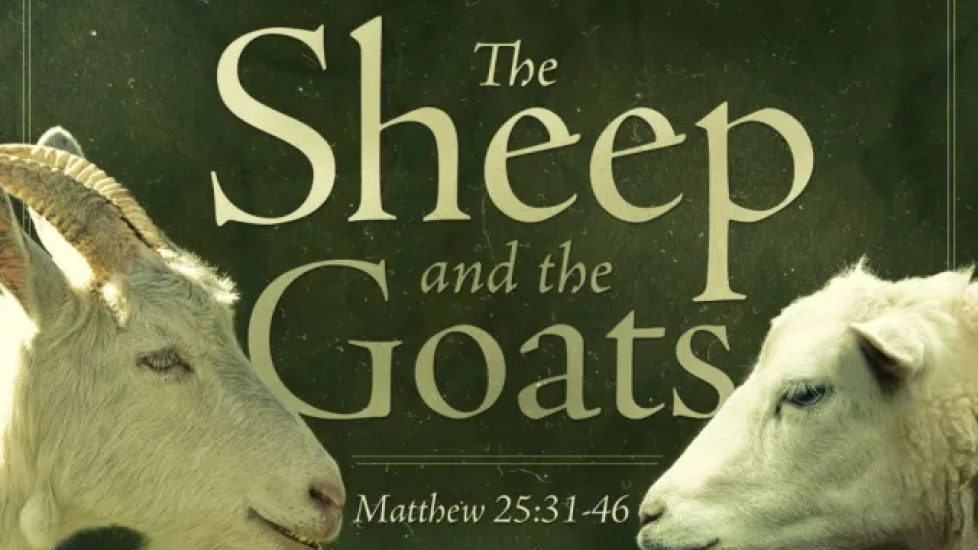
This agrees with Jesus’ other teachings in the gospel of Matthew. In Matthew 24:31, Jesus teaches that when the Son of Man comes on the clouds of heaven with power and great glory, “… He will send His angels with a great sound of a trumpet, and they will gather together His elect from the four winds, from one end of heaven to the other.” Angels also appear in Jesus’ teaching about the sheep and goat judgment in Matthew 25. There, He said, “When the Son of Man comes in His glory, and all the holy angels with Him, then He will sit on the throne of His glory. All the nations will be gathered before Him, and He will separate them one from another, as a shepherd divides his sheep from the goats.” (Matt. 25:31-32).
Listen to John MacArthur’s words as he describes the judgment using Jesus’ metaphor of the dragnet:
Men move about within that net as if they were forever free. It may touch them from time to time, as it were startling them. But they swim quickly away, thinking they have escaped, not realizing that they are completely and inescapably encompassed in God’s sovereign plan. The Invisible web of God’s judgment encroaches on every human being just as that of the dragnet encroaches on the fish. Most men do not perceive the kingdom, and they do not see God working in the world. They may be briefly moved by the grace of the gospel or frightened by the threat of judgment; but they soon return to their old ways of thinking and living, oblivious to the things of eternity. But when man’s day is over and Christ returns to set up His glorious kingdom, then judgment will come.[1]
This kingdom ‘dragnet’ would not only draw people from all people groups around the world; but it would also draw both the faithful and the faithless, both the just and the wicked. And Jesus is teaching us that not all who appear to embrace His kingdom will truly have a part in it. He warns that at the end of the age—just after He returns to this earth to assume the full possession of His kingdom—He will separate out from it those who do not belong in it.
C. The Peril of the Judgment (Matt. 13:50).
In Matthew 13:50, Jesus says that the “wicked” will be “cast them into the furnace of fire. There will be wailing and gnashing of teeth.” I think it’s very instructive that, in this parable, the Lord doesn’t tell us about the destiny of those who are His “just” ones. In the parable of the wheat and the tares, He does tell us about their destiny. He tells us that, on that great day when He returns to this earth and commences His earthly reign with the great “separation”, then “the righteous will shine forth as the sun in the kingdom of their Father” (Matt. 13:43). But there is no such joyful note here in this parable.[2] Instead, Jesus ends with the dreadful warning that the angels “will come forth, separate the wicked from among the just, and cast them into the furnace of fire. There will be wailing and gnashing of teeth” (Matt. 13:49-50).
“Wailing” suggests anguish. Hell is a place of conscious torment. And I believe that one of the greatest aspects of that torment will be an eternal separation from the God who made us for Himself and loved us, but whom we refused. The wicked did not want to bow to Him or serve Him or even know Him. And then—to their eternal anguish—they will have what they wanted.
The phrase “gnashing of teeth” describes intense hatred and malice. King David wrote of how the wicked “plots against the just and gnashes at him with his teeth” (Psa. 37:12) and of how ungodly mockers at feasts “gnashed at me with their teeth” (Psa. 35:16). Jeremiah wrote in Lamentations of how the enemies of Israel “have opened their mouth against you; they hiss and gnash their teeth” (Lam. 2:16). And in the book of Acts, after Stephen preached to the Jewish leaders—just before they rose up and stoned him to death—we’re told that “they were cut to the heart, and they gnashed at him with their teeth” (Acts 7:54). Hell is a place of eternal torment for those who hated our God and Savior Jesus Christ.
We find similar imagery in the book of Revelation at the end of the New Testament where we read: “Then Death and Hades were cast into the lake of fire. This is the second death. And anyone not found written in the Book of Life was cast into the lake of fire.” (Revelation 20:14-15)
The biblical doctrine of hell is hard for many people to accept. However, if we are to be true to God’s Word, we must accept its reality. The teachings about judgment in Scripture are essential. If there is no judgment, then there is no need for salvation. If there is no final judgment, then many of the wicked in this life would get away with their wickedness. If there is no moral reckoning, then God is unjust. But God’s kingdom is a kingdom of justice, and so, yes, there is a day of judgment coming.[3]
Hell is not a mythical place. Jesus spoke more about hell than any other prophet or apostle. He constantly emphasized the reality of eternal punishment. And He used horribly graphic terms to describe it. There is a reason. It’s because He is the Savior of mankind who will also one day come as the Judge of all the earth. He loves people more than they could ever know and does not wish for them to suffer eternal punishment. Therefore, He tells the horrible facts about it because He does not want people to experience it and has come to save them from it.
When people die, or when the Lord returns, they do not go out into nothingness or cease to exist. God will “separate” the wicked from the righteous and “cast them into the furnace of fire.” Jesus Himself knows those who are truly His within His dragnet. And on the great day of judgment when the angels pull the dragnet to shore, the Lord will see to it that the wicked are separated from the righteous—both to the praise of His grace, and to the glory of His justice.
The Bible teaches that the Lord has no pleasure in the destruction of wicked people. In Ezekiel 18:23, the Lord asks, “Do I have any pleasure at all that the wicked should die and not that he should turn from his ways and live?” 2 Peter 3:9 says, “The Lord is … longsuffering toward us, not willing that any should perish but that all should come to repentance.” Luke 19:41 records how Jesus wept over Jerusalem because the people would not repent. Our Lord is a good and merciful Savior. And when the final judgment comes, no one who heard His gospel will be able to say that He did not give them ample opportunity to believe it and trust in Him. No one under the influence of His “gospel dragnet” will be able to have an excuse for not knowing Him and trusting Him as they should. In fact, Mt.25:41 tells us hell was not created for men but was “prepared for the devil and his angels.”
Jesus’ teaching in the parable of the dragnet is clear. It is a warning that judgment is coming. Those who have rejected Christ and His kingdom will be separated out of it and sent away to eternal torment.
Jesus has just shared all seven of these parables of the kingdom. Now he encourages the disciples to teach these parables to others. So He teaches them …
2. The Parable of the Householder (vv. 51-52).
A. Have you understood? (Matt. 13:51)
In Matthew 13:51, Jesus asked His disciples, “Have you understood all these things?” The word “understand” means “put together”. We could say that He was asking them, “Have you put all the pieces of these things together so that you now comprehend them?” Remember the parables are designed both to conceal and reveal. The parables are meant to conceal the truth from those whose hearts are hardened towards God. And they are meant to reveal spiritual truth to those whose hearts are open towards God.
“Have you understood all these things?” That’s a good question for us. Do we have an understanding, have we put together these vital truths of the kingdom and the judgment? The truths Jesus teaches in these parables disclose God’s program for history and eternity.
Do we really believe what the parable of the sower teaches—that we come into the kingdom by hearing and receiving the message of the gospel so that it produces fruit in us? Do we believe that even though we live alongside unbelievers like wheat and tares in a field, that there is a time coming when we will be separated? Do we believe that the kingdom, even though it appears small and insignificant like a mustard seed, will ultimately permeate and rule over the whole world? Do we believe that the kingdom is a treasure worth more than everything else in life? Do we really believe that judgment is coming, that hell is real, and that the kingdom of heaven is glorious?
The disciples answered, “Yes, Lord.” Though their understanding was far from perfect they understood what they could at the time. They accepted the things they understood and they were eager to understand more. The truths about the kingdom that Jesus teaches in these parables are meant to be received by eager, hungry learners who love Jesus Christ, have ears to hear Him, and a heart to go forward and follow Him. They are for those whose heart cry is “Thy kingdom come!” Apart from Jesus Christ, the truths in these parables cannot be understood. But through an authentic relationship with Him by faith, they can be.[4] In Matthew 13:12, Jesus said, “For whoever has, to him more will be given, and he will have an abundance.”
So we respond to the parables of the kingdom by being eager learners, disciples who want to hear and understand.
B. Then be like good householders (Matt. 13:52)
Finally, in Matthew 13:52 Jesus said to them, “Therefore every scribe instructed concerning the kingdom of heaven is like a householder who brings out of his treasure things new and old.”
This verse is like a mini-parable that sums up the disciples’ responsibility concerning all the other parables. The word “scribe” means “one who writes.” In those days the term referred to a student and teacher of the law. The word “instructed” is the verb form of the word disciple. Under Jesus’ teaching, the disciples were becoming scribes—students and teachers of the truths of God’s kingdom.
Jesus implies an expectation of us regarding the mysteries of the kingdom. We aren’t supposed to sit passively and receive information about the kingdom—as if the Lord wants to merely pour knowledge into empty heads. Rather, we are to grow. We are to be scribes and disciples—astutely trained scholars in the school of the kingdom of Jesus Christ, who work hard at understanding and applying the kingdom truths He imparts to us.
Jesus said such a scribe was to be like a “householder.” This literally means the “house-master”. He was the manager of a household, or a family, or a large estate. He would maintain supplies of food and clothing and use them wisely. He was responsible for making sure that everything in the treasure-store was well-stocked; so that when anything was needed for the provision of each member of the household, and for the smooth operation of the house, it was provided.
The “householder” or head of the house would “bring out of his treasure [storehouse] things old and new.” They were to “bring out” the truth, which means to “cast forth.” They were not to keep the truth of the kingdom to themselves. They were to bring it out and cast it forth. In other words, one of the distinguishing marks of a true disciple of the kingdom is that they share the treasure. They share the truth of the kingdom, the word of God.
The disciples, later, as they became apostles would dispense both “new and old” revelation. In other words, both the Old Testament and the New Testament are important. They are both the word of God. The older teachings about God and the kingdom are still valuable and true. But now we must add to them these newer teachings about the kingdom.
The newer teachings do not replace the old teachings. Rather the new teachings complete them and fulfill them. Jesus said in Matthew 5:17: “Do not think that I came to destroy the Law or the Prophets. I did not come to destroy but to fulfill.” A teacher of the law who only knows the Old Testament can only teach the law. But those who know the New Testament also teach faith in Christ and God’s grace given to us in his Son Jesus.
We read in 2 Timothy 3:16-17: “All Scripture is given by inspiration of God, and is profitable for doctrine, for reproof, for correction, for instruction in righteousness, that the man of God may be complete, thoroughly equipped for every good work.”
God has given you everything you need in His word to teach others about the kingdom and to reach others for Jesus Christ. All Scripture is useful for teaching, both the old and the new. The new completes the old. So, we focus on Jesus and His teachings about the kingdom.
Jesus is coming again. When He comes, this world will end. God’s great dragnet will sweep through the earth and no one will escape. All people, great and small, will stand before the throne and be judged according to their works. The punishment for the wicked will be serious and severe. Those who have rejected Jesus Christ will experience eternal pain, mourning, and regret. Only those whose names are found written in the Lamb’s book of life will be saved.
And so, now is the time to make your decision about Jesus. It will be too late after you die or after Jesus returns. Now is the time for salvation. When Jesus returns, that will be the time for judgment. Because God will make the division then, you must make your decision now.
Have you trusted Jesus for salvation? If not, I urge you, I encourage you, I invite you, I welcome you – come to Jesus today. He loves you. He died for you. He is waiting for you. What are you waiting for?
And to us who already belong to Christ, are you telling others about Him?
I remember another phrase from the show, Dragnet. Sargent Friday would say, “We were working the day watch.”
There’s a whole mass of humanity all over the world moving toward judgment. God has placed this church here to be a lighthouse, a rescue operation to get the word out about the kingdom of heaven, about eternity, about heaven and hell, but most importantly to get the word out about the Savior, Jesus Christ. Are you working the day watch?
The church is not a country club where you come to socialize, pay a few dues, and leave. We are not a performing arts center where talented people do their thing up on stage and the congregation applauds and nods approvingly and leaves unaffected. We’re the body of Christ empowered by the Holy Spirit and commissioned to proclaim to our world that Jesus saves.
The stakes are high. It’s not just life and death, it’s eternal life and eternal death that hangs in the balance. We have the treasure, the good news of the kingdom of heaven—the word of God. We have the Savior Jesus Christ. We have the Holy Spirit to empower us. We are His church. Let’s bring the treasure of the gospel to everyone.
————————————————————————
[1] John MacArthur, New Testament Commentary—Matthew, p. 395.
[2] Greg Allen, Bad Fish in the Dragnet – Matthew 13:47-50, https://www.bethanybible.org/archive/2006/120306.htm
[3] Ray Fowler, The Parable of the Net, https://www.rayfowler.org/sermons/matthew/parable-of-the-net/
[4] Greg Allen, Students of the Kingdom – Matthew 13:51-52, https://www.bethanybible.org/archive/2007/010707.htm