My Soul Waits for the LORD
Psalm 130
1 A song of Ascents.
Out of the depths I have cried to You, O Lord;
2 Lord, hear my voice!
Let Your ears be attentive
To the voice of my supplications.
3 If You, Lord, should mark iniquities,
O Lord, who could stand?
4 But there is forgiveness with You,
That You may be feared.
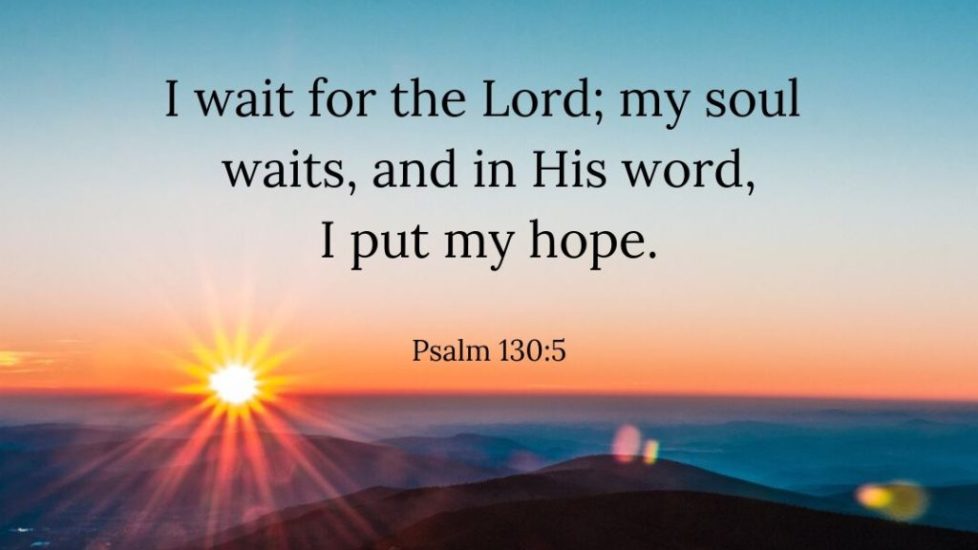
5 I wait for the Lord, my soul waits,
And in His word I do hope.
6 My soul waits for the Lord
More than those who watch for the morning–
Yes, more than those who watch for the morning.
7 O Israel, hope in the Lord;
For with the Lord there is mercy,
And with Him is abundant redemption.
8 And He shall redeem Israel
From all his iniquities.
Psalm 130 is a “Son of Ascents,” the eleventh of fifteen psalms that pilgrims to Jerusalem likely sang as they went up annually to the temple to worship the Lord. “Psalm 130 puts words to a pattern of conviction, repentance, waiting, and praise that purifies the sinner and glorifies the Savior.”[1] This Song of Ascents takes us from the depths of guilt and despair to the heights of joyous hope in the Lord.
This psalm is a prayer of conviction, repentance, trust, and worship. We can see a four-step progression in the four stanzas of two verses each. In Psalm 130:1-2, the psalmist is in the pit of despair, weighed down by guilt. In the second step, Psalm 130:3-4, he trusts in the Lord’s forgiveness for his sin. Then, in Psalm 130:5-6, he rests in God’s word and expectantly waits for the presence of the Lord. And finally, in Psalm 130:7-8, he calls on all God’s people to hope in the Lord’s redemption. Here is a man who has sinned, but in spite of his sin, he is eager to draw near to the LORD for he knows that the LORD is a God who mercifully forgives sinners.
Psalm 130 reminds us that when we gather for worship on a day like today, we celebrate the fact that our God has not treated us as our sins deserve but has indeed been merciful to us in Christ.
Our first step to worship is to …
1. Cry out to the Lord for mercy (130:1-2).
The psalm begins, “Out of the depths I have cried to You, O Lord” (Ps. 130:1). The psalmist cried out to the LORD in deepest despair. The language is similar to the cry of Jonah when he was in the depths of the sea because of his disobedience to the LORD. There, he prayed,
“I cried out to the LORD because of my affliction,
And He answered me.
Out of the belly of Sheol I cried,
And You heard my voice.
For You cast me into the deep,
Into the heart of the seas,
And the floods surrounded me;
All Your billows and Your waves passed over me.” (Jonah 2:2-3).
The rest of the psalm clearly shows that the reason for his despair is the guilt of his sin. His problem, he says, is iniquities, a word that in the Old Testament means things that are twisted or bent. In the moral sense, it means the choice to pervert or distort what is good or true. In Psalm 130:3 he says, “ If You, Lord, should mark iniquities …”, and again in Psalm 130:8 8, “… And He shall redeem Israel From all his iniquities.”
He cries out to the Lord from the depths of sin and guilt. His iniquities have brought him low. He knows that his only hope is mercy from the Lord. So he cries out to the Lord for forgiveness and redemption from his sins. When you are in the depths of your sin, there is no other way out than the LORD.
No matter how low you may be, you can cry out fervently to the Lord. The psalmist says, “Lord, hear my voice! Let Your ears be attentive To the voice of my supplications.” (Ps. 130:2). Notice the intensity of his cry. He uses God’s name eight times in these eight verses, alternating between Lord (Yahweh), the covenant name of God that emphasizes His faithfulness to His promises; and, Lord (Adonai), which emphasizes His sovereign lordship and thus His ability to fulfill His promises.
Have you ever reached such a point of despair over your sin? Cry out to the Lord. The second step is …
2. Trust in the Lord (Ps. 130:3-4).
Look at the question in Psalm 130:3, “If You, LORD, should mark iniquities, O Lord, who could stand?” Of course God knows all our sins, but the psalmist means, “If the Lord were to count up all my sins and judge me for them, I don’t have a glimmer of hope.” None of us can stand before the Holy God in our sin.
And so what is the answer? The grace and mercy of God in Christ. Psalm 130:4 says, “But there is forgiveness with You, That You may be feared.” Without forgiveness, we’re doomed, but with it, we learn to fear Him. We fear God because we know that He had every reason to condemn you, but He did not. We do not shudder in terror of His punishment now (1 John 4:18), but we do fear Him, respect Him, and hold Him in reverent awe. His forgiveness does not make us flippant about our sin, it makes us fear the Lord. Forgiveness leads us to greater worship and reverence of God.
So the psalmist tells us that no matter how deep you may be in guilt and despair, you can cry out to the Lord for mercy. He adds that there is forgiveness with God, and it leads to fear, because without it, you’re doomed. The third step is …
3. Wait for the Lord (Ps. 130:5-6).
The psalmist has prayed his prayer, he has cried out to the Lord for mercy, and now he waits expectantly for God to answer. He says, “5 I wait for the LORD, my soul waits, And in His word I do hope. 6 My soul waits for the Lord More than those who watch for the morning–Yes, more than those who watch for the morning.” (Ps. 130:5-6 NKJV). The night watchman wanted nothing more than for the sun to arise on the horizon, and for the day to dawn. His work would be finished. What is the psalmist waiting for? The LORD. He is not just waiting for help, but he is waiting for the Lord Himself.
Waiting is an expression of a sure hope. What is the basis of his hope? His hope is based on God’s word, “And in His word do I hope.” Don’t base your hope on your feelings or your circumstances, but base your hope fully on the word of God. Trust God’s promises to you in Scripture. Based on God’s sure word of promise, he eagerly anticipates and expects a renewed intimacy with the LORD.
But the psalmist can’t stop writing there. For six verses, he has described his own struggles and his own fight to wait on the LORD. But, now, he urges all of us into the same experience. So in the fourth step he calls us to …
4. Hope in the Lord (Ps. 130:7-8).
7 O Israel, hope in the LORD; For with the LORD there is mercy, And with Him is abundant redemption. 8 And He shall redeem Israel From all his iniquities. (Psalm 130:7-8).
When you’ve been in the depths and then been washed with God’s forgiveness, you want others to experience the same thing! Why should we hope in the LORD? Because with Him, there is mercy, lovingkindness. “As a father has compassion on his children, so the LORD has compassion on those who fear him.” (Psalm 103:13 CSB).
With the LORD is abundant redemption! No matter how great your sin, His redemption is abundant. It covers all your sins. Do you have great sin? God has greater grace! Your sin cannot take you out of God’s reach of redemption. Is there hope for the sinner? Yes, yes, a thousand times, yes! With the Lord is unfailing love and with the Lord is full redemption. When you cry out to Christ for mercy, He will hear and He will answer. He has never turned away a repentant sinner. You may be sunk under a load of sin, you may be crying out from the depths, but God’s word declares that He is full of love and mercy. He will hear your voice, be attentive to your prayer, forgive your sin, and restore you to fellowship with Him forever. Forgiveness is open today. Come be forgiven!
————————————————————————-
[1] Marshall Segal, Four Habits of a Happy Heart, https://www.desiringgod.org/articles/four-habits-of-a-happy-heart accessed 08/29/2025.