“This is the day the LORD has made;
We will rejoice and be glad in it.” (Psalm 118:24).
I grew up singing the words to that verse. Maybe you did too. I understood it to apply to our rejoicing in every new day that God has made. While of course, Yahweh our sovereign God controls time and our very lives, and therefore each new day we awaken with breath in our lungs is a gift from God, “the day” in Psalm 118:24 conveys a much deeper meaning.
Psalm 107 is a descriptive psalm of thanksgiving. It begins, “Oh, give thanks to the LORD, for He is good! For His mercy endures forever.” (Psalm 107:1). To give thanks (יָדָה yāḏâ) carries the idea of “extending the hands in praise.”[i] The psalmist calls us to thanksgiving because Yahweh, the LORD, is good. We are to praise Him for His “mercy”, or faithful lovingkindness, “endures forever”.
1 A song of Ascents.
Out of the depths I have cried to You, O Lord;
2 Lord, hear my voice!
Let Your ears be attentive
To the voice of my supplications.
3 If You, Lord, should mark iniquities,
O Lord, who could stand?
4 But there is forgiveness with You,
That You may be feared.
5 I wait for the Lord, my soul waits,
And in His word I do hope.
6 My soul waits for the Lord
More than those who watch for the morning–
Yes, more than those who watch for the morning.
7 O Israel, hope in the Lord;
For with the Lord there is mercy,
And with Him is abundant redemption.
8 And He shall redeem Israel
From all his iniquities.
Psalm 130 is a “Son of Ascents,” the eleventh of fifteen psalms that pilgrims to Jerusalem likely sang as they went up annually to the temple to worship the Lord. “Psalm 130 puts words to a pattern of conviction, repentance, waiting, and praise that purifies the sinner and glorifies the Savior.”[1] This Song of Ascents takes us from the depths of guilt and despair to the heights of joyous hope in the Lord.
This psalm is a prayer of conviction, repentance, trust, and worship. We can see a four-step progression in the four stanzas of two verses each. In Psalm 130:1-2, the psalmist is in the pit of despair, weighed down by guilt. In the second step, Psalm 130:3-4, he trusts in the Lord’s forgiveness for his sin. Then, in Psalm 130:5-6, he rests in God’s word and expectantly waits for the presence of the Lord. And finally, in Psalm 130:7-8, he calls on all God’s people to hope in the Lord’s redemption. Here is a man who has sinned, but in spite of his sin, he is eager to draw near to the LORD for he knows that the LORD is a God who mercifully forgives sinners.
Psalm 130 reminds us that when we gather for worship on a day like today, we celebrate the fact that our God has not treated us as our sins deserve but has indeed been merciful to us in Christ.
Our first step to worship is to …
1. Cry out to the Lord for mercy (130:1-2).
The psalm begins, “Out of the depths I have cried to You, O Lord” (Ps. 130:1). The psalmist cried out to the LORD in deepest despair. The language is similar to the cry of Jonah when he was in the depths of the sea because of his disobedience to the LORD. There, he prayed,
“I cried out to the LORD because of my affliction,
And He answered me.
Out of the belly of Sheol I cried,
And You heard my voice.
For You cast me into the deep,
Into the heart of the seas,
And the floods surrounded me;
All Your billows and Your waves passed over me.” (Jonah 2:2-3).
The rest of the psalm clearly shows that the reason for his despair is the guilt of his sin. His problem, he says, is iniquities, a word that in the Old Testament means things that are twisted or bent. In the moral sense, it means the choice to pervert or distort what is good or true. In Psalm 130:3 he says, “ If You, Lord, should mark iniquities …”, and again in Psalm 130:8 8, “… And He shall redeem Israel From all his iniquities.”
He cries out to the Lord from the depths of sin and guilt. His iniquities have brought him low. He knows that his only hope is mercy from the Lord. So he cries out to the Lord for forgiveness and redemption from his sins. When you are in the depths of your sin, there is no other way out than the LORD.
No matter how low you may be, you can cry out fervently to the Lord. The psalmist says, “Lord, hear my voice! Let Your ears be attentive To the voice of my supplications.” (Ps. 130:2). Notice the intensity of his cry. He uses God’s name eight times in these eight verses, alternating between Lord (Yahweh), the covenant name of God that emphasizes His faithfulness to His promises; and, Lord (Adonai), which emphasizes His sovereign lordship and thus His ability to fulfill His promises.
Have you ever reached such a point of despair over your sin? Cry out to the Lord. The second step is …
2. Trust in the Lord (Ps. 130:3-4).
Look at the question in Psalm 130:3, “If You, LORD, should mark iniquities, O Lord, who could stand?” Of course God knows all our sins, but the psalmist means, “If the Lord were to count up all my sins and judge me for them, I don’t have a glimmer of hope.” None of us can stand before the Holy God in our sin.
And so what is the answer? The grace and mercy of God in Christ. Psalm 130:4 says, “But there is forgiveness with You, That You may be feared.” Without forgiveness, we’re doomed, but with it, we learn to fear Him. We fear God because we know that He had every reason to condemn you, but He did not. We do not shudder in terror of His punishment now (1 John 4:18), but we do fear Him, respect Him, and hold Him in reverent awe. His forgiveness does not make us flippant about our sin, it makes us fear the Lord. Forgiveness leads us to greater worship and reverence of God.
So the psalmist tells us that no matter how deep you may be in guilt and despair, you can cry out to the Lord for mercy. He adds that there is forgiveness with God, and it leads to fear, because without it, you’re doomed. The third step is …
3. Wait for the Lord (Ps. 130:5-6).
The psalmist has prayed his prayer, he has cried out to the Lord for mercy, and now he waits expectantly for God to answer. He says, “5I wait for the LORD, my soul waits, And in His word I do hope. 6 My soul waits for the Lord More than those who watch for the morning–Yes, more than those who watch for the morning.” (Ps. 130:5-6 NKJV). The night watchman wanted nothing more than for the sun to arise on the horizon, and for the day to dawn. His work would be finished. What is the psalmist waiting for? The LORD. He is not just waiting for help, but he is waiting for the Lord Himself.
Waiting is an expression of a sure hope. What is the basis of his hope? His hope is based on God’s word, “And in His word do I hope.” Don’t base your hope on your feelings or your circumstances, but base your hope fully on the word of God. Trust God’s promises to you in Scripture. Based on God’s sure word of promise, he eagerly anticipates and expects a renewed intimacy with the LORD.
But the psalmist can’t stop writing there. For six verses, he has described his own struggles and his own fight to wait on the LORD. But, now, he urges all of us into the same experience. So in the fourth step he calls us to …
4. Hope in the Lord (Ps. 130:7-8).
7O Israel, hope in the LORD; For with the LORD there is mercy, And with Him is abundant redemption. 8 And He shall redeem Israel From all his iniquities. (Psalm 130:7-8).
When you’ve been in the depths and then been washed with God’s forgiveness, you want others to experience the same thing! Why should we hope in the LORD? Because with Him, there is mercy, lovingkindness. “As a father has compassion on his children, so the LORD has compassion on those who fear him.” (Psalm 103:13 CSB).
With the LORD is abundant redemption! No matter how great your sin, His redemption is abundant. It covers all your sins. Do you have great sin? God has greater grace! Your sin cannot take you out of God’s reach of redemption. Is there hope for the sinner? Yes, yes, a thousand times, yes! With the Lord is unfailing love and with the Lord is full redemption. When you cry out to Christ for mercy, He will hear and He will answer. He has never turned away a repentant sinner. You may be sunk under a load of sin, you may be crying out from the depths, but God’s word declares that He is full of love and mercy. He will hear your voice, be attentive to your prayer, forgive your sin, and restore you to fellowship with Him forever. Forgiveness is open today. Come be forgiven!
At our Wednesday night prayer meeting, we have started to look at Psalms 120 – 134, the “songs of ascents”. Another name for them might be “songs for going up” or “songs for the journey”. In ancient Israel, they were probably sung by travelers making their way to Jerusalem for the annual feasts. Jerusalem was a high point in the land of Palestine, and as they journeyed, they were literally “ascending”. And these songs we intended to help them also ascend spiritually as they joined together in song and prepared their hearts to worship the Lord.
I intended to share some thoughts about Psalm 122 on Wednesday, but didn’t make it back in time due to some car trouble As I read this psalm and you follow along, I want you to see if you can pick out a key word or idea in this psalm. The very first verse captures some of the excitement, the anticipation, of the psalmist preparing for the journey. “I was glad when they said to me, “Let us go into the house of the Lord.”” (Psalm 122:1).
Sometimes God brings us to a place where we find that God alone is our only hope. It could be you arrive at such a desperate place through a devastating circumstance or an internal crisis where all other comforts fail, and other hopes disappoint. In that place, you feel weak and vulnerable, and almost everything seems to be against you. It’s a place you feel overwhelmed by despair and grief.
But with God, it can also be a place of mercy and salvation. In the crucible of that testing place God forges enduring faith in us. If it were not for that place, how could we ever know that God truly is our only Rock and that our only abiding hope is found in Him? When God bring us to that place, and we find that God alone is all we need, that dreadful place becomes a beautiful place. Our desert becomes an oasis where we are refreshed by God alone.
Welcome to our 5th Sunday Sing. In this special worship service we invite you to worship our great God and Savior Jesus Christ in spirit and in truth. I want to begin our worship today with a brief look at Psalm 95. This Psalm is about worship. There’s nothing more important in the Christian life than worship. God has created us to be worshipping creatures. And Christ has redeemed us to be a worshipping people. Jesus said, “But the hour is coming, and now is, when the true worshipers will worship the Father in spirit and truth; for the Father is seeking such to worship Him. God is Spirit, and those who worship Him must worship in spirit and truth.” (John 4:23-24). There’s nothing more important that we do than worship.
Ligon Duncan gives a very helpful outline of Psalm 95 in four words: “Come – For – Worship – Today.”[1]
“COME” – Psalm 95:1-2 give us a call to worship. “Come FOR….” – Psalm 95:3-5 give us the reasons why we are to worship God. “Come for WORSHIP…” – Psalm 95:6-7a gives us what we do when we worship God. “Come for worship TODAY…” – Finally Psalm 95:7b-11 give us a warning about neglecting worship through unbelief.
Keeping those words in mind, let’s listen to God’s word and let it teach us to worship. Psalm 95
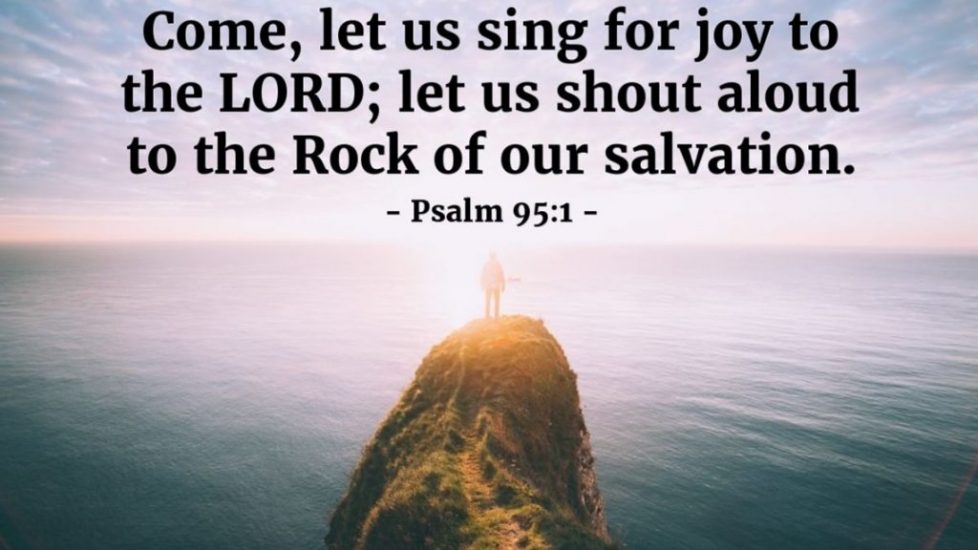
1 Oh come, let us sing to the LORD!
Let us shout joyfully to the Rock of our salvation.
2 Let us come before His presence with thanksgiving;
Let us shout joyfully to Him with psalms.
3 For the LORD is the great God,
And the great King above all gods.
4 In His hand are the deep places of the earth;
The heights of the hills are His also.
5 The sea is His, for He made it;
And His hands formed the dry land.
6 Oh come, let us worship and bow down;
Let us kneel before the LORD our Maker.
7 For He is our God, And we are the people of His pasture,
And the sheep of His hand. Today, if you will hear His voice:
8 “Do not harden your hearts, as in the rebellion,
As in the day of trial in the wilderness,
9 When your fathers tested Me;
They tried Me, though they saw My work.
10 For forty years I was grieved with that generation,
And said, ‘It is a people who go astray in their hearts,
And they do not know My ways.’
11 So I swore in My wrath,
‘They shall not enter My rest.’”
1. Come – our invitation to worship
The first half of this Psalm is framed by two calls to worship, both with the inviting word, COME. Psalm 95:1—Oh come, let us sing to the LORD! Let us shout joyfully to the Rock of our salvation; and Psalm 95:6—Oh come, let us worship and bow down; Let us kneel before the LORD our Maker.
“Come” is a command in both of these verses although they are two different words in the Hebrew. “Come” in Psalm 95:1 is literally to walk or carry yourselves. “Come” in Psalm 95:6 is to enter in. Both are in the plural. Do you see the picture? The psalmist is saying, “stop what you’re doing, leave what you’re doing behind, and come to God.” This is a call for us to come together with the people of God, to bring ourselves and enter into the presence of God. Psalm 95:2, “Let us come before His presence.” “Come” in this verse means to meet. Meet with God. Praise Him. Thank Him. Fellowship with Him. Commune with Him. Stop what you’re doing and leave it behind, and come.
How do we come?
With joyful thanksgiving! “Oh come, let us sing to the LORD!” There is no room in this verse for apathetically mumbling through a few songs while your mind is elsewhere! “Let us shout joyfully to the Rock of our salvation.” In this psalm, which refers to Israel in the wilderness, the rock that literally saved the nation was the rock that Moses struck, which then flowed with water (Exod. 17:1-7). Paul tells us that that rock was Christ (1 Cor. 10:4). This is a gospel call. Come to Christ for salvation, for forgiveness of sins.
If Christ is the rock of your salvation, who has given you living water for your soul, shouldn’t you come before Him with great joy and thanks?[2] “Let us come before His presence with thanksgiving; Let us shout joyfully to Him with psalms.” (Ps. 95:2).
Then in Psalm 95:3-5 we see why we ought to come to worship:
2. For – why we ought to come
Psalm 95:3 begins with that word “For”: “For the LORD is the great God, And the great King above all gods.” Why should we come to worship?
God is sovereign. His majesty is over all. He’s greater than any claimed god, any false god.
Psalm 95:4-5:
4 In His hand are the deep places of the earth;
The heights of the hills are His also.
5 The sea is His, for He made it;
And His hands formed the dry land.
God is the creator. He created everything and He rules the world. But even more importantly Psalm 95:6 urges us to “kneel before the LORD our Maker.” He not only made the world, He made me. And Psalm 95:7 says, “For He is our God, And we are the people of His pasture, And the sheep of His hand.” God cares for us as a shepherd cares for his sheep.
Why should I worship God? Because He’s sovereign over all, because He made the whole universe, because He made me, and because He cares for me.
“Come” – our invitation to worship.
“For” – our reason for worship.
3. Worship – what we are to do when we come
What is it exactly that we’re called to do? What does it mean to worship God?
In Psalm 95:6 you see three similar verbs that tell us how we are to come. “Oh come, let us worship and bow down; Let us kneel before the LORD our Maker.” The command in this verse is “come,” enter into the presence of God. The other three verbs, “worship,” “bow down,” and “kneel” describe what it looks like to come into the presence of God. All three convey the picture of us humbling ourselves before God. “Worship” means to fall flat before God. “Bow down” means to bend low or crouch down before God. “Kneel” means get down on your knees to give blessing to God.
The point is that our God is so mighty, so awesome, that we need to acknowledge that by joyfully, thankfully, humbly bowing down before Him. Worship…bow down with joy before your mighty Maker and your tender Shepherd.
4. Today – A warning for worshippers
So far this has been an uplifting Psalm encouraging us to come in humble worship to our great God. Then suddenly the mood changes in the middle of Psalm 95:7 and the psalmist warns “Today, if you will hear His voice:Do not harden your hearts.” What’s going on here?
The psalmist is referring to Israel’s experience in the wilderness when they tested the Lord in Exodus 17 at the waters of Meribah (rebellion, Ps. 95:8), and it refers to Moses’ own unfaithfulness at the waters of Massah (trial, Ps. 95:8) in Numbers 20. God’s people were not joyfully singing to Him, or thanking him, or worshipping Him! Just the opposite! They grumbled, complained, and quarreled. And you remember what happened as a result of their unbelief. Neither the generation of the children of Israel from Meribah nor Moses entered into the Promised Land.
The New Testament author of Hebrews cites this whole second part of Psalm 95 (7b-11) in Hebrews 3:7-11. He again quotes Psalm 95:11 in Hebrews 4:3, and verse 7b in Hebrews 4:7. Derek Kidner comments that the New Testament “forbids us to confine its thrust to Israel.” He adds, “The ‘Today’ of which it speaks is this very moment; the ‘you’ is none other than ourselves, and the promised ‘rest’ is not Canaan but salvation.”[3]
The message is you cannot worship God with an unbelieving heart. You cannot worship God if you do not take Him at His word. You cannot worship God if you do not believe on Christ, the Rock of our Salvation, as He is offered in the gospel. True worship is by faith, and unbelief is inconsistent with it.
We cannot live between Sundays unbelieving in God’s word, untrusting of Jesus Christ, unresponsive to the gospel of grace, and then come in and manufacture worship. It cannot happen. Worship must be by the Spirit, by grace, by faith in Jesus Christ, believing in God’s word, submitting our will to Him and following Christ as Lord. All of this is a part of true worship.
Adrian Rogers asked in one of his sermons, “What is the world coming to?” And his answer was “It’s coming to Jesus!” That is ultimately true even if it often does not appear to be the case. Psalm 149 is a psalm that celebrates God’s victory. Some locate its writing following the Babylonian exile during the time of Nehemiah as the Hebrew people return to the land of Israel. It may indeed originate there, but its gaze stares into the future when the Lord, “the King of Zion” will bring judgment and justice for His people.
And what is our response to God’s great victory? Worship. Let’s look briefly at Psalm 149 to answer a few questions about worship. Listen to Psalm 149:
Psalm 149
1 Praise the LORD! Sing to the LORD a new song,
And His praise in the assembly of saints.
2 Let Israel rejoice in their Maker;
Let the children of Zion be joyful in their King.
3 Let them praise His name with the dance;
Let them sing praises to Him with the timbrel and harp.
4 For the LORD takes pleasure in His people;
He will beautify the humble with salvation.
5 Let the saints be joyful in glory;
Let them sing aloud on their beds.
6 Let the high praises of God be in their mouth,
And a two-edged sword in their hand,
7 To execute vengeance on the nations,
And punishments on the peoples;
8 To bind their kings with chains,
And their nobles with fetters of iron;
9 To execute on them the written judgment–
This honor have all His saints. Praise the LORD!
Psalm 149 begins with “Praise the LORD!” or “Hallelujah!” It ends with the same, “Hallelujah!” or “Praise the LORD!”
1. The “WHO” of Worship (Psalm 149:1, 5, 9)
Who is called to worship? Worshipers are called “Saints” (Psa. 149:1, 5, 9). “Praise the LORD! Sing to the LORD a new song, And His praise in the assembly of saints” (Psa. 149:1). The word for “saints” means those who are godly due to God’s mercy and kindness. Specifically they are called to worship “in the assembly of saints,” the congregation. This word is translated into the New Testament as “ekklesia” the church. We are the assembly of the saints, those who have been made saints by grace through faith in Jesus Christ. We are “His people” (Psa. 149:4) like “Israel” and “the children of Zion” were in the Old Testament (Psa. 149:2).
2. The “WHAT” of Worship (Psalm 149:1, 9)
What are worshipers called to do? “Praise the LORD!” The Hebrew is “הַלְלוּ יָהּ, Hallelujah”. Hallel is a command meaning to praise; Jah is the short form of Yahweh, the Lord. The psalm begins and ends with Hallelujah,Praise the LORD!
What does our praise look like? We are to “Sing to the LORD a new song, and His praise” (Psa. 149:1b). To “Sing to the LORD a new song” is to sing a song to God on a new occasion of His deliverance. The new song is the song of the redeemed (Rev. 5:9; 14:3). Genuine worship is fresh. Our worship should not be stale ritual or empty tradition.
Hebrews 13:15 says, “Therefore by Him let us continually offer the sacrifice of praise to God, that is, the fruit of our lips, giving thanks to His name.”
While there is the danger of having a “praiseless” heart we must beware of offering heartless praise. It is essential for every believer to praise the Lord; however, this is not to the exclusion of explicit trust and obedience to the Lord. Properly rendered praise must come from a heart and life surrendered to the Lordship of Jesus Christ.
3. The “HOW” of Worship (Psalm 149:2-3, 5)
2 Let Israel rejoice in their Maker;
Let the children of Zion be joyful in their King.
3 Let them praise His name with the dance;
Let them sing praises to Him with the timbrel and harp.
5 Let the saints be joyful in glory;
Let them sing aloud on their beds.
Did you notice the attitude of our worship? JOY! The psalmist repeats it (Psa. 149:2), “Let Israel rejoice in their Maker” and “Let the children of Zion be joyful in their King” and again (Psa. 149:5), “Let the saints be joyful in glory.” Psalm 149:3 with its dancing and timbrels pictures a victory celebration like Israel did when God drowned the Egyptian army in the Red Sea (Exo. 15:20). Today we are joyful because Christ has won the victory for us over sin and death.
Specifically, what are they to do? They are to praise God as their “Maker” and as “their King.” Our Maker is our Savior, our King. Our joy is in our Maker and our King. We “rejoice in the Lord always” (Phil. 4:4).
4. The “WHY” of Worship (Psalm 149:4)
“For the LORD takes pleasure in His people; He will beautify the humble with salvation.” Why do we worship? Because of who God is and what He has done. Our salvation is the primary motivation to worship the Lord from a humble heart of gratitude. We worship the Lord because He “takes pleasure in His people.” The Lord takes pleasure in His people because He can see us as we shall be, “clothed in white garments” (Rev. 3:5) “made … white in the blood of the Lamb” (Rev. 7:14). It is the Lord who beautifies the humble with salvation. Our salvation in Christ Jesus is our motivation for humble worship.
5. The “WHEN” of worship (Psalm 149:6-9)
Unlike the church of today Israel was given a militant role. Israel was God’s agent of judgement on the Canaanite peoples for their incredible evil idolatry. God was on their side when they walked in obedience to him and he would fight on their behalf against their enemies.
This is why we shouldn’t be surprised when Psalm 149:7-9 speaks of two-edged swords, vengeance and punishment. God punishes sin, this is a matter of justice. How can we declare that we believe in justice being done here on earth when someone does wrong; yet deny God the right to execute judgement against individuals and nations for their acts of evil?
Unlike the nation of Israel, our enemies are not the unbelievers or the ungodly nations. No, “… we do not wrestle against flesh and blood, but against principalities, against powers, against the rulers of the darkness of this age, against spiritual hosts of wickedness in the heavenly places” (Eph. 6:12). And “the weapons of our warfare are not carnal but mighty in God,” (2 Cor. 10:4). We fight this spiritual battle with “the word of God” which “is living and powerful, and sharper than any two-edged sword” (Heb. 4:12). We overcome “by the blood of the Lamb and by the word of (our) testimony” (Rev. 12:11).
The day of the Lord will come. Jesus Christ will return to bring justice and judgment on this world. When He does Revelation 19:15 says, “Now out of His mouth goes a sharp two edged sword, that with it He should strike the nations. And He Himself will rule them with a rod of iron. He Himself treads the winepress of the fierceness and wrath of Almighty God.”
This Psalm begins and ends with “Hallelujah!” That’s where we also live: between the Hallelujahs. We sing “Hallelujah” because Christ has come as the Suffering Servant, who was “led like a lamb to the slaughter” (Isa 53:7) to take away our sin. And we sing “Hallelujah” because Christ will return in victory as the “King of kings and Lord of lords” (Rev 19:11,16). This Psalm looks forward to the day of final judgment when the Lord will judge the nations with justice and righteousness. It calls us to sing a new song today in anticipation of the Lord’s ultimate victory tomorrow. Praise the Lord! Hallelujah!