


Preparation for the Cross
Matthew 26:1-16
By turning the page to Matthew 26, we have come to the final section of this Gospel. Matthew has told of the virgin birth of the King. He has shown Christ’s mighty works, given us His authoritative teachings, and related His conflict with the Jewish authorities. Jesus’ ministry on earth is coming to an end. The only thing left is His passion—His suffering, death, and resurrection. I know it may seem unseasonal for us to be considering Jesus preparing for the cross on the Sunday before celebrating Christmas. This morning, we have sung about Christmas Day, the birth of the Lord Jesus, laid in a manger, with shepherds worshipping and angels proclaiming peace on earth.
So, doesn’t it seem strange to speak of suffering and death while singing with wonder and joy? Yet, knowing the story of Jesus as Matthew has presented it, we aren’t really surprised, are we? No one in the history of the world came with more profound irony than Jesus. Matthew knew it, and he recorded it frequently. The divine King of the universe was born in humble obscurity in the tiny town of Bethlehem. The true King of the Jews was forced to flee to Egypt from the earthly despot Herod. Jesus experienced hunger, but He fed the multitudes. He grew weary but gave rest to others. He was the Son of God but paid taxes and tribute at the temple. He was called a devil but freed those tormented by demons. He would not turn stones to bread to feed Himself but gave His life as bread for His people. The king is a servant.
Nowhere is this irony more poignant than in His passion. His enemies thought they were destroying Him, but in reality, they were fulfilling God’s plan to save the world. He was sold for thirty pieces of silver, but He gave His life a ransom for many. Soldiers crowned Him with thorns and scorned Him as “King of the Jews” but their mocking words were nonetheless true. They jeered, “He saved others; Himself He cannot save” (Matt. 27:42), yet He redeemed His people from their sins. He died the death of a sinner but gave life to all who believe in Him.
This is the message of the Gospel. The sinless Son of God, Christ Jesus, who was born to be the king, suffered the death of a sinner. This is the truth we celebrate at Christmas. The birth of Jesus would have no eternal meaning without His death and resurrection. This is why He came to earth as a man and lived among us as Emmanuel, God-with-us.
So, I think it fits with Matthew’s approach and purpose for us to consider Jesus’ death as we celebrate His incarnation and birth. Christ’s passion is the climax of the gospel accounts. It is what everything—Jesus’ birth, life, teaching, miracles, controversies—everything is moving toward the cross. “All of human history flowed to this one grand, decisive act when the Incarnate Son would hang suspended between heaven and earth as the Mediator between God and men (1 Tim. 2:5) … Now, the purpose of His coming would be fulfilled. The countless prophesies of Messiah the Savior would be fulfilled.”[1]
In these first 16 verses of Matthew 26, he shows us four aspects of the preparation for Jesus’ death on the cross. First, we see that Jesus’ death was …
1. God’s Predetermined Plan (Matt. 26:1-2).
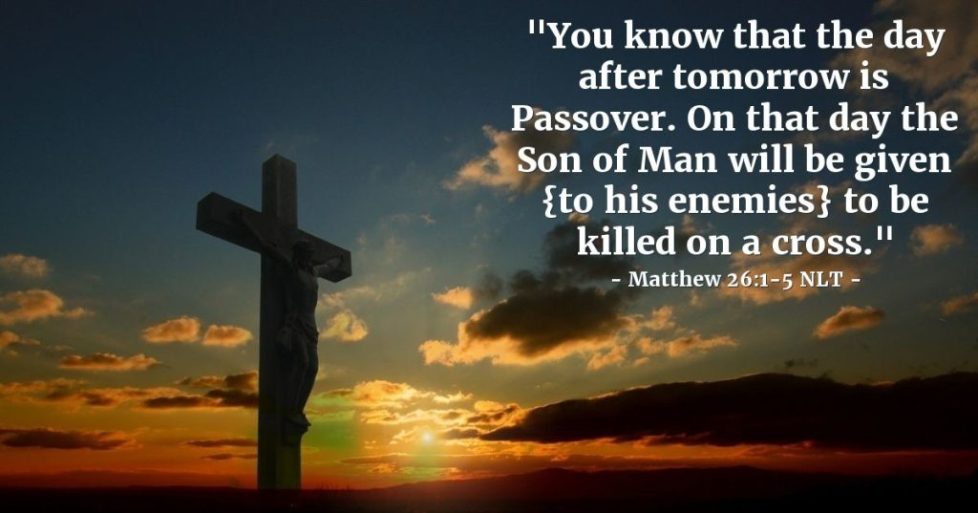
1 Now it came to pass, when Jesus had finished all these sayings, that He said to His disciples, 2 “You know that after two days is the Passover, and the Son of Man will be delivered up to be crucified.” (Matt. 26:1-2).
Matthew 26:1 marks the transition from Jesus’ Olivet Discourse to His preparations for the cross. This is Matthew’s typical formula to turn from a teaching section back to the narrative. Matthew returns to the story of Jesus’ last week in Jerusalem that began in Matthew 21 on Palm Sunday.
Here, Jesus reminds His disciples why they have come to Jerusalem—not only for the Passover feast, but for His crucifixion. “When Jesus had finished all these sayings,” about His future coming and kingdom, He snapped His disciples back into the reality of the present by saying specifically that “after two days” He would be “delivered up to be crucified.” Jesus knew that this was God’s predetermined plan. Look at what Jesus knew.
Jesus knew when He would die. Jesus said He would die “after two days” and at “the Passover.” That Jesus would die at “Passover” was no coincidence. Passover was when the sacrificial lambs were slain in remembrance of God redeeming His people from their slavery in Egypt. What happened when God delivered Israel from bondage in Egypt and from the judgment of the Death Angel only foreshadowed what would happen hundreds of years later in the death of Jesus Christ. Jesus, the true Passover Lamb will be slain. His blood will save from sin and death. As John the Baptist had proclaimed, Jesus is “the Lamb of God who takes away the sin of the world” (John 1:29). Isaiah had prophesied about the Servant of the Lord, “He was led as a lamb to the slaughter, And as a sheep before its shearers is silent, So He opened not His mouth.” (Isaiah 53:7). Thus, Paul could say in 1 Corinthians 5:7, “For indeed Christ, our Passover, was sacrificed for us.” “It is good for people to be delivered from slavery and bondage. It is better, far better, to be eternally delivered from the bondage of sin and slavery to the devil! It is good to be delivered from the Death Angel. It is better, far better, to be delivered from the eternal judgment of God!”[2]
This was God’s predetermined time for Jesus’ death. Every other previous attempt to destroy Jesus had failed because, as John 7:30 says, “His hour had not yet come” (cf. John 7:6, 8; 8:20). Herod tried to have Jesus killed as an infant in Bethlehem in Matthew 2. As early as Matthew 12, the Pharisees were plotting against Jesus to destroy Him (Matt. 12:14). The other Gospels record even more attempts on Jesus’ life (Luke 4:28-29; 6:11; John 5:18; 10:39; 11:53-57). The time was not right for Jesus to die on any of these previous occasions.
Now however, it was the Passover and God’s divine timetable was at hand. According to God’s predetermined plan, Jesus knew when He would die.
Jesus also knew how He would die. He says, “the Son of Man will be delivered up to be crucified” (Matt. 26:2). This is the fifth time Matthew records Jesus telling His disciples about His upcoming death. In Matthew 16, just after Peter made his great confession that Jesus is “The Christ, the Son of the Living God” (Matt. 16:16), Jesus explicitly told them that He would soon “suffer many things from the elders and chief priests and scribes, and be killed and be raised the third day” (Matt. 16:21).
In Matthew 17, as Jesus descended from the Mount of Transfiguration with Peter, James and John, He spoke of the martyrdom of John the Baptist. Then He pointedly added, “Likewise the Son of Man is also about to suffer at their hands” (Matt. 17:12). Just a short time later, in Matthew 17:22-23, Jesus said, “The Son of Man is about to be betrayed into the hands of men and they will kill Him and the third day He will be raised up.”
Then, in Matthew 20:17-19, Jesus again gave even more details, “Behold we are going up to Jerusalem and the Son of Man will be betrayed to the chief priests and to the scribes; and they will condemn Him to death and deliver Him to the Gentiles to mock an to scourge and to crucify. And the third day He will rise again.”
Now for the fifth time, Jesus tells His disciples that He is about to “be delivered up to be crucified.” Jesus knew He must die. He knew exactly how He would die. He knew He was born for and came for this purpose.
In John 12, Jesus prayed, “Now My soul is troubled, and what shall I say? ‘Father, save Me from this hour’? But for this purpose I came to this hour” (John 12:27). Later in Matthew 26, after the last supper, Jesus said to the disciples, “The Son of Man indeed goes just as it is written of Him…” (Matt. 26:24; Mark 14:21; Luke 22:22). Peter would preach on the day of Pentecost that Jesus was “delivered by the determined purpose and foreknowledge of God” (Acts 2:23). Revelation 13:8 describes Jesus as “the Lamb slain from the foundation of the world.” Isaiah prophesied, “For He was cut off from the land of the living; For the transgressions of My people He was stricken” (Isaiah 53:8). Daniel 9:26 says “Messiah shall be cut off.” Zechariah 13:7 says, “Awake, O sword, against My Shepherd, Against the Man who is My Companion, Says the LORD of hosts. Strike the Shepherd, And the sheep will be scattered…” Over and over, scripture declares that Jesus’ death on the cross was the predetermined plan of God.
Listen, Jesus was no reluctant victim but the willing sacrifice for our sins. He said, “… the Son of Man did not come to be served, but to serve, and to give His life a ransom for many” (Matt. 20:28). In John10:17-18, He said, “Therefore My Father loves Me, because I lay down My life that I may take it again. No one takes it from Me, but I lay it down of Myself. I have power to lay it down, and I have power to take it again. This command I have received from My Father.”
Jesus is the divine Son of Man. He is the sovereign Lord. He is in full control of all that will take place over the next two days. He know He will be handed over to be crucified, but no one takes His life from Him. He gives it.
Jesus was prepared for His death because He knew it was God’s predetermined plan. The next aspect of preparation for the cross is …
2. The Rulers’ Perverse Plot (Matt. 26:3-5).
3 Then the chief priests, the scribes, and the elders of the people assembled at the palace of the high priest, who was called Caiaphas, 4 and plotted to take Jesus by trickery and kill Him. 5 But they said, “Not during the feast, lest there be an uproar among the people.”
There are echoes of Psalm 2 here where we read how the rulers gather together and conspire in vain against the Lord and His Messiah. The “chief priests, scribes, and the elders” comprised the religious and civil rulers of the Jews with “Caiaphas” the “high priest” leading their murderous schemes against Jesus.
We have seen in our walk through the Gospel of Matthew that for three years, over and over again, Jesus had publicly exposed the hypocrisy and ungodliness of the religious leaders. His reproach reached its climax in the temple in Matthew 23, when Jesus pronounced a blistering series of woes for their hypocrisy. If they wanted to be rid of Jesus before, now they are determined to kill Him.
But they wanted to find some way to “kill” Jesus without upsetting the masses of pilgrims who were in Jerusalem for the Passover. So, even though they wanted to seize Him as soon as possible, they were worried, saying, “Not during the feast, lest there be an uproar among the people” (Matt. 26:5). They have to be very careful how they proceed. They need to be secretive and deceitful about it. They plan to put off arresting Jesus until after the feast. But their plans were in vain because God had already sovereignly chosen this Passover as the time for His Son’s death.
Think about the irony here. They had tried time and again to seize and kill Jesus, and could not do it. Now, the one time when they don’t want to do it, God will ensure it happens. These powerful rulers of the Jews met in secret seeking to kill the Son of God, but they can do nothing but fulfill God’s predetermined plan. Their preserve plot prepared what God intended.
Next, Jesus is prepared for His death by the beautiful sacrifice of Mary contrasted with the treachery of Judas. Preparations for the cross come through …
3. A Woman’s Precious Present (Matt. 26:6-13).
6 And when Jesus was in Bethany at the house of Simon the leper, 7 a woman came to Him having an alabaster flask of very costly fragrant oil, and she poured it on His head as He sat at the table. 8 But when His disciples saw it, they were indignant, saying, “Why this waste? 9 For this fragrant oil might have been sold for much and given to the poor.”
10 But when Jesus was aware of it, He said to them, “Why do you trouble the woman? For she has done a good work for Me. 11 For you have the poor with you always, but Me you do not have always. 12 For in pouring this fragrant oil on My body, she did it for My burial. 13 Assuredly, I say to you, wherever this gospel is preached in the whole world, what this woman has done will also be told as a memorial to her.”
According to John 12, this meal at the house of Simon the leper took place six days before the Passover. At this point in his narrative, Matthew gives us a flashback to Saturday because it shows the contrast between this woman’s devotion and Judas’ betrayal. “Bethany” was just east of Jerusalem near the Mount of Olives. We don’t know who this Simon the Leper was, although he was most likely a former leper, perhaps someone whom Jesus had healed. Matthew does not give us the name of the woman, but of John tells us that it was Mary, the sister of Martha and Lazarus, whom Jesus raised from the dead (John 12:3).
Coming to Jesus, she had in her hands “an alabaster flask of very costly fragrant oil” (Matt. 26:7). Mark tells us that the oil’s value was “over three hundred denarii” (Mark 14:5), nearly a year’s wages. Mary approached Jesus “as He sat at the table.” Mark says she “broke the flask” and Matthew says she “poured it on His head” as He sat there. She didn’t pour out just a little. She emptied it. She held back nothing but gave it all up for Jesus. John says, “the house was filled with the fragrance of the oil” (John 12:3). I imagine that the others at the table just sat there for a few moments in stunned silence.
Then calculating its value, some became “indignant” saying, “Why this waste? For this fragrant oil might have been sold for much and given to the poor.” Now doesn’t that sound so spiritual? But John, in his account, exposed the motives behind it. John wrote:
4 But one of His disciples, Judas Iscariot, Simon’s son, who would betray Him, said, 5 “Why was this fragrant oil not sold for three hundred denarii and given to the poor?” 6 This he said, not that he cared for the poor, but because he was a thief, and had the money box; and he used to take what was put in it. (John 12:4-6).
What Judas saw was a missed opportunity to line his own pockets, and he commented on it. The other unsuspecting disciples also echoed his rebuke. The extravagance of the gift overwhelmed them. The anointing of oil on the head was reserved for the guest of honor, accompanied by the washing of feet. But instead of common household oil, Mary used this very expensive perfumed oil. And she didn’t just dab it on Jesus’ head, she emptied it on Him. Mary, with reckless, careless abandon poured out the perfume on Jesus’ head and let it run all down His body. The gospel of John tells us she also poured some on His feet and wiped His feet with her hair. The word “Christ” or “Messiah” means the anointed one, and Mary anointed her Messiah in this extravagant act of love and worship.
Then the rebuke came from the Master. Jesus asked, “Why do you trouble the woman? For she has done a good work for Me. For you have the poor with you always , but Me you do not have always.” Certainly, Jesus taught and modeled that helping the “poor” and ministering to physical needs is always important. However, Jesus defends Mary. Where the disciples saw only waste, Jesus saw a beautiful demonstration of love. Jesus says, “For in pouring this fragrant oil on My body, she did it for My burial.” As important as helping the poor is, there was something even more important right here, at this moment. Mary seemed to understand what none of the twelve yet grasped—Jesus is going to His death. The cross was looming, and Jesus tells the disciples that this woman anointed Him with the perfume to prepare Him for His burial. I love the picture that Philip Keller gives,
“The delicious fragrance ran down over His shining hair and thick beard. It enfolded His body with its delightful aroma. Even His tunic and flowing undergarments were drenched with its enduring pungency. Wherever he moved during the ensuing 48 hours, the perfume would go with Him: into the Passover, into the Garden of Gethsemane, into the high priest’s home, into Herod’s hall, into Pilate’s praetorium, into the crude hands of those who cast lots for His clothing at the foot of the cross. … It was a significant moment of momentous meaning.”[3]
Jesus indicated the solemnity of this anointing when He said, “Assuredly, I say to you, wherever this gospel is preached in the whole world, what this woman has done will also be told as a memorial to her.” (Matt. 26:13). And here we are almost 2000 years later on the other side of the world, preaching the gospel and telling what she has done.
How would you honor the death of your Savior? Mary not only gave her finest possession, but she also humbled herself in the way she gave it. She worshiped in gratitude for the death of her Savior. Mary loved Jesus who would pour out His life for her, and so she poured out on Him that which cost her most. Worship springs from a heart of love. Love is extravagant and lavish. Love doesn’t look for cheap bargains. It gives the best it can.
I’m afraid too often some Christians worship in a way that costs them nothing. Why? Their view of God is deficient. Their understanding of the cross is inadequate. Their evaluation of salvation is cheap. Their knowledge of sin is shallow. True worship is loving God with all our heart, all our mind, all our soul, and all our strength. Worship is responding in gratitude and love to the Lord who first loved us and gave Himself for us. Does your worship reflect the true worthiness of your Savior?
In response to the love of Christ for her, and in preparation for His death, Mary boldly came, broke the neck of the perfume bottle, and poured the entire contents upon the head and upon the feet of Jesus. This was costly, humble worship that prepared Jesus for the cross.
But next, Matthew contrasts the beauty of her worship with the ugliness of Judas’ treachery. Mary was an instrument of grace; Judas an instrument of sin. Mary had the light of love; Judas the darkness of treachery. Mary openly worshipped; Judas secretly betrayed. She will always be remembered for her love. He will always be remembered for his betrayal.
So last we see Jesus’ death prepared by …
4. The Traitor’s Pernicious Pact (Matt. 26:14-16).
14 Then one of the twelve, called Judas Iscariot, went to the chief priests 15 and said, “What are you willing to give me if I deliver Him to you?” And they counted out to him thirty pieces of silver. 16 So from that time he sought opportunity to betray Him.
Thirty pieces of silver! The price for a gored slave (Exodus 21:32). The exact princely price that was prophesied in Zechariah (Zech. 11:12-13). Do you see the contrast? Mary thought Jesus was worth the most expensive thing she had. But Judas sold Jesus for a mere thirty pieces of silver. One gave all she had. The other took all he could get.
What happened with Judas? That’s a question Bible scholars have asked for centuries. We assume that because he was one of the twelve, he shared the same experiences as the other eleven. He saw the miracles. He heard the teaching. He traveled with, ate with, and lived with Jesus for three and a half years. He heard the Shepherd’s voice. He had felt the Lord’s embrace. How could he betray Him?
Surely, Judas betrayed Jesus because he never really knew Jesus. Like all hypocrites, he honored Jesus with his lips but his heart was far from Him (Matt. 15:8). In John 6:64 Jesus says, “But there are some of you who do not believe.” Then John comments, “For Jesus knew from the beginning who they were who did not believe, and who would betray Him.” Because of his unbelief and greed, he rejected the Christ of the cross. But here’s the problem: without the Christ of the cross, there is no hope, no life, no forgiveness, and no Savior. Judas’ betrayal left him lost and alone. And although he regretted what he did, instead of repenting and returning to Jesus, he took his own life. He went out of this life lost and condemned because he would not accept the Christ of the cross.
Listen, only the way of the cross leads home. You cannot be forgiven without the cross. You cannot have eternal life apart from the cross. You cannot be prepared to go to heaven unless you enter by way of the cross.
Jesus’ death was no accident or tragic fate. It was the sovereign plan of God to purchase the redemption of sinners. What is your response? Do you rest in God’s sovereignty as Jesus did? Do you scheme against it as the Jewish leaders did? Do you worship the Lord with the adoration and sacrifice of Mary? Or do you abandon the Savior for what you can get in this life as Judas did?
Isaac Watts expressed his response in the hymn, When I Survey the Wondrous Cross, with this stanza,
Were the whole realm of nature mine,
That were a present far too small;
Love so amazing, so divine,
Demands my soul, my life, my all!
—————————————————
[1] Phil Newton, Anointed for Burial: Matthew 26:1-13, http://archive.southwoodsbc.org/sermons/matthew_26.01-13.php
[2] Phil Newton, ibid.
[3] Philip Keller, Rabboni, pp.222-223.


