There are two basic approaches to preaching that you will find in most churches today. One is to approach the sermon from the felt needs of the congregation. As one pastor said, “Each week we think through needs in the congregation and preach a message to meet those needs.” This approach lends itself to topical or textual sermons that major on “How to” sermons that seek to help Christians overcome different issues they are facing. In this approach the meaning of the biblical text is often secondary to pressing need of the congregation or the topic of the sermon.
The second approach is expository preaching which starts with the biblical text, explaining and applying the Bible text so that the sermon’s content and intent are expresses the content and intent of a particular passage of Scripture. In other words, “the preacher says what the passage says, and he intends for his sermon to accomplish in his listeners exactly what God is seeking to accomplish through the chosen passage of his Word” (Mike Bullmore).
Felt-needs preaching often stems from a preacher’s love for his flock and his genuine desire to see people grow in Christ. But the problems I see with a constant use of this approach are:
It communicates that the Bible is primarily about meeting our needs instead of receiving the revelation of God. A great danger in having felt needs as your starting point in preaching is man-centeredness. The Bible is not primarily about us, it is about God and our Lord Jesus Christ (Luke 24:24). Human history is not primarily about us, but about God and His purpose to redeem sinful humanity through Jesus Christ (Eph. 1:3–14). Approaching the Bible as God’s revelation of Himself to humanity puts God in the center of our lives and not ourselves.
God knows our needs better than we do. God’s Word alone meets our every spiritual need and exposes the thoughts and intentions of the heart (2 Tim. 3:16-17; Heb. 4:12). Our attempts to faithfully diagnose needs cannot compare to God’s: we need God’s Word to shine its light into our blind spots and expose our true needs. Expository preaching takes seriously the inspiration and sufficiency of the scriptures.
We can miss the whole counsel of God. God gave us the Bible in book format, not random collections of verses and stories. If preachers only preach topical messages or one-off expositions, they often miss the overall intent of the passage and books of the Bible. Expository preaching enables Christians to understand the Bible better and treat it less like a book of inspirational quotations or a self-help manual.
I would dare say that people who believe that that we should preach to people’s felt needs would rarely if ever preach Genesis 10.
When the story of Noah and the flood is told, today’s text is usually the part that gets left out. We all know about the reason for the flood: the corruption and violence of the human race. We know about God instructing Noah to build an ark and to take his family and the animals onto it to be saved from the flood. We know about the extent of the flood and how God brought Noah, his family and the animals off the ark after the flood. We know about Noah’s offering and God’s promise not to flood the earth again confirmed by the rainbow. These details are often retold in children’s picture books.
But today’s text is not retold in children’s books. After all the good things we have learned about Noah, Genesis 9:21 is shocking; Noah gets drunk and naked. The text moves from the rainbows into the shadows. You almost wish this verse wasn’t in the Bible, but the Bible never glosses over the flaws and sins of its characters, even the godly ones. It’s interesting that Noah lived 350 years after the flood, and this is the only episode from that long life that Moses records for us.
Pay attention as I read our text today (Genesis 9:18-29):
18 Now the sons of Noah who went out of the ark were Shem, Ham, and Japheth. And Ham was the father of Canaan. 19 These three were the sons of Noah, and from these the whole earth was populated. 20 And Noah began to be a farmer, and he planted a vineyard. 21 Then he drank of the wine and was drunk, and became uncovered in his tent. 22 And Ham, the father of Canaan, saw the nakedness of his father, and told his two brothers outside. 23 But Shem and Japheth took a garment, laid it on both their shoulders, and went backward and covered the nakedness of their father. Their faces were turned away, and they did not see their father’s nakedness.
24 So Noah awoke from his wine, and knew what his younger son had done to him. 25 Then he said: “Cursed be Canaan; A servant of servants He shall be to his brethren.” 26 And he said: “Blessed be the LORD, The God of Shem, And may Canaan be his servant. 27 May God enlarge Japheth, And may he dwell in the tents of Shem; And may Canaan be his servant.”
28 And Noah lived after the flood three hundred and fifty years. 29 So all the days of Noah were nine hundred and fifty years; and he died.
The text that is before us today is broken neatly into two parts. First, we have the story of Noah’s drunkenness, the shameful response of Ham to his father’s nakedness, and the honorable response of Shem and Japheth in covering the shame of their father. That story is told in Genesis 9:18-23. Secondly, we find the speech of Noah where he pronounced a curse upon Canaan (the son of Ham), and blessed both Seth and Japheth in Genesis 9:24-28.
1. Noah’s Drunkenness and Shame (Gen. 9:18-23)
It is crucial to see that in this story—the account of Noah’s drunkenness, the shameful response of Ham to his father’s nakedness, and the honorable behavior of Shem and Japheth—we find an echo of the story of Adam’s fall into sin from Genesis 3. Many of the themes present in the story of Adam’s fall are repeated here in this narrative. This is very significant, for it helps us to see what this story is—a reiteration the pervasiveness of sin and of God’s purpose save a people for Himself despite man’s sin. Sin survived the flood, but so did God’s plan to save humanity.
In Genesis 9:18-19 we read, “Now the sons of Noah who went out of the ark were Shem, Ham, and Japheth. And Ham was the father of Canaan. These three were the sons of Noah, and from these the whole earth was populated.”
Genesis 9:18 picks up where Genesis 6 left off before the whole account of the great flood. There Genesis 6:10 concluded: “And Noah begot three sons: Shem, Ham, and Japheth.” Now we return to focus on these figures: Noah and his three sons, Shem, Ham, and Japheth. Genesis 9:19 tells us that from these three that the whole earth would be repopulated or dispersed after the flood. The important emphasis in Genesis 9:18 is the statement that “Ham was the father of Canaan.” In Genesis 10 Moses will list all the sons of Shem, Ham, and Japheth and the nations that would come from their lines. But of all the sons and grandsons that are listed in Genesis 10, only one is especially emphasized here: Canaan. In Genesis 9:22 we see it emphasized again, “… Ham, the father of Canaan …” Canaan is mentioned five times in this section. This will become an important piece of information later in the story, so don’t forget it—Ham was the father of Canaan.
A. Noah’s sin
In Genesis 9:20-21 we read, “And Noah began to be a farmer, and he planted a vineyard. Then he drank of the wine and was drunk, and became uncovered in his tent.” The story is simple enough. Noah was a farmer. He planted a vineyard—nothing wrong with that, vineyards and wine are often associated with joy in God’s blessings in the scriptures (Deut. 14:26; Psa. 104.15; Pro. 31:6-7; Ecc. 9:7). But Noah misused God’s blessing when he became drunk with the wine and, therefore, laid shamefully naked and exposed in his tent.
This is the first mention of wine in the Bible, and it’s not a pretty picture. A godly man like Noah was trapped by its subtle but potent influence. Getting drunk resulted in shame and a curse. While the Bible does not prohibit a careful use of wine, it repeatedly warns of the dangers of drinking (Pro. 23:29-35) and it always condemns drunkenness as a deed of the flesh, warning that the one who practices it will not inherit the kingdom of God (1 Cor. 5:11; 1 Cor. 6:10; Gal. 5:21).
I want to call attention to several important points of comparison that we can see between Noah and Adam. First, notice that Noah and Adam were both farmers. Adam was put by God “in the garden of Eden to tend and keep it” (Gen. 2:15) and after the fall Genesis 3:23 says, “therefore the LORD God sent him out of the garden of Eden to till the ground from which he was taken.” Noah was also a farmer. “And Noah began to be a farmer (literally “a man of the ground [אִישׁ הָֽאֲדָמָה, IshAdamah]”), and he planted a vineyard” (Gen. 9:20).
Second, both Adam’s sin and Noah’s sin involved a misuse of God’s blessing of the fruit of the ground. God gave Adam every tree in the garden to eat except one, the tree of the knowledge of good and evil (Gen. 2:16-17). Adam sinned when he ate of that forbidden fruit (Gen. 3:6). God blessed Noah with a vineyard. He sinned when he misused the fruit of the vine and became drunk.
Third, notice the similar results of Adam’s sin and Noah’s sin. Both involved the shame of nakedness. When Adam and Eve sinned by eating of the forbidden fruit, “Then the eyes of both of them were opened, and they knew that they were naked; and they sewed fig leaves together and made themselves coverings” (Gen. 3:7). When Noah sinned by getting drunk on wine, he passed out naked in his tent (Gen. 9:21).
These similarities suggest that these episodes are meant to be compared. After God created the heavens and earth, He created man in His own image and placed him in Eden. Adam was to obey God as a representative of all humanity. Instead, he rebelled and sinned, experiencing the shame of his nakedness. Likewise with Noah, God brought forth a new earth after the flood. God established His covenant with Noah as a representative for all humanity. Noah was to obey God, but he also sinned and experienced the shame of his nakedness.
B. The sons’ response
Genesis 9:22-23 record the response of Noah’s sons to his sin and shame: “And Ham, the father of Canaan, saw the nakedness of his father, and told his two brothers outside. But Shem and Japheth took a garment, laid it on both their shoulders, and went backward and covered the nakedness of their father. Their faces were turned away, and they did not see their father’s nakedness.”
It is obvious that Ham responded sinfully and shamefully while Shem and Japheth responded honorably. Ham showed disrespect to his father when he exposed and ridiculed Noah’s sin instead of seeking to cover it. He found his father drunk and shamefully exposed. And instead of covering his father’s nakedness, he went out to tell his brothers, presumably to mock his father in his moment of shame.
Shem and Japheth did the opposite. They showed respect to their father and covered the shame of his nakedness. They draped the garment over their shoulders, walked backwards into the tent together, and dropped it over their father to cover his shame.
It is important to God that children honor their parents. Later in the law, the fifth of the ten commandments speak to this (Exo. 20:12; Deut. 5:16). This command is repeated in the New Testament by Jesus (Matt. 15:4); Mark 10:19). Paul emphasized that commandment when he wrote, “Children, obey your parents in the Lord, for this is right. ‘Honor your father and mother,’ which is the first commandment with promise: ‘that it may be well with you and you may live long on the earth.’” (Eph. 6:1–3). Children to are to show honor two their parents. Honor them when you are young and when you are old, even if your parent is acting in less than an honorable way (like Noah).
Ham disrespected his father by failing to cover him, and by mocking his nakedness. Shem and Japheth honored their father by refusing to look upon his shame, and by going to the trouble to cover him in his moment of disgrace.
Perhaps you are thinking that Noah being uncovered the fact that Ham saw him that way doesn’t seem like such a big deal. After all, wasn’t Noah in the privacy of his own tent? In fact, you may be more shocked at the extreme measures taken by Shem and Japheth than the nakedness Noah or the reaction of Ham. But that says more about us than it does about the Bible. The lengths to which Shem and Japheth went in order not to see their father seem almost extreme in our sexually permissive society. Robert Deffinbaugh (The Nakedness of Noah and the Cursing of Canaan) has some very helpful insight regarding this issue:
Our great problem today is that we have almost no sense of identification with the attitudes or actions of Noah’s two godly sons, Shem and Japheth. We feel no shame and no shock at the report of Noah inside his tent. And the reason is the real shock of the passage: We are a part of a society that senses no shame and no shock at moral and sexual indecency. Virtually every kind of sexual intimacy is portrayed upon the movie and television screen. Even abnormal and perverted conduct has become routine to us. Without any sense of indecency, the most intimate and private items are advertised before us and our children.
Do you see the point? We are not troubled by Noah’s nakedness because we are so much farther down the path of decadence that we hardly flinch at what happened in this passage. Now, my friend, if the condemnation of God fell upon Ham’s actions and upon those who walked in his ways, what does that say to you and to me? God forgive us for being beyond the point of shockability and shame. God save us from the sins of the Canaanites. God teach us to value moral purity and to be ruthless with sin. May we refuse to let it live among us, just as Israel was taught in this text.
When Shem and Japheth covered their fathers nakedness, they were behaving in a godly manner. They had the heart of God who grieved over the sin of Adam and graciously covered the shame of his nakedness (Gen. 3:20–21). One test of Christ-like character is how we respond to the sins of others.
Moses, by retelling this story, has set the stage for the curse pronounced on Canaan (Ham’s son) and for the blessing on Shem and Japheth.
2. Noah’s Curse and Blessing (Gen. 9:24-29)
Genesis 9:24 tells us the aftermath of the incident, “So Noah awoke from his wine, and knew what his younger son had done to him.” We do not know how Noah learned of this. I doubt that Shem and Japheth told Noah, or anyone else. I suspect that the story was well known around the camp the next morning, and probably due to Ham. If Ham didn’t hesitate to tell his brothers, why hesitate to tell all?
Noah then pronounces a curse and blessings. Noah’s words here are words of prophecy. Noah is foretelling the trajectory of world history through his sons. He is speaking an oracle under the inspiration of God, predicting the course of the nations that will come from his three sons.
Notice first the,
A. Curse on Canaan
Genesis 9:25, “Then he said: ‘Cursed be Canaan; A servant of servants He shall be to his brethren.’” The major question that arises here is: Why did Noah curse his grandson Canaan and not his son Ham? The immediate text does not fully answer that question. Was Canaan somehow involved with Ham’s sinful disrespect? Again, the text doesn’t say so. The key to understanding the curse on Canaan is to remember that he became the father of a vast group of people called the Canaanites. In later generations they occupied the land of Canaan which God promised to give to Abraham and his descendants, the Israelites. The Canaanites developed an idolatrous religion based on gross sexual perversion. Leviticus 18 specifies the sins of the Canaanites in graphic detail including incest, homosexual behavior, and bestiality. These sins are described repeatedly with the words “uncover” and “nakedness.”
Moses is wanting us to see the connection here. Ham was the father of Canaan and Canaan was the father of the Canaanites. They were a people under God’s curse because of their sin. The Canaanites were sexually perverted idol-worshipers who were the sworn enemies of the people of Israel. When the Israelites got ready to enter the Promised Land, God told them to utterly wipe out the Canaanites—destroy their cities, kill their animals, and kill all the people—men and women, adults and children (. Their immorality and false religion was so toxic it was like spiritual Anthrax—so deadly it must be wiped out or the Israelites themselves would be infected.
It’s important to say that Noah is not putting a “hex” on his grandson, so that Canaan could not help himself. Nor is he fixing the fate of every person descended from Canaan, as if individuals could not escape the curse. Indeed, a few Canaanites (like Rahab) would become believers and part of Israel and its blessings. Rather, he is predicting that Canaan’s descendants would serve the descendants of Shem and Japheth.
This curse has nothing to do with the other sons of Ham and their descendants. It has absolutely nothing to do with skin color. Contrary to what some have falsely taught, the black race is not descended from Canaan. His descendants were those peoples dwelling in the land of Canaan when Israel conquered the land under Joshua. The prophecy was fulfilled under Joshua and Solomon, both of whom put Canaan’s descendants in forced service to Israel (Josh. 9:23; 1 Kings 9:20-21).
Noah not only prophesies a curse on Canaan he also gives a,
B. Blessing for Shem and Japheth
Genesis 9:26 says, “And he said: ‘Blessed be the LORD, The God of Shem, And may Canaan be his servant.’”
Notice that Noah does not bless Shem directly, but he blesses the Lord, Shem’s God. “Blessed be the LORD, The God of Shem.” There is a play on words here with the name Shem. Shem means “name”, and here is the distinguishing characteristic of the line of Shem—they have taken the name of the LORD to themselves. They are God’s people. The LORD is their God. Like Seth before them, they call upon the name of the LORD, Yahweh. The blessing flows out of the relationship which Shem has with Yahweh, the covenant God of Israel. And the servitude of Canaan is evidence of this blessing. This was fulfilled in that Abraham and the nation of Israel, and later Jesus the Messiah, came from the line of Shem.
Just as Shem’s blessing consists in his relationship to Yahweh, Japheth will be blessed in his relationship to Shem (Gen. 9:27), “May God enlarge Japheth, And may he dwell in the tents of Shem; And may Canaan be his servant.” The name “Japheth” is thought to mean ‘to enlarge’ or ‘to make wide.’ By a word play, Noah blessed Japheth by using his own name. The blessing of Japheth is to be found in relationship to Shem and not independently. God will state this promise more specifically in Genesis 12:3 when the LORD blessed Abram and said: “I will bless those who bless you, And I will curse him who curses you; And in you all the families of the earth shall be blessed.” This is the first glimmer in Scripture of the grafting in of the Gentiles to the spiritual blessings of Israel. We who are Japheth’s descendants have truly been blessed by dwelling in the tents of Shem!
Our text ends with the death of Noah (Gen. 9:28-29), “And Noah lived after the flood three hundred and fifty years. So all the days of Noah were nine hundred and fifty years; and he died.” This is proof that the flood was not God’s ultimate solution to the problem of human sin, nor was Noah the savior, the seed of the woman who would bruise the serpent’s head (Gen. 3:15). The Messiah would come from the seed of the woman; He would come through the line of Shem and Abraham and God would bless the whole world through Him. That one is Jesus Christ, the Son of God whom God sent into the world. He lived a perfect, sinless life in obedience to His Father. His atoning death covers our sins and His resurrection guarantees us eternal life. Christ took the curse for our sin and gives us the blessing of His righteousness.
Have you come to Christ? Have you turned from your sin and yourself to the Savior? Have you believed on the Lord Jesus Christ? Is He blessing others through His relationship with you?
Adrian Rogers asked in one of his sermons, “What is the world coming to?” And his answer was “It’s coming to Jesus!” That is ultimately true even if it often does not appear to be the case. Psalm 149 is a psalm that celebrates God’s victory. Some locate its writing following the Babylonian exile during the time of Nehemiah as the Hebrew people return to the land of Israel. It may indeed originate there, but its gaze stares into the future when the Lord, “the King of Zion” will bring judgment and justice for His people.
And what is our response to God’s great victory? Worship. Let’s look briefly at Psalm 149 to answer a few questions about worship. Listen to Psalm 149:
Psalm 149
1 Praise the LORD! Sing to the LORD a new song,
And His praise in the assembly of saints.
2 Let Israel rejoice in their Maker;
Let the children of Zion be joyful in their King.
3 Let them praise His name with the dance;
Let them sing praises to Him with the timbrel and harp.
4 For the LORD takes pleasure in His people;
He will beautify the humble with salvation.
5 Let the saints be joyful in glory;
Let them sing aloud on their beds.
6 Let the high praises of God be in their mouth,
And a two-edged sword in their hand,
7 To execute vengeance on the nations,
And punishments on the peoples;
8 To bind their kings with chains,
And their nobles with fetters of iron;
9 To execute on them the written judgment–
This honor have all His saints. Praise the LORD!
Psalm 149 begins with “Praise the LORD!” or “Hallelujah!” It ends with the same, “Hallelujah!” or “Praise the LORD!”
1. The “WHO” of Worship (Psalm 149:1, 5, 9)
Who is called to worship? Worshipers are called “Saints” (Psa. 149:1, 5, 9). “Praise the LORD! Sing to the LORD a new song, And His praise in the assembly of saints” (Psa. 149:1). The word for “saints” means those who are godly due to God’s mercy and kindness. Specifically they are called to worship “in the assembly of saints,” the congregation. This word is translated into the New Testament as “ekklesia” the church. We are the assembly of the saints, those who have been made saints by grace through faith in Jesus Christ. We are “His people” (Psa. 149:4) like “Israel” and “the children of Zion” were in the Old Testament (Psa. 149:2).
2. The “WHAT” of Worship (Psalm 149:1, 9)
What are worshipers called to do? “Praise the LORD!” The Hebrew is “הַלְלוּ יָהּ, Hallelujah”. Hallel is a command meaning to praise; Jah is the short form of Yahweh, the Lord. The psalm begins and ends with Hallelujah,Praise the LORD!
What does our praise look like? We are to “Sing to the LORD a new song, and His praise” (Psa. 149:1b). To “Sing to the LORD a new song” is to sing a song to God on a new occasion of His deliverance. The new song is the song of the redeemed (Rev. 5:9; 14:3). Genuine worship is fresh. Our worship should not be stale ritual or empty tradition.
Hebrews 13:15 says, “Therefore by Him let us continually offer the sacrifice of praise to God, that is, the fruit of our lips, giving thanks to His name.”
While there is the danger of having a “praiseless” heart we must beware of offering heartless praise. It is essential for every believer to praise the Lord; however, this is not to the exclusion of explicit trust and obedience to the Lord. Properly rendered praise must come from a heart and life surrendered to the Lordship of Jesus Christ.
3. The “HOW” of Worship (Psalm 149:2-3, 5)
2 Let Israel rejoice in their Maker;
Let the children of Zion be joyful in their King.
3 Let them praise His name with the dance;
Let them sing praises to Him with the timbrel and harp.
5 Let the saints be joyful in glory;
Let them sing aloud on their beds.
Did you notice the attitude of our worship? JOY! The psalmist repeats it (Psa. 149:2), “Let Israel rejoice in their Maker” and “Let the children of Zion be joyful in their King” and again (Psa. 149:5), “Let the saints be joyful in glory.” Psalm 149:3 with its dancing and timbrels pictures a victory celebration like Israel did when God drowned the Egyptian army in the Red Sea (Exo. 15:20). Today we are joyful because Christ has won the victory for us over sin and death.
Specifically, what are they to do? They are to praise God as their “Maker” and as “their King.” Our Maker is our Savior, our King. Our joy is in our Maker and our King. We “rejoice in the Lord always” (Phil. 4:4).
4. The “WHY” of Worship (Psalm 149:4)
“For the LORD takes pleasure in His people; He will beautify the humble with salvation.” Why do we worship? Because of who God is and what He has done. Our salvation is the primary motivation to worship the Lord from a humble heart of gratitude. We worship the Lord because He “takes pleasure in His people.” The Lord takes pleasure in His people because He can see us as we shall be, “clothed in white garments” (Rev. 3:5) “made … white in the blood of the Lamb” (Rev. 7:14). It is the Lord who beautifies the humble with salvation. Our salvation in Christ Jesus is our motivation for humble worship.
5. The “WHEN” of worship (Psalm 149:6-9)
Unlike the church of today Israel was given a militant role. Israel was God’s agent of judgement on the Canaanite peoples for their incredible evil idolatry. God was on their side when they walked in obedience to him and he would fight on their behalf against their enemies.
This is why we shouldn’t be surprised when Psalm 149:7-9 speaks of two-edged swords, vengeance and punishment. God punishes sin, this is a matter of justice. How can we declare that we believe in justice being done here on earth when someone does wrong; yet deny God the right to execute judgement against individuals and nations for their acts of evil?
Unlike the nation of Israel, our enemies are not the unbelievers or the ungodly nations. No, “… we do not wrestle against flesh and blood, but against principalities, against powers, against the rulers of the darkness of this age, against spiritual hosts of wickedness in the heavenly places” (Eph. 6:12). And “the weapons of our warfare are not carnal but mighty in God,” (2 Cor. 10:4). We fight this spiritual battle with “the word of God” which “is living and powerful, and sharper than any two-edged sword” (Heb. 4:12). We overcome “by the blood of the Lamb and by the word of (our) testimony” (Rev. 12:11).
The day of the Lord will come. Jesus Christ will return to bring justice and judgment on this world. When He does Revelation 19:15 says, “Now out of His mouth goes a sharp two edged sword, that with it He should strike the nations. And He Himself will rule them with a rod of iron. He Himself treads the winepress of the fierceness and wrath of Almighty God.”
This Psalm begins and ends with “Hallelujah!” That’s where we also live: between the Hallelujahs. We sing “Hallelujah” because Christ has come as the Suffering Servant, who was “led like a lamb to the slaughter” (Isa 53:7) to take away our sin. And we sing “Hallelujah” because Christ will return in victory as the “King of kings and Lord of lords” (Rev 19:11,16). This Psalm looks forward to the day of final judgment when the Lord will judge the nations with justice and righteousness. It calls us to sing a new song today in anticipation of the Lord’s ultimate victory tomorrow. Praise the Lord! Hallelujah!
1 So God blessed Noah and his sons, and said to them: “Be fruitful and multiply, and fill the earth. 2 And the fear of you and the dread of you shall be on every beast of the earth, on every bird of the air, on all that move on the earth, and on all the fish of the sea. They are given into your hand. 3 Every moving thing that lives shall be food for you. I have given you all things, even as the green herbs. 4 But you shall not eat flesh with its life, that is, its blood. 5 Surely for your lifeblood I will demand a reckoning; from the hand of every beast I will require it, and from the hand of man. From the hand of every man’s brother I will require the life of man. 6 Whoever sheds man’s blood, By man his blood shall be shed; For in the image of God He made man. 7 And as for you, be fruitful and multiply; Bring forth abundantly in the earth And multiply in it.”
8 Then God spoke to Noah and to his sons with him, saying: 9 “And as for Me, behold, I establish My covenant with you and with your descendants after you, 10 and with every living creature that is with you: the birds, the cattle, and every beast of the earth with you, of all that go out of the ark, every beast of the earth. 11 Thus I establish My covenant with you: Never again shall all flesh be cut off by the waters of the flood; never again shall there be a flood to destroy the earth.”
12 And God said: “This is the sign of the covenant which I make between Me and you, and every living creature that is with you, for perpetual generations: 13 I set My rainbow in the cloud, and it shall be for the sign of the covenant between Me and the earth. 14 It shall be, when I bring a cloud over the earth, that the rainbow shall be seen in the cloud; 15 and I will remember My covenant which is between Me and you and every living creature of all flesh; the waters shall never again become a flood to destroy all flesh. 16 The rainbow shall be in the cloud, and I will look on it to remember the everlasting covenant between God and every living creature of all flesh that is on the earth.” 17 And God said to Noah, “This is the sign of the covenant which I have established between Me and all flesh that is on the earth.”
Genesis is a book of beginnings. We have seen the beginning of the heavens and the earth in God’s work of creation in Genesis 1; we’ve seen the beginning of relationship with God and man in Genesis 2. In Genesis 3, we saw the beginnings of human sin, the consequences of sin, and the promise of a deliverer. In Genesis 4, we’ve seen examples of the sin and grace which co-existed in the human family descending from Adam and Eve. In Genesis 5 we saw the godly line from Seth to Noah. Genesis 6 through 9 tells the story of Noah and the flood. In particular we saw in Genesis 6:1-8 the corrupt, sinful condition of the world prior to God’s judgement in the flood of Noah. In Genesis 6:9-22, we saw God’s judgment and grace on the last generation of the old Adamic world. In Genesis 7 we saw the deluge itself, and in Genesis 8, we saw how God remembered Noah, dried the land and brought them off the ark. The flood brought an end to the pre-Adamic world with its corruption and violence.
But by God’s grace Genesis does not end with the flood, nor does the story of mankind. In Genesis 9 we have a new beginning. God gives mankind a new start with Noah and his sons. As we go through this passage, keep in mind that it’s all about God. He’s the only person who speaks or acts. Noah doesn’t say a thing and he doesn’t do a thing. God is the subject, the actor, the initiator. He establishes a new beginning, puts forth a new command, and gives a new promise.
Peanuts characters Lucy and Linus were looking out the window on a rainy day. “Boy, look at it rain,” said Lucy, “What if it floods the whole world?” “It will never do that,” Linus replies confidently. “In the ninth chapter of Genesis, God promised Noah that would never happen again, and the sign of the promise is the rainbow.” “You’ve taken a great load off my mind,” says Lucy with a relieved smile. Linus affirms, “Sound theology has a way of doing that!” If we pay attention to the scripture here in Genesis 9, we will discover sound theology that will bring hope to us as well.
First we see God establishes:
1. A New Beginning (Gen. 9:1-3)
1 So God blessed Noah and his sons, and said to them: “Be fruitful and multiply, and fill the earth. 2 And the fear of you and the dread of you shall be on every beast of the earth, on every bird of the air, on all that move on the earth, and on all the fish of the sea. They are given into your hand. 3 Every moving thing that lives shall be food for you. I have given you all things, even as the green herbs.” (Genesis 9:1-3).
God’s words to Noah in Genesis 9:1, 7 sound familiar to us because they’re a repeat of what God said to the first man and woman in Genesis 1. Genesis 1:28 says, “Then God blessed them, and God said to them, ‘Be fruitful and multiply; fill the earth and subdue it; have dominion over the fish of the sea, over the birds of the air, and over every living thing that moves on the earth.’” Moses wants us to see this as a new beginning for mankind. God commissions Noah and his family to spread out across the earth and re-establish human civilization. Just as Adam was head of the human race in the beginning, Noah is now the head of the reconstituted human race after the flood. All humankind will flow from Noah through his three sons. God values human life and ordained the propagation of the human race through families to promote His purposes.
In Genesis 9:2 God reiterate the dominion of man over the animals as He had at the beginning, but here God’s words take on a more negative effect than in Genesis 1. God gives the animals into man’s hands, but their relationship will now be unfriendly. The animals will now “fear” and “dread” man. This change in relationship between man and animals probably reflects the curse on the ground due to man’s sin.
Another reason for this fear is the permission that God gives for men to now eat meat. In Genesis 1-2 God had given the green plants and the fruit of the trees to man for food. But now He gives permission to hunt animals for food and to raise animals for meat. Human life takes priority over animal life.
So God establishes a new beginning for mankind with Noah and his sons. Second God gives,
2. A New Command (Gen. 9:4-7)
In Genesis 9:4-7 God is stressing to Noah the principle: “Respect Life.” Everything flows from that. That rule is applied in two commands. First, don’t eat living animals. That’s the meaning of Genesis 9:4, “But you shall not eat flesh with its life, that is, its blood.” Since God now gives people permission to eat animals for food, He adds the restriction that they must first be put to death and the blood drained from them. The point of first killing the animal, draining the blood, and then eating it is to show respect for God who gave life in the first place.
This text anticipates the later biblical instruction that the life of the flesh is in the blood. God here is preparing man for understanding the connection between blood sacrifice and atonement. In Leviticus 17:10-11 the Lord will command Moses,
10 ‘And whatever man of the house of Israel, or of the strangers who dwell among you, who eats any blood, I will set My face against that person who eats blood, and will cut him off from among his people. 11 For the life of the flesh is in the blood, and I have given it to you upon the altar to make atonement for your souls; for it is the blood that makes atonement for the soul.’
God’s command here in Genesis 9 and the laws He gives under Moses are meant to establish the connection between the blood and life and atonement. The ultimate fulfillment of this principle is the shed blood of Jesus Christ that atones for the sins of the world.
The second command for respecting life is: Murderers should be put to death. This is the plain meaning of Genesis 9:5-6
5 Surely for your lifeblood I will demand a reckoning; from the hand of every beast I will require it, and from the hand of man. From the hand of every man’s brother I will require the life of man. 6 Whoever sheds man’s blood, By man his blood shall be shed; For in the image of God He made man.
If a man sheds the blood of another man, by the hand of man his own blood shall be shed. Life for life. If you show such disrespect for human life that you murder it, then you have forfeited your right to your own life. The reason given for this rule is crucial. Genesis 9:6 says it is because man is made in the image of God.
Everyone we know, everyone we meet, every person in the whole world is made in the image of God. We were each created with the ability to know God, to love Him, and to worship Him. That makes each one of us unique and valuable and worthy of respect and honor and protection. And that image of God means that human life is valuable inside the womb, from the very moment of conception.
This is the biblical foundation for capital punishment. We all understand that God is the source of life. He alone has the right to give life or to take it away. But in this passage God delegates to human authority the right to take life in certain circumstances. Later on in the Old Testament God will specify for the nation of Israel certain crimes where the death penalty is justified.
To discuss the issue of capital punishment in depth would take an entire message, but suffice it to say that I am not aware of any passage in the rest of the Bible that contradicts, cancels, nullifies what is said in Genesis 9. Romans 13:4 tells us that when a civil authority (judge, police officer, soldier, etc) acts to uphold righteousness and to punish evildoers, “he does not bear the sword in vain.” That sword of punishment—which includes capital punishment—is part of God’s judgment against those who do evil, and especially against those who take innocent human life.
So God establishes a new beginning, makes a new command and third, God gives,
3. A New Promise (Gen. 9:8-17)
Genesis 9:8-8 says, “Then God spoke to Noah and to his sons with him, saying: And as for Me, behold, I establish My covenant with you and with your descendants after you.”
The idea of the covenant is the central theme of this section. The word “covenant” is used seven times in these verses (Gen. 9:8-17). In the Bible God makes several covenants with people. A covenant is “a pledged and defined relationship” (Herbert M. Carson, Basic Christian Doctrines [Baker, 1962], ed. by Carl Henry, p. 117). God pledges to do certain things in a defined relationship with certain people. This is the first great covenant of the Bible, the Noahic Covenant. When God makes a covenant, He makes promise. The promise is in Genesis 9:11, “Never again shall all flesh be cut off by the waters of the flood; never again shall there be a flood to destroy the earth.”
Consider the following aspects of God’s covenant with Noah:
It is a unilateral covenant. God took the sole initiative. God said (Gen. 9:9), “And as for Me, behold, I establish My covenant …” Noah didn’t think this up. He didn’t negotiate with God. God originated this covenant and announced its terms to Noah.
It is a universal covenant. God said (Gen. 9:9-10), “I establish My covenant with you and with your descendants after you, and with every living creature that is with you: the birds, the cattle, and every beast of the earth with you, of all that go out of the ark, every beast of the earth.” God included all Noah’s descendants (that’s every human being since then). God even included the animals. God’s promise not to destroy again by the judgment of a universal flood extends to every living thing. While there have been local floods that have killed many people and animals, there has never been a flood of such proportions as the one in Noah’s day.
It is an unconditional covenant. That is, there are no conditions to be met by Noah or any other person. God didn’t say, “If you obey me, I promise never to flood the earth again,” or “If you offer a sacrifice, I promise never to flood the earth again.” God asks nothing of Noah or the human race. No obedience, no sacrifice, no faith, no prayer. This is an unconditional promise made by God in spite of the fact that the world had just been destroyed because of sin, and in full knowledge that the world would soon plunge back into sin. This is a covenant of pure grace, free grace, grace greater than our sin.
It is a covenant guaranteed with a sign. Genesis 9:12-13: “And God said: ‘This is the sign of the covenant which I make between Me and you, and every living creature that is with you, for perpetual generations: I set My rainbow in the cloud, and it shall be for the sign of the covenant between Me and the earth.’” Some think the rainbow first appears here; others think that God is giving new significance to something Noah already knew about. Either way, God’s sign of the rainbow was both gracious and appropriate.
God put the sign in the clouds, where Noah and his family would have looked with fear when the storms came. The same water which destroyed the earth now causes the rainbow. The rainbow appears due to the conjunction of the sun and the storm. It points to God’s mercy breaking through even in His judgment. Coming at the end of the storm, it shows that the storm of God’s wrath is past. Rainbows occur all over the world, thus making the sign available to the same extent as the flood itself. Rainbows display their colors across the full spectrum of light, covering all possible shades and hues. Here is a sign perfectly fitted for the entire human race, at all times, in every location. And it is a sign easily understood by all ages.
Listen to what God says about the rainbow (Gen. 9:14-16),
14 It shall be, when I bring a cloud over the earth, that the rainbow shall be seen in the cloud; 15 and I will remember My covenant which is between Me and you and every living creature of all flesh; the waters shall never again become a flood to destroy all flesh. 16 The rainbow shall be in the cloud, and I will look on it to remember the everlasting covenant between God and every living creature of all flesh that is on the earth.”
Twice God says that when the rainbow appears in the cloud that He will remember: in Genesis 9:15 God says, “and I will remember My covenant …”; and in Genesis 9:16 God says, “I will look on it to remember the everlasting covenant …” I our last study we saw that when God “remembers” it means that God acts on His promises. When the rainbow appears it means that God is acting on His promise not to destroy the world by a flood again. It means God is faithful to keep His promises. And God keeps His promises to the end because,
E. It is an eternal covenant. God calls it an “everlasting covenant.” It will never be revoked or come to an end.
In closing I would like to point out some parallels and differences between God’s covenant with Noah and our new covenant in Christ. Just as God destroyed the world through the flood, and the only ones saved were those in the ark, so He has said that He will yet destroy the world through fire and only those who are in Christ will be saved (2 Pet. 3:4-7, 10). Jesus instituted the New Covenant in His blood (Luke 22:20), through which He promised to deliver all who trust in Him.
The New Covenant is unilateral. Like the Noahic covenant, the new covenant in Christ comes completely from God. He initiated it, He laid down the stipulations of it. God He has done it all in Christ. We can only receive as a gift what He has done.
The New Covenant is universal. That is, it is available to all who will believe in Jesus Christ. 1 John 2:2 says, “And He Himself is the propitiation for our sins, and not for ours only but also for the whole world.” Christ purchased for God with His blood those from every tribe and tongue and people and nation (Rev. 5:9). Does that means that all will be saved? Jesus said, “All that the Father gives Me will come to Me, and the one who comes to Me I will by no means cast out” (John 6:37). It includes all that the Father has chosen and given to the Son.
The New Covenant is conditioned on faith in Jesus Christ. God’s covenant with Noah applies to everyone, apart from their faith. It even applies to all the animals. But God’s new covenant in Christ applies only to those who put their trust in Him as Savior. John writes, “… whoever believes in Him should not perish, but have everlasting life” (John 3:16). Faith in Jesus Christ is the only condition of the new covenant. Faith not a work that we do. Faith is a gift of God (Eph. 2:8) that He imparts to your heart as you hear the truth about the Lord Jesus Christ in His Word (Rom. 10:17).
The New Covenant sign is the Lord’s Supper. When the Lord, on the night He was betrayed, offered the bread and the wine, He said that the cup was the new covenant in His blood (Luke 22:20). Just as Noah could look at the rainbow and know that God’s judgment was past, so we can contemplate the emblems of the Lord’s Supper and know that His judgment for us is past. Our sins are forgiven. “There is therefore now no condemnation to those who are in Christ Jesus” (Rom. 8:1).
Behold the Lamb who bears our sins away,
Slain for us: and we remember:
The promise made that all who come in faith
Find forgiveness at the cross. …
The body of our Saviour, Jesus Christ,
Torn for you: eat and remember.
The wounds that heal, the death that brings us life,
Paid the price to make us one. …
The blood that cleanses every stain of sin,
Shed for you: drink and remember.
He drained death’s cup that all may enter in
To receive the life of God. …
The New Covenant is eternal. Jesus said in John 6:51, “I am the living bread which came down from heaven. If anyone eats of this bread, he will live forever; and the bread that I shall give is My flesh, which I shall give for the life of the world.”
If you come to Jesus, He will not turn you away. His blood will save you. God’s mercy is for you.
Many of us are disturbed by the things going on in the world. The Coronavirus has many people in a pandemic panic. Political turmoil has led to hatred and violence on both sides in our nation. We see corruption in government, corporations, and other institutions. The economic outlook is uncertain. Families are in distress. Immorality is growing.
In the church things don’t appear to be much better. Some churches are closing for good. Famous preachers have been caught in immorality. High profile Christians have abandoned the faith. Many churches are completely given over to false doctrine and idolatry. Even in Bible preaching churches, attendance, commitment, and giving have waned. Baptisms are down as we have forgotten evangelism. What do we do in times like these?
The apostle Peter wrote to Christians who were, like us, living in stressful times. Peter is writing to counter some false teachers who were denying that Jesus is coming again to judge the world. They denied that truth because they wanted to pursue their greedy, sensual lifestyle. They were drawing away some naïve professing Christians with their message of “freedom,” which was really leading people into slavery to sin (2 Pet. 2:19). The unbelieving people around them were mocking their faith and saying, “What happened to the promise of the return of the Lord? Things are going on just the same as they always have” (2 Pet. 3:4).
Peter encouraged believers by reminding them that things had not, in fact, gone on just as they always had—that God once destroyed the inhabitable earth with a flood (2 Pet. 3:5-6). God has a different perspective on time (2 Pet. 3:7). And he also assured them that the seeming delay in the Lord’s return was not an act of negligence; but rather, was an act of mercy. Our gracious God is not willing that any perish, but that all come to repentance (2 Pet. 3:9). And then, in 2 Peter 3:10-13, the apostle wrote:
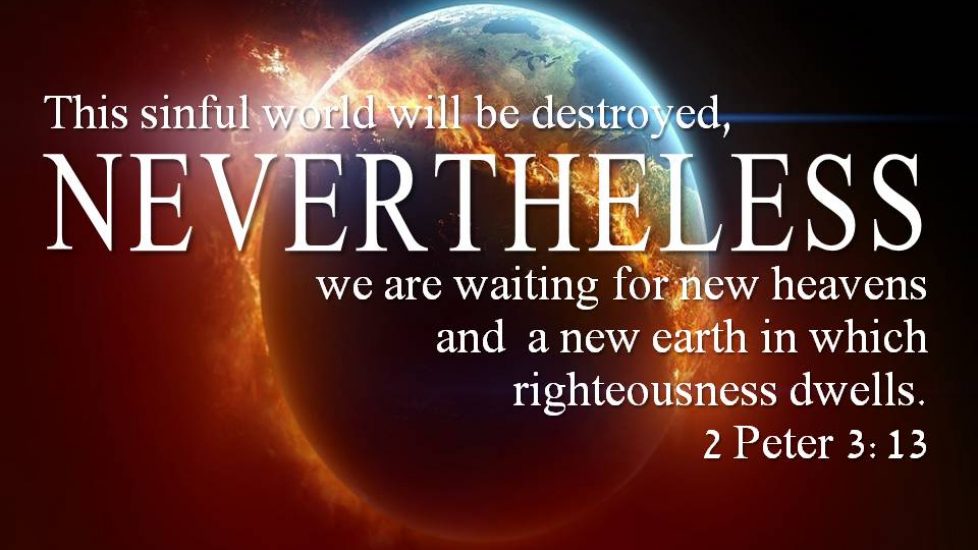
But the day of the Lord will come as a thief in the night, in which the heavens will pass away with a great noise, and the elements will melt with fervent heat; both the earth and the works that are in it will be burned up. Therefore, since all these things will be dissolved, what manner of persons ought you to be in holy conduct and godliness, looking for and hastening the coming of the day of God, because of which the heavens will be dissolved, being on fire, and the elements will melt with fervent heat? Nevertheless we, according to His promise, look for new heavens and a new earth in which righteousness dwells (2 Peter 3:10-13).
Listen, the apostle Peter is showing us that our hope for living in the present evil age is our certainty in the coming of the Lord and our eternal dwelling with Him. If we do not have a clear view of eternity, we have a hard time living for the Lord in this world.
Obviously, this passage gives us a perspective of things that most of the world around us do not believe. Most of the people around us, in fact, believe that—except perhaps for the trials we’ve been enduring most recently—the world is, right now, pretty much as it always has been. And they live as if the Lord Jesus will never come—as if things are going along as they always have, and as if there’s no day of judgment coming, and as if this world will never come to an end. But Peter begins with the strong affirmation that “the day of the Lord will come” (2 Pet. 3;10). “Will come” is first in the Greek text to emphasize that the Lord certainly will come (Thomas Schreiner, The New American Commentary, 1, 2 Peter, Jude [Broadman & Holman Publishers], p. 383). There is no doubt about it!
The theme of the “day of the Lord” is familiar from the Old Testament prophets. Sometimes it points to near historical judgments, whereas other times it looks ahead to a final great day of judgment. In both cases, it always uses frightening language of destruction. For example, Isaiah 13:9 warns, “Behold, the day of the LORD comes, Cruel, with both wrath and fierce anger, To lay the land desolate; And He will destroy its sinners from it.” (See, also, Jer. 46:10; Ezek. 13:5; 30:3; Joel 1:15; 2:1, 11, 31; 3:14; Amos 5:18, 20; Obad. 15; Zeph. 1:7, 14; Mal. 4:1, 5.) The New Testament repeats this theme (Acts 2:20; 1 Cor. 5:5; 2 Cor. 1:14; 1 Thess. 5:2; 2 Thess. 1:7-10; 2:2; Rev. 16:14). As I understand it, “the day of the Lord” in 2 Peter 3:10 is synonymous with the more unusual phrase, “the day of God,” in verse 12 (although MacArthur sees a distinction).
So the “day of the Lord” is not just one day (24 hours). It is another name for the final stages of God’s redemptive program for the ages. It involves the series of events that precede the return of the Lord Jesus Christ to this earth, and that includes His glorious thousand-year reign on earth after that return, and that culminates in the destruction of this present order of things and the creation of new heavens and a new earth.
Peter is not interested here in setting forth a detailed, chronological account of the end times, so that we can draw up prophecy charts. Rather, he is driving home one main point: This world and all that it treasures is going to burn. God is going to re-create a new heavens and new earth in which righteousness dwells. So, you need to make a basic choice: Do you want to live for everything that is certain to be destroyed, or do you want to live so that you will have an inheritance in that new heavens and earth?
Just think of what a remarkable passage this is! In it, God the Holy Spirit—through His servant Peter—graciously gives us a perspective of this world that we could not possibly have unless He revealed it to us. In it, God graciously lets us in on His plan for the future. He lets us know that this fallen order of creation is only temporary—that its present form will be demolished, and it will be replaced with a new heaven and a new earth in which righteousness dwells. And He lets us know that, by virtue of our being “in Christ” by faith, it’s our joyful destiny to live forever in that new heavens and new earth with Him!
And this truth is meant to affect our daily lives. Look at what he says in 2 Peter 3:11, “Therefore, since all these things will be dissolved, what manner of persons ought you to be …?” Knowing the truth about the coming day of the Lord should dramatically impact the way we currently live our Christian lives today.
So then; let’s look closer at Peter’s words, and examine this perspective in greater detail. You can break it down into three very applicable propositions. And the first is that …
1. This present creation is destined for destruction.
“But the day of the Lord will come as a thief in the night ….” Peter is repeating the words of Jesus (Matt. 24:42-44), who said, “therefore, for you do not know what hour your Lord is coming. 43 But know this, that if the master of the house had known what hour the thief would come, he would have watched and not allowed his house to be broken into. 44 Therefore you also be ready, for the Son of Man is coming at an hour you do not expect.” (See, also, 1 Thess. 5:2-3.)
Just as in the days prior to the flood, the people around Noah were going on about life with no thought of impending judgment, so it will be in the day when Jesus returns (Matt. 24:37-39). His coming is certain, it is sudden and unexpected by many, but it is not without warning.
What will the day of the Lord bring? Peter tells us, first of all, that “the heavens will pass away with a great noise”. Peter isn’t speaking here of “heaven” in the singular—which is the glorious abode of God. Rather, he’s speaking of “the heavens” in the plural. He is talking about the very sky above us, and the very reaches of space around us—and of all the created things that they contain!
The heavens were brought into existence by God (Gen. 1:1). They are, as Psalm 8:3 tells us, ‘the work of His fingers’. And they only continue to exist by the power of His providential hand. But one day, He will remove His hand; and with “a great noise”, the heavens will pass away. In 2 Peter 3:12, Peter said that, because of the coming of “the day of God”, these very heavens will be “dissolved” or be “destroyed”. Look up at the moon; and know that it’s only temporary. Look up on a clear night and see the stars; and know that they, too, are only temporary. Look up on a clear afternoon and see the sun shining in the sky; and know that even it is only temporary.
Second, Peter tells us that “the elements will melt with fervent heat”. The word that Peter uses here for “elements” means the basic fundamental principles of a thing. And though some translations of the Bible render this word “heavenly bodies”, it seems that, in this context, it refers to the foundational elements of the created universe.
Third, Peter even says that “both the earth and the works that are in it will be burned up”. In some translations such as the New International Version, it has it that the earth and its works will be “laid bare”; or as the English Standard Version has it, the earth and its works will be “exposed”. This reflects the fact that, in some ancient manuscripts, a different Greek word is being used. And if this is the correct word, then this would speak of the fact that, in that great day of the Lord, all things that are hidden in the works of men will be fully revealed. It would be the ultimate fulfillment of Hebrews 4:13; where it says, “And there is no creature hidden from His sight, but all things are naked and open to the eyes of Him to whom we must give account” (Hebrews 4:13). The idea would then be that those who thought that they could hide their sins from God will be exposed. No one, no matter how clever, will get away with anything.
But if the word that is translated “burned up” is the correct one—as in the NKJV—then this is saying something more like what we’re told in 1 Corinthians 3:11-15;
For no other foundation can anyone lay than that which is laid, which is Jesus Christ. Now if anyone builds on this foundation with gold, silver, precious stones, wood, hay, straw, each one’s work will become clear; for the Day will declare it, because it will be revealed by fire; and the fire will test each one’s work, of what sort it is. If anyone’s work which he has built on it endures, he will receive a reward. If anyone’s work is burned, he will suffer loss; but he himself will be saved, yet so as through fire (1 Corinthians 3:11-15).
And so, taken all together, Peter is telling us—through the inspiration of the Holy Spirit—that on the coming day of the Lord, the universe as it is now known to us will come to an end. All that exists of this created order will dissolve and pass away with a great noise and in fervent heat. We’re told that it will come “as a thief” upon the people of this world; that is, suddenly and unexpectedly—just when they think that they have this world structured and ordered in the way that they want it. As the apostle Paul writes in 1 Thessalonians 5:2-3;
For you yourselves know perfectly that the day of the Lord so comes as a thief in the night. For when they say, “Peace and safety!” then sudden destruction comes upon them, as labor pains upon a pregnant woman. And they shall not escape (1 Thessalonians 5:2-3).
And you and I cannot even begin to live as we should in this temporal world until we embrace that fact. Hope for living in this life can never be found in anything in this temporary created order. The past year has, to some degree, taught us that! Only what is ours in our Lord Jesus Christ will endure forever.
Now, all of this talk about the destruction of the present heavens and earth would indeed sound very gloomy if it weren’t for another important point that Peter makes …
2. A new heavens and new earth will take its place.
In the original language of 2 Peter 3:13, Peter puts the matter emphatically; “But new heavens and a new earth, according to the promise of God, we look for …” What a staggering thing this is to think about! We could not know about it unless God—our Creator—told us.
Will it be “new” in the sense of something completely unconnected to the old? Will it be that God will completely wipe away all traces of the fundamental elements of the first creation and make a new one, as it were, “from scratch”—utterly disconnected from the old creation? Some theologians have believed that this is so. They have suggested that, because of the fall of Adam, the whole of the created order has been completely ruined by the contamination of sin; and that it must now be done away with completely. But I don’t believe this is so. It seems to me that to believe such a thing would be to admit that the devil and sinful man succeeded in so spoiling that which God, at the very beginning, declared to be “very good” (Genesis 1:31); and that our mighty God is now incapable of restoring that which was ruined. “New”, in this case, doesn’t mean ‘completely new with no connection whatsoever to the old’.
A good analogy of what “new” would mean could be drawn from our Lord Jesus Himself. When He was born into the human family, He was made from the material of this present created order; being made in His humanity from the real substance of His mother Mary. And He lived in that same body of this created order throughout His life on this earth. When He died on the cross, He also died in that same body. And when He rose in glory, He rose in the same body in which He had died; only now glorified. He even bore, in His resurrected body, the prints of the nails in His hands (John 20:25-27). He ascended to the Father in the same resurrected body that had been crucified. And He sits even now at the right hand of the Father in heaven in the very same body that was connected to His pre-resurrection body—only now and forever glorified.
Jesus lives forever, in heavenly glory, in a body that is connected to the substance of this created order. But it is a body that has been ‘renewed’ in glory. It has real continuity to the material body that died on the cross; but it is completely ‘new’ in form and quality. It has been raised in glory. And it will be in that same body that our Lord will return to this earth on His “day”—a body composed of the same material substance taken from this created order of things; but that is eternally “renewed”. And in the same way, we are to look for new heavens and a new earth—not “new” in the sense of having no connection to the old whatsoever, but “new” in the sense of its material substance being gloriously “renewed”.
We could also consider our own salvation in Christ a good analogy of this. The Bible says that, “if anyone is in Christ, he is a new creation; old things have passed away; behold, all things have become new” (2 Corinthians 5:17). When you placed your trust in Jesus, God truly made you a new creation. But you were not made “new” in the sense that there was no connection whatsoever to the old ‘you’. You still have the same family. You still live in the same house. All your old clothes still fit. But the inward ‘you’ that ‘was’ has been ‘renewed’ into a brand new ‘you’—possessing real continuity with the “old”, but radically different in glory.
This is what the Bible tells us about our future hope of resurrection because of our salvation in Christ. Paul writes (1 Corinthians 15:42-44),
The body is sown in corruption, it is raised in incorruption. It is sown in dishonor, it is raised in glory. It is sown in weakness, it is raised in power. It is sown a natural body, it is raised a spiritual body.
It’s not with an entirely different body that we will be ‘raised’. It will be with the same body in terms of possessing a material relationship with the substance of this old created order. But it’s one that is dramatically different in form from what it was. The same body that is “sown” is also “raised” with real continuity with that which was “sown”, but as a wondrously glorified body that is made fit to live eternally in God’s presence.
And in the same sense, the “new” creation will have real, material continuity with the “old” one—but as a created order that is “new” in complete and glorious renewal. Seeing the “new heavens” and “the new earth” in this way helps us understand more clearly the amazing words that the apostle Paul wrote in Romans 8:19-22;
For the earnest expectation of the creation eagerly waits for the revealing of the sons of God. For the creation was subjected to futility, not willingly, but because of Him who subjected it in hope; because the creation itself also will be delivered from the bondage of corruption into the glorious liberty of the children of God. For we know that the whole creation groans and labors with birth pangs together until now (Romans 8:19-22).
It is this created order—the one in which we now live—that eagerly awaits and groans after its renewal. Right now, it suffers under things like pandemics, wildfires, civil unrest, corruption, death, and so many of the other things that have troubled us over the past year. And yet, the new order of things will be so gloriously different from its present, fallen condition that it will be as “new” heavens and a “new” earth! And just think of what a greater glory this brings to our mighty God! He doesn’t utterly scrap the old created order and make a new creation. He takes that which mankind, under the influence of the devil, has ruined in a point of time through sin, and “renews” it into a gloriously new created order!
As Peter tells us, this will be in accordance with God’s own promise. Back in Isaiah 65:17–some seven and a half centuries before Peter wrote these words–God spoke through the prophet Isaiah and said;
“For behold, I create new heavens and a new earth; and the former shall not be remembered or come to mind” (Isaiah 65:17).
The new will be so glorious that the old will not even come to remembrance.
Now; notice one of the great differences that will distinguish the new from the old. In 2 Peter 3:13, Peter tells us that we, according to God’s promise, look for new heavens and a new earth “in which righteousness dwells”. Righteousness does not characterize this present created order. Rather—as we all sadly know—what characterizes it is all of the terrible damage that sin has brought upon it, and the death that permeates it.
But listen to the glorious description we’re given—on the last few pages of the Bible—of our life in this wonderful “new” heavens and “new” earth:
Now I saw a new heaven and a new earth, for the first heaven and the first earth had passed away. Also there was no more sea. Then I, John, saw the holy city, New Jerusalem, coming down out of heaven from God, prepared as a bride adorned for her husband. And I heard a loud voice from heaven saying, “Behold, the tabernacle of God is with men, and He will dwell with them, and they shall be His people. God Himself will be with them and be their God. And God will wipe away every tear from their eyes; there shall be no more death, nor sorrow, nor crying. There shall be no more pain, for the former things have passed away.” Then He who sat on the throne said, “Behold, I make all things new.” And He said to me, “Write, for these words are true and faithful” (Revelation 21:1-5).
That’s our future in Jesus Christ. And though we live for a time in this present created order of things, we are to live in it with a perspective that is radically different from that of the unbelieving people around us. We know, from God’s own promise, that this created order is only temporary. Everything about it, and everything that we see in it—including the sin and death that sadly permeate it—is marked with the words “scheduled for demolition”. We don’t live for this world as it is now. We only live in it. We’re not held captive to the present order of things—things that are doomed to pass away. Instead, we live for God’s glorious renewal of this created order—and for our own renewal with it on His great day.
And that leads us to our last point—which is really the main point of this whole passage—that …
3. Because of the coming Day of the Lord, we ought to live holy lives .
As Peter says (2 Pet. 3:11-12a), “Therefore, since all these things will be dissolved, what manner of persons ought you to be in holy conduct and godliness, looking for and hastening the coming day of God …?” Peter is not asking a question. He’s making an exclamation! The word “conduct” means way of life, or lifestyle. Peter uses it often in his first letter. He writes (1 Pet. 1:15), “but as He who called you is holy, you also be holy in all your conduct.” In 1 Peter 2:12, he urges, “having your conduct honorable among the Gentiles, that when they speak against you as evildoers, they may, by your good works which they observe, glorify God in the day of visitation.” (See also, 1 Pet. 1:18; 3:1, 2, 16.) “The day of visitation” is the same as “the day of the Lord” or “the day of God.” It is the day of judgment, when we must give an account to God.
“Holy” conduct (2 Pet. 3:11) means conduct that is distinct from this evil world. We hold to the values that the Bible teaches us to live by. We live in light of eternity, not for all of the junk that’s going to burn. We value people above things. We treasure Christ above all else.
“Godliness” has the root idea of reverence and awe towards God. William Barclay (New Testament Words [Westminster Press], p. 107) says that it is “the attitude which gives God the place he ought to occupy in life and in thought and in devotion.” Peter used this word back in 2 Peter 1:3, where he said that God “has given to us all things that pertain to life and godliness.” He includes it in the list of qualities that he gives us in 2 Peter 1:5-7: moral excellence, knowledge, self-control, perseverance, godliness, brotherly kindness, and love.
In 2 Peter 3:11 holy conduct and godliness are both plurals. It may refer to repeated acts of holiness and godliness (Schreiner, p. 389), or it may mean that every part of our conduct towards God and man should be holy and godly (editor’s footnote in Calvin’s Commentaries [Baker], p. 421). In other words, we should live all of life in the presence of God, with reverence towards Him. Peter says we should be “looking for and hastening the coming of the day of God.” We should always be thinking of that day when we will stand before the Lord, and govern everything we do in light of it. As we live holy lives and take the gospel to the nations, it hastens Christ’s coming.
Peter goes on to write (2 Peter 3:14-15b):
Therefore, beloved, looking forward to these things, be diligent to be found by Him in peace, without spot and blameless; and consider that the longsuffering of our Lord is salvation ….
May Peter’s closing exhortation, then, sink deeply into our hearts. And may it transform the way we live in the coming year—and always.
In our study of the book of Genesis we are in the middle of the account of the great flood that God brought to destroy life on the earth because of the sinful corruption of the human race. It is a historical account of God’s judgment on sin; God’s grace toward Noah; the salvation God provides; and God’s faithfulness to His promises. Listen to our text for today (Genesis 8:1-22):
1 Then God remembered Noah, and every living thing, and all the animals that were with him in the ark. And God made a wind to pass over the earth, and the waters subsided. 2 The fountains of the deep and the windows of heaven were also stopped, and the rain from heaven was restrained. 3 And the waters receded continually from the earth. At the end of the hundred and fifty days the waters decreased.
4 Then the ark rested in the seventh month, the seventeenth day of the month, on the mountains of Ararat. 5 And the waters decreased continually until the tenth month. In the tenth month, on the first day of the month, the tops of the mountains were seen.
6 So it came to pass, at the end of forty days, that Noah opened the window of the ark which he had made. 7 Then he sent out a raven, which kept going to and fro until the waters had dried up from the earth. 8 He also sent out from himself a dove, to see if the waters had receded from the face of the ground. 9 But the dove found no resting place for the sole of her foot, and she returned into the ark to him, for the waters were on the face of the whole earth. So he put out his hand and took her, and drew her into the ark to himself. 10 And he waited yet another seven days, and again he sent the dove out from the ark. 11 Then the dove came to him in the evening, and behold, a freshly plucked olive leaf was in her mouth; and Noah knew that the waters had receded from the earth. 12 So he waited yet another seven days and sent out the dove, which did not return again to him anymore.
13 And it came to pass in the six hundred and first year, in the first month, the first day of the month, that the waters were dried up from the earth; and Noah removed the covering of the ark and looked, and indeed the surface of the ground was dry. 14 And in the second month, on the twenty-seventh day of the month, the earth was dried.
15 Then God spoke to Noah, saying, 16 “Go out of the ark, you and your wife, and your sons and your sons’ wives with you. 17 Bring out with you every living thing of all flesh that is with you: birds and cattle and every creeping thing that creeps on the earth, so that they may abound on the earth, and be fruitful and multiply on the earth.” 18 So Noah went out, and his sons and his wife and his sons’ wives with him. 19 Every animal, every creeping thing, every bird, and whatever creeps on the earth, according to their families, went out of the ark.
20 Then Noah built an altar to the LORD, and took of every clean animal and of every clean bird, and offered burnt offerings on the altar. 21 And the LORD smelled a soothing aroma. Then the LORD said in His heart, “I will never again curse the ground for man’s sake, although the imagination of man’s heart is evil from his youth; nor will I again destroy every living thing as I have done. 22 “While the earth remains, Seedtime and harvest, Cold and heat, Winter and summer, And day and night Shall not cease.”
First, I want you to learn something from the structure of our text. Moses skillfully wrote the Genesis flood account with exacting precision. Allen Ross points out that in literary terms Genesis 6:9-8:22 is a chiasmus. That is, the flood story divides into halves, with the second half being a mirror image of the first, but in reverse order. The first half describes God’s de-creation of the earth by the beginning and rising of the flood. The second half gives the re-creation of the earth by the receding of the floodwaters and drying of the land. Look at how Moses presents it:
After introducing Noah (Gen. 6:9-10) the narrative begins with (A) God resolving to destroy the corrupt human race (Gen. 6:11-13); the story ends with (A’) the Lord resolving not to destroy every living thing again (Gen. 8:21-22). Next, (B) Noah builds the ark according to God’s instructions (Gen. 6:14-22); in it’s counterpoint after the flood (B’) Noah builds an altar (Gen. 8:20). Third, (C) the Lord commands the remnant to enter the ark (Gen. 7:1-9); after the flood (C’) God commands the remnant to leave the ark (Gen. 8:15-19). Fourth, (D) the God opens the windows of heaven and it rains 40 days (Gen. 7:10-16); on the other side (D’) the earth dries and after 40 days Noah opened the window of the ark (Gen. 8:6-14). Finally, (E) the flood prevails 150 days and the mountains are covered (Gen. 7:17-24); but afterwards (E’) the flood recedes 150 days and the mountains are visible (Gen. 8:1b-5).
The center of this mirror-imaged structure is the opening line of Genesis 8, “Then God remembered Noah.” This is the focus of the whole flood narrative. God remembered Noah. Those three words tell us a great deal about the Lord. When the text tells us that God “remembered” Noah, it doesn’t mean that God had forgotten him. It’s not like God got busy with other things and Noah slipped from His mind for a while. Then, something reminded Him and God snapped His fingers and said, “Noah! I forgot all about him down there!”
Rather, in the Bible, when it says “God remembered” it means that God acted on His promises. It means that in the midst of the great flood, God stayed faithful to His promises. He promised to deliver Noah and his family and all those animals, and during the flood, with all its death and destruction, the Lord looked down on the earth, on Noah in the ark, and God acted to fulfill His promise.
When God destroyed the wicked cities of Sodom and Gomorrah, He “remembered Abraham” and “sent Lot out of the midst of the overthrow” (Gen. 19:29). When Rachel wanted to bear children, but could not, we read that “Then God remembered Rachel, and God listened to her and opened her womb” (Gen. 30:22). When Israel was in bondage in Egypt, we read, “So God heard their groaning, and God remembered His covenant with Abraham, with Isaac, and with Jacob” (Exod. 2:24). When Hannah prayed to have a child “the LORD remembered her” and she “bore a son, and called his name Samuel, saying, ‘Because I have asked for him from the LORD’” (1 Sam 1:19-20). When Mary conceived Jesus by the Holy Spirit, she praised God because “He has helped His servant Israel, In remembrance of His mercy” (Luke 1:54). The penitent thief on the cross asked, “Lord, remember me when You come into Your kingdom” (Luke 23:42); Jesus said, “Assuredly, I say to you, today you will be with Me in Paradise” (Luke 23:43). In every case, the idea is the same: God remembers by being faithful to act on His promises.
How did God faithfully act on His promises here in Genesis 8? How did the Lord remember Noah during the flood?
I. God Remembered Noah
James Montgomery Boice points out three ways in which the Lord remembered Noah during the flood.
A. God sent a wind.
Genesis 8:1 says “Then God remembered Noah, and every living thing, and all the animals that were with him in the ark. And God made a wind to pass over the earth, and the waters subsided.” As God controlled the rain to bring the flood, so God controls the wind to dry the earth. As the Spirit of God hovered over the waters of the deep in Genesis 1, God made a “wind” (same Hebrew word as “spirit”) to pass over the waters of the flood. God is beginning the re-creation of the earth. God remembers, God acts, and the water level began to decrease. Genesis 8:2 says, “The fountains of the deep and the windows of heaven were also stopped, and the rain from heaven was restrained.” Psalm 104:9 says about the waters, “You have set a boundary that they may not pass over, That they may not return to cover the earth.” Every drop of water, every gust of wind, and every icy snowflake comes from the hands of God. Even hurricanes and tornadoes serve His purposes. The storms that batter the earth are fully under His divine control. God turned off the faucet, the heavens dried up, and the water began to evaporate from the surface of the earth because God remembered Noah.
It is significant that the flood waters did not disappear in a day. Genesis 8:3 says, “And the waters receded continually from the earth. At the end of the hundred and fifty days the waters decreased.” Although the judgment of the flood came suddenly, the waters rose slowly and fell slowly. Listen, just because we don’t always see God act quickly (maybe not as quick as we want), it doesn’t mean that God has forgotten. The Lord remembers. God is faithful. He keeps His promises.
So Moses reports in Genesis 8:4, “Then the ark rested in the seventh month, the seventeenth day of the month, on the mountains of Ararat.” Seven months after the rain began to fall the ark came to rest. The waters were still receding, but they had lowered to the point where the ark was sitting on the sea floor on the mountains of Ararat. Finally, Genesis 8:5 tells us, “And the waters decreased continually until the tenth month. In the tenth month, on the first day of the month, the tops of the mountains were seen.” God made the dry land appear as He had done in the Genesis 1 creation. God is re-creating the earth.
So we see that God remembered Noah by sending a wind to dry the land. Also God remembered Noah when,
B. God gave Noah a sign.
Genesis 8:6 says, “So it came to pass, at the end of forty days, that Noah opened the window of the ark which he had made.” Noah was looking for signs that the flood was coming to an end. Noah, his family, and the animals had been on that ark, shut up in that big wooden box for almost a year. I’m sure they are all ready to disembark. But Noah needs confirmation that the earth is ready to sustain life again.
“Then he sent out a raven” (Gen. 8:7). Since the raven is a scavenger bird, it no doubt found plenty of rotting flesh to eat on the surface of the ocean and the muddy hilltops. It “kept going to and fro until the waters had dried up from the earth.” That is, it did not return to the ark. The raven was a sign that there was death. But Noah is looking for signs of life.
So, Noah tries again (Gen. 8:8), “He also sent out from himself a dove, to see if the waters had receded from the face of the ground.” But the waters had not yet gone down enough (Gen. 8:9), “But the dove found no resting place for the sole of her foot, and she returned into the ark to him, for the waters were on the face of the whole earth. So he put out his hand and took her, and drew her into the ark to himself.” Noah tries again a week later (Gen. 8:10), “And he waited yet another seven days, and again he sent the dove out from the ark.” This second time the dove brings back a sign of life (Gen. 8:11), “Then the dove came to him in the evening, and behold, a freshly plucked olive leaf was in her mouth; and Noah knew that the waters had receded from the earth.” Plants and trees were beginning to grow. Again, a week later Noah does the same (Gen. 8:12), “So he waited yet another seven days and sent out the dove, which did not return again to him anymore.” The dove must have found plants or seeds to eat and a place to nest. Noah knew then that the end of the flood must be very near.
But why did Noah send the birds in the first place? The answer is simple and perhaps easy to overlook. God had told him when the flood would start but not when it would end. God had spoken to Noah with instructions for building the ark (Gen. 6:13) and He spoke to Noah to tell him to enter the ark (Gen. 7:1). But now it is a year later and we have no record of God speaking to Noah all that time on the ark. God has certainly been faithful in acting on behalf of Noah. By God’s providence the ark and those in it survived the flood. God kept them alive as He had promised to do. But as far as we know, God has been silent.
Listen, the ark was no pleasure cruise. It was salvation for those in the ark, but it was also a trial. It could not have been an easy time for Noah. When we are going through our own trials, we usually want to know: “When will this end?” And the answer is always: “In God’s time, not one day sooner, not one day later.” Nothing can rush, change, or hinder God’s designs for His children. In our doubt and confusion, we can rest on this truth: God can make the dry ground appear when He chooses.
And just as God gave Noah a sign of life, a sign of a future, He still gives signs of His grace today. Often it is a scripture or a song repeated at just the right moment. It might be a phone call or a letter of encouragement from another saint. God reminds us that we are never alone, never forgotten—signs of life in this dark world.
God fulfilled His promise to keep Noah and those with him on the ark alive. Genesis 8:13 confirms it, “And it came to pass in the six hundred and first year, in the first month, the first day of the month, that the waters were dried up from the earth; and Noah removed the covering of the ark and looked, and indeed the surface of the ground was dry.” What a great birthday present for Noah! He opens the ark’s cover and sees the dry ground. But Noah is not in a hurry. He waits for the command of God. He waits on the Lord for another eight weeks.
God remembered Noah by sending the wind, through the sign of the doves, and then,
C. God spoke to Noah again.
So, Genesis 8:14 says, “And in the second month, on the twenty-seventh day of the month, the earth was dried.” It’s been a year and 10 days since the flood began—over a year since we heard God speak to Noah. What was it like for Noah during that long silent year inside the ark drifting aimlessly on the waters and waiting for the land to dry?
What do you do in the waiting time? You do what Noah did. As Noah watched and waited, he went about his duties. Day after day, Noah had to get up and take care of his responsibilities on the ark. It did not matter if he “felt” like it or not. God had given him a job to do and it must be done. He knew that God had led him this far, and he believed the word of the Lord. While he waited for the Lord to speak again, he did the only thing we could do. He remained faithful. Wait on the Lord. And while you wait, obey as much as you know.
But God is not late. He is always right on time. In Genesis 8:15-17 God speaks to Noah again:
15 Then God spoke to Noah, saying, 16 “Go out of the ark, you and your wife, and your sons and your sons’ wives with you. 17 Bring out with you every living thing of all flesh that is with you: birds and cattle and every creeping thing that creeps on the earth, so that they may abound on the earth, and be fruitful and multiply on the earth.”
The long wait is over. God has been faithful to His promise. God remembered Noah. God spoke again and Noah obeys. God repeats His blessing on this new creation as He had on the original creation, “be fruitful and multiply on the earth.” These words are meant to remind us of Genesis 1. God has re-created the earth and blesses His creation to “abound on the earth.” Why? God remembered Noah. The Lord acted to fulfill His promises.
So first we see God’s remembrance of Noah; we also see Noah’s remembrance of God. Since God in faithfulness remembered Noah,
II. Noah Remembers God
Although Genesis 8 is primarily about God remembering Noah, it also contains wonderful truth about how Noah remembered God. How? By obedience to God’s word and by sacrificial worship. First,
A. Noah left the Ark
Genesis 8:18-19, “18 So Noah went out, and his sons and his wife and his sons’ wives with him. 19 Every animal, every creeping thing, every bird, and whatever creeps on the earth, according to their families, went out of the ark.” Think about how much courage it took for Noah to leave the ark. Even though the ark had been crowded and no doubt somewhat smelly, it had been safe. Now they were leaving the known for the unknown. The world they had known was gone forever. Cities gone, roads gone, homes gone, people gone. Geography changed, landmarks all different. Nothing looked the same. Everything was new. Noah was trusting God for a totally unknown future.
We remember the Lord by acting in faith. Faith means taking the next step … and then trusting God with the results. Are you trusting God for your future? Are you willing to take that next step in obedience to Him?
Noah remembered God by leaving the ark in obedience to God’s word. How else did Noah show he remembered the Lord?
B. Noah built an Altar
Genesis 8:20 says, “Then Noah built an altar to the LORD, and took of every clean animal and of every clean bird, and offered burnt offerings on the altar.” God tells Noah to leave the ark; he leaves the ark; and the first thing he does after stepping on dry ground is to build an altar to the Lord. His first act was to publicly thank God for his deliverance.
God’s response to Noah’s offering was one of grace (Gen. 8:21-22), “21 And the LORD smelled a soothing aroma. Then the LORD said in His heart, “I will never again curse the ground for man’s sake, although the imagination of man’s heart is evil from his youth; nor will I again destroy every living thing as I have done. 22 While the earth remains, Seedtime and harvest, Cold and heat, Winter and summer, And day and night Shall not cease.”” Though the sinful nature of mankind has not changed, God in His grace promises not to again curse the ground or destroy every living thing. God responded to Noah’s sacrifice with grace to humanity.
Noah recognized that he owed everything to the Lord. It was God who warned him, God who told him to build the ark, God who designed the ark, God who called the animals to the ark two by two, God who shut the door, God who preserved the ark through the flood, God who brought the ark to a safe place, and it was God who told Noah when it was safe to leave the ark. God did it all!
This is an Old Testament picture of salvation by grace. Noah takes no credit. Instead, by his offering he signifies that God has delivered him and his family. His offering is a way of saying, “By rights I should have perished in that flood but God in his mercy delivered me.”
Noah’s sacrifice showed that he still must approach God through shed blood. Noah wasn’t presuming on some new privileged relationship with God since he had survived the flood. He still knew himself to be a sinner, and he offered sacrifices as the only way he could approach a holy God. Noah’s sacrifice was an expression of gratitude for God’s salvation.
In the same way, God wants us to remember Him by coming to Him through the shed blood of Jesus Christ. One of the ways God has ordained for us to do that is through the Lord’s Supper. Jesus said, “do this in remembrance of Me” (Luke 22:19). In that ordinance, we reflect on His salvation for us in the past; on the present provision He has given us for life and godliness; and on His promised coming and the future salvation we will enjoy. Next week we will remember the Lord in this way and give thanks for His salvation. Plan and prepare to share in the Lord’s Supper with us next Sunday.
God has remembered you by saving you from sin through the death and resurrection of His Son Jesus Christ. So, let this be your resolve: I will remember the Lord who saved me. I will take time to give thanks. I will build an altar where I will meet the Lord every day. I will pray. I will serve His church. I will give offerings to the Lord. I will speak up for Jesus. I will bless the name of the Lord.
Remember the God who remembers you. He will be your joy and comfort in this life and in the life to come. Amen.
As Pastor Luis has shown us, Revelation is vision of the majesty of a sovereign God in complete control of His creation. It highlights the glory of the Lord Jesus Christ and His eternal kingdom. From an earthly perspective, it might seem like the enemies of the kingdom of God are winning. As you read through Revelation you find that Christians are being persecuted, imprisoned, and martyred. Tragedy and trial and turmoil are rampant and the Great Dragon (Satan), the Beast, and the False Prophet appear to have the upper hand. But John’s vision reveals that appearances can be deceiving! The course of history is not determined by political intrigue or military might, but by the sovereign God of scripture. What John discovered is that there are two worlds, two dimensions of reality. One is earthly and visible, the other is heavenly and invisible. These two realms are intricately connected because they are both controlled by the Lord.
Remember that Revelation 2-3 look at letters from the Lord Jesus Christ to seven churches here on earth. These are seven real churches that also represent the whole of the church during this church age. Revelation 6 then begins to describe the final judgment of God as He pours out His wrath on the unbelieving world prior to the second coming of our Lord Jesus Christ. What happens in between the letters to the churches and the description of God’s judgment? Revelation 4 and 5.
These chapters take place in heaven. Revelation 4:1 says, “After these things I looked, and behold, a door standing open in heaven. And the first voice which I heard was like a trumpet speaking with me, saying, ‘Come up here, and I will show you things which must take place after this.’” The events of Revelation 4-5 take place around the throne of God. John writes in Revelation 4:2, “Immediately I was in the Spirit; and behold, a throne set in heaven, and One sat on the throne.” The throne is the focus of these two chapters. The word “throne” appears 17 times in chapters 4-5 and 38 times in the entire book of Revelation. The throne is at the center and everything else is “around” (kuklothen and its derivatives, Rev. 4:3,4,6,8; 5:11; 7:11) the throne. John thus describes the throne of God as the focus of a series of concentric circles made up of first a rainbow (Rev. 4:3), then a circle of the four living creatures (Rev. 4:6), then a circle of the twenty-four thrones upon which the twenty-four elders sit (Rev. 4:4). According to Revelation 5:11 (and again in 7:11), a great host of angels also encircled the throne.
John’s description of God on the throne conveys His majesty, glory and holiness (Rev. 4:3), “And He who sat there was like a jasper and a sardius stone in appearance; and there was a rainbow around the throne, in appearance like an emerald.” Then Revelation 4:5 gives us a picture of God’s power and wisdom, “And from the throne proceeded lightnings, thunderings, and voices. Seven lamps of fire were burning before the throne, which are the seven Spirits of God.” The whole scene shouts the truth that God reigns.
The atmosphere of John’s experience is one of mystery and wonder. We have a glimpse of heaven and the heavenly worship given to God the Father and the Lord Jesus Christ. We see God in a resplendent blaze of unapproachable light, the jewels refracting the glory and majesty of His luminous beauty. Here is where all worship begins: in the throne room of heaven where God reigns supreme! When we see God as He is, sovereign over all, we will worship Him as we should.
Now back to Revelation 4:4. John’s vision moves out from the center focus of the throne of God to what surrounds it (Rev. 4:4), “Around the throne were twenty-four thrones, and on the thrones I saw twenty-four elders sitting, clothed in white robes; and they had crowns of gold on their heads.” The twenty-four elders play an important role in the heavenly worship of God and are described in the following ways:
(1) They wear white garments and golden crowns (Rev. 4:4).
(2) They prostrate themselves before God in worship (Rev. 4:10; 5:14; 11:16; 19:4) and cast before him their golden crowns (Rev. 4:10).
(3) They sing hymns of praise to God (Rev. 4:11; 5:9–10; 11:17–18).
(4) They have harps and bowls full of incense that are said to represent the prayers of the saints (Rev. 5:8).
(5) Individual elders make comments to John (Rev. 5:5; 7:13), and on one occasion an elder functions as an interpreter for John, describing the significance of the innumerable multitude.
(6) While the twenty-four elders play a central role in Rev. 4–5 (where they are mentioned seven times), they are peripheral in the throne scenes in the rest of the book (Rev. 7:11, 13; 11:16; 14:3; 19:4).
There are several views as to their identity. I will briefly mention four.
(1) Some see in them an exalted angelic order, like the cherubim and seraphim. Some grounds for this view are: Like angels, the elders mediate the prayers of the saints to God (Rev. 5:8); They also interprete for John the meaning of the heavenly visions (Rev. 5:5; 7:13), another standard angelic function in Revelation; John describes them in Rev. 4:9-10; 5:8,14; 7:11; and 19:4 as joining with the four living creatures and the rest of the angelic host in typical angelic activity.
(2) Some believe these are Old Testament saints. They point out that the 24 Elders are distinguished as a separate group from the angels. Also, nowhere else in the Bible (outside Revelation) are angels called “elders”. Furthermore, in Revelation angels never wear crowns or white clothing or sit on thrones, but such descriptions are predicated only of saints who are in heaven (Rev. 7:13-15; 19:7-8,14) or of the saints’ reward after death, as a result of their perseverance (Rev. 2:10; 3:4-5; 3:21; 20:4). In the Old Testament David organized the temple servants into twenty-four orders of priests (1 Chron. 24:3-19), twenty-four Levitical gatekeepers (1 Chron. 26:17-19), and twenty-four orders of Levites commissioned to prophesy, give thanks, praise God, and sing to the accompaniment of harps and lyres and cymbals (1 Chron. 25:6-31). Hebrews 11:2 calls the faithful Old Testament saints presbuteroi “elders”.
(3) Another possibility is that they are exalted NT saints. The resurrection of the righteous will be to a form similar to angels (Luke 20:35-36, “But those who are counted worthy to attain that age, and the resurrection from the dead, neither marry nor are given in marriage; nor can they die anymore, for they are equal to the angels and are sons of God, being sons of the resurrection.” Thrones are sometimes used as a metaphor for the heavenly reward of the righteous.
(4) A fourth view is a combination of the last two; that they are representatives of the entire community of the redeemed from both testaments. It is difficult not to see in the number 24 a reference to the 12 tribes of Israel and the 12 apostles of the NT church (they are associated again in Rev. 21:12-14).
The 24 courses of priest in the Old Testament finds its fulfillment in the saints of God in Christ. Revelation 1:6 says that Jesus Christ “has made us kings and priests to His God and Father.” So the 24 elders are a picture of a holy priesthood. And it’s also a holy kingship (Rev. 4:4), “Around the throne were twenty-four thrones, and on the thrones I saw twenty-four elders sitting, clothed in white robes; and they had crowns of gold on their heads.” They are a royal priesthood. That is what Peter calls us (1 Pet. 2:9), “But you are a chosen generation, a royal priesthood, a holy nation, His own special people, that you may proclaim the praises of Him who called you out of darkness into His marvelous light.” It’s a picture of you in heaven. These 24 elders represent the entire body of Christ.
“Sitting”, they are sitting because the work of redemption is finished. As Paul looked forward to (2 Tom. 4:7) they have “fought the good fight, … have finished the race, … have kept the faith.” So Paul says (2 Tim 4:8), “… there is laid up for me the crown of righteousness, which the Lord, the righteous Judge, will give to me on that Day, and not to me only but also to all who have loved His appearing.” They are clothed in white garments; they are clean. Golden crowns on their heads; they’re royal.
And notice what they do in Revelation 4:10, “the twenty-four elders fall down before Him who sits on the throne and worship Him who lives forever and ever, and cast their crowns before the throne.”
We finally get our humility down as we worship before the throne. It’s an act of submission, of reverence, of humility. It’s an acknowledgment that “God I am only here because of You.” On that day our selfish, sinful pride will be gone and we will have our humility together.
And we will know and believe the word of God from the very beginning—starting in Genesis. Notice Revelation 4:11, saying:
“You are worthy, O Lord,
To receive glory and honor and power;
For You created all things,
And by Your will they exist and were created.”
There will be no doubt about the word of God. We will finally believe every word of God is true from the account of creation forward. No more atheistic evolution; no more humanistic promotion. We see the truth of God is it really is. This is God’s eternal discipleship plan come to fulfillment.
Then look at Revelation 5:1. John writes, “And I saw in the right hand of Him who sat on the throne a scroll written inside and on the back, sealed with seven seals.” As Pastor Luis showed, this scroll represents God’s redemptive plan and righteous judgment. The scroll contains the content, course, and consummation of history, how things will end for both Christian and non-Christian. When the seals are broken we see the contents of the scroll immediately transpire in Revelation 6 through the end of the book.
The scroll is meant to be opened and read. Revelation 5:2 says, “Then I saw a strong angel proclaiming with a loud voice, “Who is worthy to open the scroll and to loose its seals?” The problem comes in Revelation 5:3, “And no one in heaven or on the earth or under the earth was able to open the scroll, or to look at it.” John’s reaction to this predicament is sorrow (Rev. 5:4), “So I wept much, because no one was found worthy to open and read the scroll, or to look at it.” John weeps because he knows that the scroll has to be opened for history to come to its consummation for the glory of God—and no one is found worthy.
Now look at who answers John. Revelation 5:5, “But one of the elders said to me, “Do not weep. Behold, the Lion of the tribe of Judah, the Root of David, has prevailed to open the scroll and to loose its seven seals.”” It is one of the elders, one of the 24 who represent the whole of believers in Christ. Look at who finally get their view of sovereignty together. We finally know the truth only God is sovereign and only the Lord Jesus Christ is worthy to control history and bring all things to consummation for the glory of God.
Revelation 5:6-7 show us the picture of Jesus Christ, the Lion of the tribe of Judah, the one who is worthy:
6 And I looked, and behold, in the midst of the throne and of the four living creatures, and in the midst of the elders, stood a Lamb as though it had been slain, having seven horns and seven eyes, which are the seven Spirits of God sent out into all the earth. 7 Then He came and took the scroll out of the right hand of Him who sat on the throne.
Then notice what else the elders do in Revelation 5:8, “Now when He had taken the scroll, the four living creatures and the twenty-four elders fell down before the Lamb, each having a harp, and golden bowls full of incense, which are the prayers of the saints.” They fell down before the Lamb. We are finally going to get our worship right. We are going to fall down in the presence of Christ. And each one has a harp. We are going to sing and present musical worship to God in perfection. We are going to have a magnificent chorus to give worthy worship to Him who is worthy of worship.
And we’re finally going to get our prayer life together. They had, “golden bowls full of incense, which are the prayers of the saints.” We’re finally going to pray as we were always meant to pray. It will come before God’s throne as sweet smelling incense, pleasing to God.
And notice in Revelation 5:9 we are finally going to get our doctrine of the atonement down, “And they sang a new song, saying: “You are worthy to take the scroll, And to open its seals; For You were slain, And have redeemed us to God by Your blood Out of every tribe and tongue and people and nation.”” So we finally get down a correct understanding of the cross and of salvation. Revelation 5:10 goes on, “And have made us kings and priests to our God; And we shall reign on the earth.” There is no bad doctrine in glory. And also we are going to get our doctrine of prophecy down, “And we shall reign on the earth.” We will come back to reign with Christ in the millennium.
So, do you see what happens when the church is in the presence of God and sees Him on His throne as He is? God completes us so that we get it right: our theology, bibliology, Christology, pneumatology, soteriology, anthropology, ecclesiology, eschatology. We truly worship because we know the truth. We are sitting and kneeling before the one true teacher, our Lord Jesus Christ. We are in the presence of the seven-fold Holy Spirit of God. We see God on His throne. This is worship in spirit and in truth.
Some day we will worship perfectly, worthily, for God’s glory. But listen. This book is meant to be instruction for us now as well. John intends for us to understand the scene in Revelation 4-5 as a heavenly pattern according to which worship in the church is to be patterned. That’s why Pastor Luis repeats to us: “Doctrine matters.” When we get our doctrine right; when we believe the word of God; when we see God for who He is; when we get a full view of the glorified Christ—that is when we get our worship right.
In our study of Genesis we have completed the first six chapters. We’ve seen God’s work of creation recorded in Genesis 1. We’ve seen God’s special favor towards man in Genesis 2. We’ve seen the most tragic moment in human history in Genesis 3, when sin came into the world through one man, and thus death through sin. In Genesis 4 we saw in the story of Cain and Abel a contrast between sin and grace in the human family. In Genesis 5 we saw death reign even in the godly line from Seth. In Genesis 6 we saw the culmination of sin in the world prior to the flood. The book of Noah began in Genesis 6:9, where last time we saw a picture of God’s judgment and grace on the last generation in the old Adamic world. We saw the righteousness of Noah; the corruption of men on the earth; and God’s plans to destroy the world with a flood but to save Noah and his family on the ark.
Today in Genesis 7 we come to the account of the flood itself. Let’s hear God’s holy and inspired word beginning in Genesis 7:1,
1 Then the LORD said to Noah, “Come into the ark, you and all your household, because I have seen that you are righteous before Me in this generation. 2 You shall take with you seven each of every clean animal, a male and his female; two each of animals that are unclean, a male and his female; 3 also seven each of birds of the air, male and female, to keep the species alive on the face of all the earth. 4 For after seven more days I will cause it to rain on the earth forty days and forty nights, and I will destroy from the face of the earth all living things that I have made.”
5 And Noah did according to all that the LORD commanded him. 6 Noah was six hundred years old when the floodwaters were on the earth. 7 So Noah, with his sons, his wife, and his sons’ wives, went into the ark because of the waters of the flood. 8 Of clean animals, of animals that are unclean, of birds, and of everything that creeps on the earth, 9 two by two they went into the ark to Noah, male and female, as God had commanded Noah. 10 And it came to pass after seven days that the waters of the flood were on the earth.
11 In the six hundredth year of Noah’s life, in the second month, the seventeenth day of the month, on that day all the fountains of the great deep were broken up, and the windows of heaven were opened. 12 And the rain was on the earth forty days and forty nights.
13 On the very same day Noah and Noah’s sons, Shem, Ham, and Japheth, and Noah’s wife and the three wives of his sons with them, entered the ark– 14 they and every beast after its kind, all cattle after their kind, every creeping thing that creeps on the earth after its kind, and every bird after its kind, every bird of every sort. 15 And they went into the ark to Noah, two by two, of all flesh in which is the breath of life. 16 So those that entered, male and female of all flesh, went in as God had commanded him; and the LORD shut him in.
17 Now the flood was on the earth forty days. The waters increased and lifted up the ark, and it rose high above the earth. 18 The waters prevailed and greatly increased on the earth, and the ark moved about on the surface of the waters. 19 And the waters prevailed exceedingly on the earth, and all the high hills under the whole heaven were covered. 20 The waters prevailed fifteen cubits upward, and the mountains were covered.
21 And all flesh died that moved on the earth: birds and cattle and beasts and every creeping thing that creeps on the earth, and every man. 22 All in whose nostrils was the breath of the spirit of life, all that was on the dry land, died. 23 So He destroyed all living things which were on the face of the ground: both man and cattle, creeping thing and bird of the air. They were destroyed from the earth. Only Noah and those who were with him in the ark remained alive. 24 And the waters prevailed on the earth one hundred and fifty days.
First I want to stress three things about my approach to the flood account. I am not going to approach the flood from a scientific or phenomenological viewpoint. The Genesis text is not about geology, meteorology, or paleontology. I am wary of the certitudes of atheistic science that purport to tell how things have always been and must be. I am also wary of the certitudes of creation scientists who use the same methods as scientific naturalism to make their case. I simply want to understand what the biblical text clearly teaches.
Having said that, I believe the text clearly indicates that the great flood of Noah’s time was:
Historical. The text clearly presents this event as an historical record not a legend, an allegory or a fairy tale. Moses marks the date of the flood according to the age of Noah to the year, month and day (Gen. 7:11). Derek Kidner states, this “has the mark of a plain fact well remembered; and this is borne out by the further careful notes of time in the story” (Genesis [IVP], p. 90). Also, the New Testament clearly interprets the flood as historical. Both the Lord Jesus and the apostle Peter refer to it as an example of the way people in the end times will scoff at God’s judgment (2 Pet. 2:5; 3:3-10; Matt. 24:37-39; Luke 17:26-27). Second the flood was,
Universal. Genesis also portrays this flood as worldwide in scope. Many have tried to explain the flood in Genesis as just a big local flood in the Mesopotamian valley. Most often scholars have taken this view not because the Genesis text demands its, but in order to reconcile the text with their view of other historical or scientific theories. But Genesis text doesn’t seem to allow for a just smaller-scale flood. The language in the text could not be stronger in describing a flood of universal proportions. You will notice that the word “all” is used 32 times in Gen. 6-9 (NKJV) and “every” 33 times. For instance, Genesis 7:21 says, “And all flesh died that moved on the earth: birds and cattle and beasts and every creeping thing that creeps on the earth, and every man.” While I agree that the words “all” and “every” are sometimes used in a relative sense in the Bible, Genesis 7 uses deliberately strong, repetitive language to describe the extent of the flood (Gen. 6:7,17; 7:4; 8:9,21; 9:11,15). We know that God’s purpose in sending the flood was to “to destroy from under heaven all flesh in which is the breath of life” (Gen. 6:17). That must include everything that breathes, especially all of mankind who had corrupted themselves on the earth (Gen. 6:12).
In Genesis 7:2-3 the Lord tells Noah to take some of every kind of animal onto the ark, “to keep the species alive on the face of all the earth.” That would not seem necessary if this were just a local flood of the Mesopotamian valley. The massive size of the ark that we saw in Genesis 6:15 would not be necessary either if it was not meant to carry the large population of earth’s creatures.
The depth of the flood shows its extent (“15 cubits…the mountains were covered” Gen. 7:19-20). The duration of the flood indicates a huge flood (“the waters prevailed on the earth 150 days,” Gen. 7:24; it took months for the land to dry, Gen. 8:13). All told, it was just over a year before it was safe for Noah and those on the ark to disembark (Gen. 8:14-15). It seems unlikely that even a great local flood would require that much time for the water to subside.
God’s promise not to destroy the earth (or land) in this manner again (Gen. 8:21-22; 9:15-16) would not be true if the flood was merely local, because there have been many severe local floods in history that have brought widespread destruction. Genesis 9:19 and 10:32 state that the whole earth was repopulated from Noah’s three sons, the only humans left on earth. So the biblical evidence that the flood was universal is overwhelming. The flood was both historical and universal. Third, the flood was,
Sudden but forewarned. God alerted Noah about the coming flood a hundred years before it happened. 2 Peter 2:5 calls Noah “a preacher of righteousness.” Hebrews 11:7 says he “condemned the world.” Noah must have warned people of the judgment of God. The righteous Enoch named his son Methuselah, which means, “when he is dead, it will come.” What? The judgment will come. As a testimony of God’s grace and patience, Methuselah lived 969 years, more than any other person in the Bible. Finally, he died in the year of the flood. But the world of people in Noah’s day ignored God’s warnings.
Why are these three things important? There’re important because the flood is the one great historical example of God’s future judgment on the whole earth. The scripture is clear that God will judge the world again some day in the future. Like Noah’s flood, it too will be an historical event. Paul says that God “has appointed a day on which He will judge the world in righteousness by the Man whom He has ordained. He has given assurance of this to all by raising Him from the dead” (Acts 17:31). The future judgment is as certain and historical as the resurrection of Jesus Christ from the dead! The future judgment will also be universal, Paul writes, “For we shall all stand before the judgment seat of Christ” (Rom. 14:10; 2 Cor. 5:10). It will be sudden, but not without warning. Peter writes (2 Pet. 3:10), “But the day of the Lord will come as a thief in the night, in which the heavens will pass away with a great noise, and the elements will melt with fervent heat; both the earth and the works that are in it will be burned up.” The Bible is full of warnings about the final judgment and the events leading up to it.
So studying the Genesis flood helps us to understand the future judgment of God on the earth, to be forewarned and prepared for it. Now back to our text in Genesis 7. In this chapter two things are described. One, the entry of Noah, his family and the animals into the ark. And two, the arrival of the great and worldwide flood. These two things are described over and over again in this passage, considered from different vantage points and with increasing detail. We have already seen how God gave Noah instructions about constructing the ark and filling it in Genesis 6. As Genesis 6:22 said, “Thus Noah did; according to all that God commanded him, so he did.” It is now 100 years later. The ark has been built. The food has been stored. The time has come. So, in Genesis 7:1 God speaks a second time to Noah.
1. The Lord sees the righteousness of Noah (Gen. 7:1-5)
1 Then the LORD said to Noah, “Come into the ark, you and all your household, because I have seen that you are righteous before Me in this generation. 2 You shall take with you seven each of every clean animal, a male and his female; two each of animals that are unclean, a male and his female; 3 also seven each of birds of the air, male and female, to keep the species alive on the face of all the earth. 4 For after seven more days I will cause it to rain on the earth forty days and forty nights, and I will destroy from the face of the earth all living things that I have made.”
Here we have the final countdown to the flood. The Lord gives His invitation to Noah to “Come into the ark, you and all your household” seven days before the flood comes. As we saw in Genesis 6, the thing that stands out here is the righteousness of Noah. The Lord says to Noah (Gen. 7:1), “Come into the ark, you and all your household, because I have seen that you are righteous before Me in this generation.” We saw in Genesis 6 that Noah was righteous before God (Gen. 6:9) because of God’s grace (Gen. 6:8). Hebrews 11:7 showed that Noah was righteous because he believed. But he also lived a righteous and holy life. Noah’s actions proved his faith. Noah’s household was spared on account of Noah’s singular righteousness.
In verses 2 and 3 we see that Noah was also commanded to take the animals into the ark with him. We already knew from God’s instruction in Genesis 6 that Noah was to take a pair of every kind of animal, but here God gives more specific instructions. Noah was to bring a pair of every unclean animal, and a seven of every clean animal. “Clean” and “unclean” does not mean dirty and less dirty, but rather it has to do with ceremonial purity. If you know the scriptures well, you know that later in the Law of Moses a distinction is made between things that are “clean” and “unclean”. You can read about it for yourself in the book of Leviticus, particularly chapter 11. That book is filled with the language of “clean” and “unclean”.
After the flood, Noah will build an altar and offer the clean animals and clean birds to the Lord. By emphasizing the “clean” and “unclean” animals Moses is showing the connection between Noah and God’s people Israel. God’s lays out a pattern that will be repeated. They were to be a holy people who worship the Lord.
Genesis 7:4-5 again show us the purpose of the flood and the obedient faith of Noah, “For after seven more days I will cause it to rain on the earth forty days and forty nights, and I will destroy from the face of the earth all living things that I have made.” It would be an interesting side study to examine the picture of seven days (or times) prior to judgment as it appears again in Daniel and Revelation—but no time for that today!
These verses show us that the Lord sees the righteousness of His people and determines to save them. Next we see,
2. The Lord protects them from the great flood (Gen. 7:6-16)
In Genesis 6:6-16 we see the flood and those who were saved on the ark. Notice how repetitive this passage is. Really, only two events are described in this section: the flooding of the earth, and the entrance of Noah, his family, and the animals into the ark.
Genesis 7:6 sets the date of the flood. “Noah was six hundred years old when the floodwaters were on the earth.”
Geneiss 7:7-9 describes the entrance into the ark. “7 So Noah, with his sons, his wife, and his sons’ wives, went into the ark because of the waters of the flood. 8 Of clean animals, of animals that are unclean, of birds, and of everything that creeps on the earth, 9 two by two they went into the ark to Noah, male and female, as God had commanded Noah.”
Genesis 7:10-12 again describes the arrival of the flood, “10 And it came to pass after seven days that the waters of the flood were on the earth. 11 In the six hundredth year of Noah’s life, in the second month, the seventeenth day of the month, on that day all the fountains of the great deep were broken up, and the windows of heaven were opened. 12 And the rain was on the earth forty days and forty nights.”
Genesis 7:13-16 repeats the entrance into the ark, “13 On the very same day Noah and Noah’s sons, Shem, Ham, and Japheth, and Noah’s wife and the three wives of his sons with them, entered the ark– 14 they and every beast after its kind, all cattle after their kind, every creeping thing that creeps on the earth after its kind, and every bird after its kind, every bird of every sort. 15 And they went into the ark to Noah, two by two, of all flesh in which is the breath of life. 16 So those that entered, male and female of all flesh, went in as God had commanded him; and the LORD shut him in.”
And then in Genesis 7:17 we find yet another statement regarding the flood, “Now the flood was on the earth forty days. The waters increased and lifted up the ark, and it rose high above the earth.”
The pattern is flood, entrance, flood, entrance, flood. The text is repetitive. It drives home the message is that God judged the corrupt earth just as He had warned, and God provided salvation to His people just as he promised He would. The repetition is meant to emphasize these two truths.
The language of Genesis 7:11 is utterly cataclysmic, “on that day all the fountains of the great deep were broken up, and the windows of heaven were opened.” It is a picture of the reversal of the creation we saw in Genesis 1. In Genesis 1, do you remember how on day two God separated the waters from above and from below (Gen. 1:6-7)? Now God brings together again the waters above and the waters below, bringing destruction upon the whole of the earth as those waters join. In a sense, God is de-creating the earth.
But through this destructive flood, God will protect and preserve His people. The Lord called them to come into the ark and the Lord shut them safely in the ark. Salvation is of the Lord. Thirdly we see,
3. The Lord brings the flood to judge the wicked and cleanse the world (Gen. 7:17-24)
These verses are dramatic and graphic in describing the great flood judgment. Look at the succession of events. Noah enters the ark in his 600th year, the 2nd month, the 10th day. For seven days they wait and then the deluge comes. The rain begins to fall on his 600th year, the 2nd month, the 17th day, and it rains for 40 days and 40 nights. And then the rain ceases, and on the 600th year, the 3rd month, the 26th and 27th day at the end of that 40 days, we see the waters still rising, and they rise for a total of 150 days.
Notice four things:
One, the waters not only covered the earth, they “prevailed” (Gen. 7:18), “greatly increased” (Gen. 7:18), and “prevailed exceedingly” (Gen. 7:19). All the high hills and mountains were covered (Gen. 7:19-20). The judgements of God are truly awesome and great.
Two, notice the emphasis upon the death of all living. “And all flesh died that moved on the earth: birds and cattle and beasts and every creeping thing that creeps on the earth, and every man. All in whose nostrils was the breath of the spirit of life, all that was on the dry land, died.” Truly, the wages of sin is death.
Three, notice that the flood event took the earth back to its condition as described in Genesis 1:2, and was therefore an act of de-creation. In Genesis 1:2 we read, “The earth was without form, and void; and darkness was on the face of the deep. And the Spirit of God was hovering over the face of the waters.” In Genesis 7:18 we read, “The waters prevailed and greatly increased on the earth, and the ark moved about on the surface of the waters.” The flood was an act of de-creation. We will see in Genesis 8-9 that the receding of floodwaters and the repopulation of the earth by Noah’s family and the animals was an act of re-creation.
Four, again notice in Genesis 7:23 the emphasis on the salvation the LORD provides: “Only Noah and those who were with him in the ark remained alive.” The only ones who were saved were those who got on board the ark before the flood.
Let me conclude by making the same application that Peter made in his epistle which we read from in the introduction to this sermon.
In 2 Peter 2:4 and following we read, “For if God… did not spare the ancient world, but saved Noah, one of eight people, a preacher of righteousness, bringing in the flood on the world of the ungodly … then the Lord knows how to deliver the godly out of temptations and to reserve the unjust under punishment for the day of judgment, and especially those who walk according to the flesh in the lust of uncleanness and despise authority …” (2 Peter 2:4–10).
The story of the flood should cause those who are in Christ to take courage, to remain in Him and to walk with God in righteousness and holiness.
The story of the flood should cause the wicked to tremble and to run to Christ for refuge before the final judgment overtakes them. Like Noah’s flood, it will be a real event, universal in scope, and sudden but not without warning. God invited Noah and his family aboard the ark with the words, “Come into the ark…” That’s His invitation to you today. God has not yet closed the door of salvation. At the end of the Bible, after warning of the judgment to come, the final appeal is, “And the Spirit and the bride say, “Come!” And let him who hears say, “Come!” And let him who thirsts come. Whoever desires, let him take the water of life freely” (Rev. 22:17). But lest you put it off, the Bible goes on in the next to the last verse to warn, “He who testifies to these things says, ‘Surely I am coming quickly.’” (Rev. 22:20). The Lord Jesus is coming to judge the earth; He invites you to come aboard before He comes to close the door. Come to Christ now!
9 This is the genealogy of Noah. Noah was a just man, perfect in his generations. Noah walked with God. 10 And Noah begot three sons: Shem, Ham, and Japheth.
11 The earth also was corrupt before God, and the earth was filled with violence. 12 So God looked upon the earth, and indeed it was corrupt; for all flesh had corrupted their way on the earth.
13 And God said to Noah, “The end of all flesh has come before Me, for the earth is filled with violence through them; and behold, I will destroy them with the earth. 14 Make yourself an ark of gopherwood; make rooms in the ark, and cover it inside and outside with pitch. 15 And this is how you shall make it: The length of the ark shall be three hundred cubits, its width fifty cubits, and its height thirty cubits. 16 You shall make a window for the ark, and you shall finish it to a cubit from above; and set the door of the ark in its side. You shall make it with lower, second, and third decks. 17 And behold, I Myself am bringing floodwaters on the earth, to destroy from under heaven all flesh in which is the breath of life; everything that is on the earth shall die. 18 But I will establish My covenant with you; and you shall go into the ark–you, your sons, your wife, and your sons’ wives with you. 19 And of every living thing of all flesh you shall bring two of every sort into the ark, to keep them alive with you; they shall be male and female. 20 Of the birds after their kind, of animals after their kind, and of every creeping thing of the earth after its kind, two of every kind will come to you to keep them alive. 21 And you shall take for yourself of all food that is eaten, and you shall gather it to yourself; and it shall be food for you and for them.”
22 Thus Noah did; according to all that God commanded him, so he did.
In our study through the book of Genesis we have come now to the very familiar story of Noah and the ark. Even people who don’t know the Bible and never come to church probably know about Noah, his ark, and all those animals coming in two by two. There are jokes about it, pictures of it, movies about the search for the ark, one man even built a full-size replica of it. Knowledge of a great flood is almost universal among human cultures, even apart from the biblical account in Genesis.
Let me say three things by way of introduction:
One, we will regard the flood, and Noah’s deliverance from it, as true history. Moses presents the story of Noah and the ark as historical narrative. Noah was a real man who built a real ark according to God’s instructions. There was a real flood in which all people and animals perished except those on the ark. The rest of scripture also treats the flood narrative as true history. Jesus himself spoke of Noah and the flood as real history. In fact, Jesus taught that before He returns to judge the world and to consummate His kingdom the world will be like it was in the days of Noah. “And as it was in the days of Noah, so it will be also in the days of the Son of Man: They ate, they drank, they married wives, they were given in marriage, until the day that Noah entered the ark, and the flood came and destroyed them all.” (Luke 17:26–27). Jesus viewed the flood narrative as real history, and so do we.
Two, the purpose of our study is not to give a detailed analysis of the scientific plausibility of the worldwide flood nor of mechanics of the ark and how Noah fit and fed all the animals. There are multiple books written by both bible scholars and scientists who major on these topics. I do not in any way wish to discredit or discourage such efforts. These are interesting digressions, but I do not want them to sidetrack us from the main message of the text.
Three, the flood narrative of Genesis 6-9 is a very important part of the overarching biblical story of redemption. The flood, Noah’s deliverance from it, and the covenant made with Noah illustrate the biblical themes of human depravity, God’s judgment, God’s grace, and obedience to God’s word. It illustrates our salvation in Jesus Christ (1 Pet. 3:20-21). It also foreshadows the fiery judgement that will come upon the earth at the end of time when Christ returns (2 Pet. 2:5; 3:5-7).
I want to examine this text in four parts.
1. The Righteousness of Noah (Gen. 6:9-10)
The words, “These are the generations of Noah …” (Gen. 6:9) begin a new section in the book of Genesis that runs through the end of Genesis 9. This is the third toledot heading we have seen in Genesis. The first was in Genesis 2:4, “This is the history of the heavens and the earth …” The second was in Genesis 5:1, “This is the book of the genealogy of Adam.”
Here in Genesis 6:9 we learn that “Noah was a just man, perfect in his generations.” This does not mean that Noah was perfect. No one is without sin. Noah was no exception. This will be evident when we read about Noah’s drunkenness after the flood in Genesis 9.
What does it mean, then, that Noah was just and perfect? The word just or righteous is used in two ways in the Bible. Frist, it is used of the righteousness of faith, that is, of imputed righteousness (Rom. 3:21-4:25). When a person trusts in Christ as his sin-bearer, God credits the righteousness of Jesus Christ to his account. Was Noah justified by faith? Yes. Hebrews 11:7 makes this clear when it says, “By faith Noah, being divinely warned of things not yet seen, moved with godly fear, prepared an ark for the saving of his household, by which he condemned the world and became heir of the righteousness which is according to faith.”
Noah received righteousness by faith. As we pointed out in our last study, Genesis 6:8 says, “But Noah found grace in the eyes of the LORD.” Noah was not favored by God because of his own righteousness, but he inherited God’s righteousness by grace through faith. It would be wrong to say that Noah found favor with God (Gen. 6:8) because he was a righteous man. Rather, because he was the object of God’s grace, he was righteous.
Secondly, the word just or righteous can refer to the right conduct which stems from being justified by faith. It means that Noah lived a holy life. He stood out as distinct in the world. While everyone around him lived for their own pleasure and in sin, Noah lived a righteous life. This is also indicated by the term, perfect which means complete or whole. It means Noah that had integrity, he was “blameless in his time” (NASB). No one could put a charge against him that would stick. Noah’s righteousness and blamelessness are summed up in the words, “Noah walked with God.” Only Noah and his great grandfather Enoch are said to have “walked with God.” As we saw with Enoch, walking with God implies faith in God, obedience to God, and fellowship with God.
“And Noah begot three sons: Shem, Ham, and Japheth” (Gen. 6:10) The text probably repeats the names of Noah’s three sons in here (given previously in Gen. 5:32) to remind us of the effect that Noah’s godly life had on them. They easily could have been influenced to leave their father in his crazy project of building this huge ark and to blend in with the world. The reason they stayed with Noah and got on board the ark was that they saw in their father a life that rang true. Do your children see in you a life of faith in God, obedience to God and fellowship with God?
“Noah was a just man, perfect in his generations. Noah walked with God. And Noah begot three sons: Shem, Ham, and Japheth.” With these words, the main characters in the flood narrative are introduced to us.
2. The Corruption of the earth (Gen. 6:11-12)
In Genesis 6:11-12 we find a statement concerning the corruption of man that had filled the earth in Noah’s day: “The earth also was corrupt before God, and the earth was filled with violence. So God looked upon the earth, and indeed it was corrupt; for all flesh had corrupted their way on the earth.”
Notice the threefold repetition of the word “corrupt” in this passage. “The earth also was corrupt before God …” And “So God looked upon the earth, and indeed it was corrupt …”, “for all flesh had corrupted their way on the earth.”
The Hebrew verb translated as “corrupt” means “to spoil, to ruin, to destroy, to pervert.” The earth, that is to say the people of the earth, had ruined themselves by their perversion. They had distorted God’s design by their rebellion against His revealed will. And God saw it all. When we read the words, “So God looked upon the earth …” it reminds us of those repeated words of Genesis 1 “and God saw that it was good” (Gen. 1:4, 10, 12, 18, 21, 31). But here in Genesis 6:11 we read, “God looked upon the earth, and indeed it was corrupt.”
Notice that outcome of the corruption of man was violence. Twice this text says, “the earth was filled with violence” (Gen. 6:11, 13). Corrupt and sinful societies will always devolve into a state of violence. Where there is covetousness and greed, where there is dishonesty, where there is theft, and where there is adultery there will also be widespread violence—men will murder one another as corruption increases. In Noah’s day, the earth was thoroughly corrupt and filled with violence.
Does it seem to you that violence has been increasing in our land? The nightly news repeatedly bombards our senses with murders, mass shootings, sexual assaults, bombings, fights and wars. Moral corruption and violence go together.
This text is especially applicable to us, because Jesus said that just as it was in the days of Noah, so it will be in the days prior to His return (Luke 17:26). People were going on about life oblivious to God, “They ate, they drank, they married wives, they were given in marriage, until the day that Noah entered the ark, and the flood came and destroyed them all” (Luke 17:27). They were living without regard to God and His impending judgment. What a description of our time!
One of the frightening thing is that there were grandchildren of the godly Enoch, brothers and sisters of Noah, who were swept away in the flood. They knew about God. Perhaps some of them even claimed to know God. But they had blended in so much with the evil around them that they didn’t listen to God’s repeated warnings of judgment.
2 Peter 2:5 calls Noah “a preacher of righteousness.” Don’t you think that Noah warned them about the coming judgment? Don’t you know that he preached the righteousness of faith in God to his generation? Don’t you suppose that Noah called people to repent? Jesus preached, “Repent, for the kingdom of heaven is at hand” (Matt. 4:17); “Repent, and believe in the gospel” (Mark 1:15); “… unless you repent you will all likewise perish” (Luke 13:3, 5). Peter preached, “Repent, and let every one of you be baptized in the name of Jesus Christ for the remission of sins…” (Acts 2:38); “Repent therefore and be converted, that your sins may be blotted out…” (Acts 3:19). Paul preached, “God … commands all men everywhere to repent” (Acts 17:30). Can we do any less? We must preach the good news to this lost generation. We must preach about the judgment to come. We must call people to repent and believe. We must preach Jesus Christ crucified for sins and raised from the dead. We must preach justification by grace through faith in Jesus Christ alone.
So we have seen in this text the righteousness of Noah in the midst of the corruption of the earth. So next we find that God intervenes.
3. God’s instructions to Noah (Gen. 6:13-21)
In Genesis 6:13-21 we encounter the first of four divine speeches found within the flood narrative. God is communicating with Noah, but only God speaks here. “And God said to Noah…” Let us think about those words for a moment. God spoke to Noah. God speaks. Noah listens.
And what did God say to Noah? God speaks of four things to Noah here:
A. God’s plan to judge the earth (Gen. 6:13)
First, God communicates His plans to judge the earth. God says (Genesis 6:13), “The end of all flesh has come before Me, for the earth is filled with violence through them; and behold, I will destroy them with the earth.” If we were reading this text in the original Hebrew we would certainly notice that Hebrew word which was translated “corrupt” three times in Genesis 6:11-12 appears here again in Genesis 6:13 translated as “destroy”. The connection becomes clear if we translate it with the “ruin.” Listen to it that way:
“The earth also was [ruined] before God, and the earth was filled with violence. So God looked upon the earth, and indeed it was [ruined]; for all flesh had [ruined] their way on the earth. 13 And God said to Noah, “The end of all flesh has come before Me, for the earth is filled with violence through them; and behold, I will ruin them with the earth.”
Because man had ruined his way and ruined the earth, God determined to ruin them. God tells Noah He is going to rid the earth of corrupted man. God has not yet told Noah how He will do this. That will come in Genesis 6:17. But first we see,
B. God’s instructions for the ark (Gen. 6:14-16)
The second thing God communicates to Noah is instructions regarding the construction of the ark (Genesis 6:14–16):
14 Make yourself an ark of gopherwood; make rooms in the ark, and cover it inside and outside with pitch. 15 And this is how you shall make it: The length of the ark shall be three hundred cubits, its width fifty cubits, and its height thirty cubits. 16 You shall make a window for the ark, and you shall finish it to a cubit from above; and set the door of the ark in its side
I will make just a couple comments here that demonstrate the significance of Noah’s obedience. First, the ark was massaive: about 450 feet long by 75 feet wide by 45 feet tall with three levels. That’s over 100,000 square feet of floor space. God warned Noah of the impending judgment and told him to start building the ark 120 years before the flood (Gen. 6:3). Noah was building and filling the ark for over 100 years. That is perseverance. The pressure to quit must have been tremendous. Yet Noah kept at it.
Second, Noah was commanded to build the ark, and God gave him specific instructions concerning its design and construction. You can understand how Noah must have been considered the biggest fool in all of history. People saw him lay the keel of that great hulk of a boat and they must have laughed themselves silly. But Noah endured all this—he built an Ark because he believed God. Every tree he felled shouted, FAITH. Every board he sawed, shouted FAITH. Every swing of his hammer, shouted FATIH. Every seam to which he applied the pitch shouted, FAITH. Let me ask, do your works reflect your faith? Faith will work—and often that “work” will be counter-cultural.
C. God’s means of judgment: the flood (Gen. 6:17)
Thirdly, God communicates the nature of His coming judgement. Genesis 6:17: “And behold, I Myself am bringing floodwaters on the earth, to destroy from under heaven all flesh in which is the breath of life; everything that is on the earth shall die.”
Ponder for a moment the severity of God’s judgment. How many people and animals perished in the flood? All of them except those on the ark. Did God do wrong when He judged the earth in this way? Certainly not. God was right to judge the wicked. And will God do wrong when at the end of time He judges the ungodly? Certainly not, for all of His judgments are right and true. The flood is not the final judgement. God spared Noah, his family and some of the animals so that the life would continue on earth. But it is a type of the judgement to come. Peter compares the flood to the judgment on the day of the Lord saying,
… by the word of God the heavens were of old, and the earth standing out of water and in the water, by which the world that then existed perished, being flooded with water. But the heavens and the earth which are now preserved by the same word, are reserved for fire until the day of judgment and perdition of ungodly men. (2 Pet. 3:5-7).
We can be sure that since the Lord judged the world by a flood, He will also judge the world by fire as He promised. If the Lord has not yet fulfilled His promise to return and judge the earth Peter says, “The Lord is not slack concerning His promise, as some count slackness, but is longsuffering toward us, not willing that any should perish but that all should come to repentance.” God will judge. Many will perish. Are you ready? Have you repented?
D. God’s purpose to save Noah (Gen. 6:18-21)
Fourthly, God communicates His purpose for having Noah build the ark. Genesis 6:18-21: “But I will establish My covenant with you; and you shall go into the ark—you, your sons, your wife, and your sons’ wives with you.”
God’s purpose for the construction of the ark was so that He might preserve Noah and his family and confirm a covenant with him. This is the first time the word “covenant” is used in scripture. The covenant is a promise from God. In Genesis 9 we will see the details of God’s covenant with Noah. God is promising to save Noah and his family through the flood in the ark. Genesis 6:19-21 show that God’s plan also included keeping alive the animals that were on the ark. God will make a future for His creation as well.
So the reason for the flood is given to Noah: Because of sin. The deliverance provided for him: the ark. The means of judgment: a flood. The promise in the judgment: a covenant with you. This was the man, Noah, chosen by grace; justified by faith; walked with God; in covenant relationship with the Lord. He is a picture of the man God saves from judgment.
4. Noah’s obedience. (Gen. 6:22)
Finally, in the last verse Moses comments on Noah’s faithfulness. Genesis 6:22, “Thus Noah did; according to all that God commanded him, so he did.”
Listen again to Hebrews 11:7: “By faith Noah, being divinely warned of things not yet seen, moved with godly fear, prepared an ark for the saving of his household, by which he condemned the world and became heir of the righteousness which is according to faith.”
Conclusion
I will conclude by making three clear appeals to you:
First, I urge you to repent of your sin and place your faith in Christ. He is your only shelter from the coming judgment of God. Only the righteous will stand in the judgment. Therefore your only hope for eternal life is to stand in Christ, covered by His blood and clothed in His righteousness. The ark carried Noah and his family through the waters of the flood. Only Christ is able to carry you through the fiery judgement at the end of time. I plead with you: repent of your sins and believe upon Christ.
Secondly, if you are in Christ I ask: Are you living righteously before God? Is your way of life distinguishable from the way of the world? Are you a man or woman of integrity? Blameless in your time? None of us are perfect, I know. But I are you pursuing holiness?
Thirdly, I would urge you not to lose hope or to despair over the increase of wickedness that we see in the world around us. Yes, we should grieve over sin—ours and the sins of others. But we should not lose heart. God will accomplish His purposes and save His people. You are in covenant with God and He is faithful to keep His promises.
1 Now after Jesus was born in Bethlehem of Judea in the days of Herod the king, behold, wise men from the East came to Jerusalem, 2 saying, “Where is He who has been born King of the Jews? For we have seen His star in the East and have come to worship Him.” 3 When Herod the king heard this, he was troubled, and all Jerusalem with him. 4 And when he had gathered all the chief priests and scribes of the people together, he inquired of them where the Christ was to be born. 5 So they said to him, “In Bethlehem of Judea, for thus it is written by the prophet:
6 ‘But you, Bethlehem, in the land of Judah,
Are not the least among the rulers of Judah;
For out of you shall come a Ruler
Who will shepherd My people Israel.’ “
7 Then Herod, when he had secretly called the wise men, determined from them what time the star appeared. 8 And he sent them to Bethlehem and said, “Go and search carefully for the young Child, and when you have found Him, bring back word to me, that I may come and worship Him also.” 9 When they heard the king, they departed; and behold, the star which they had seen in the East went before them, till it came and stood over where the young Child was. 10 When they saw the star, they rejoiced with exceedingly great joy. 11 And when they had come into the house, they saw the young Child with Mary His mother, and fell down and worshiped Him. And when they had opened their treasures, they presented gifts to Him: gold, frankincense, and myrrh. 12 Then, being divinely warned in a dream that they should not return to Herod, they departed for their own country another way.
In Matthew 2 we read the familiar story of the “wise men,” or Magi, who come to worship the Christ child. Matthew’s account is the only source we have of this event and it leaves us with several unanswered questions: Who were the magi? How many were there? Where in the east did they come from? How did they know to look for the “King of the Jews”? What was the “star” that they saw? How long after Jesus’ birth did they arrive?
Because of the mystery and the unanswered questions, great legends have grown up about them. Our traditional understanding of the Magi has been shaped almost entirely by Christmas carols and cards which are more based on imagination than revelation. What we can certainly see from Matthew 2 is that they made worshiping Jesus their number one priority. Worship is a key word in this text. It’s found in Matthew 2:2, “Where is He who has been born King of the Jews? For we have seen His star in the East and have come to worship Him”; Matthew 2:8, “… when you have found Him, bring back word to me, that I may come and worship Him also”; and Matthew 2:11, “And when they had come into the house, they saw the young Child with Mary His mother, and fell down and worshiped Him.” The magi came to Judea for the sole purpose of worship. Worship was why they left their homeland. Worship was why they brought their treasure. Worship was why they journeyed. Worship was at the heart of everything we see them do in this passage. They had their hearts set on coming before the Lord Jesus Christ to worship Him.
The word “worship” is προσκυνέω (proskynéō) meaning literally to kiss toward (like a dog licking his master’s hand). It expresses profound reverence and homage often by kneeling or prostrating oneself. Worship is the outward expression of respect and homage that comes from an inward submission and reverence of the heart. MacArthur give a simple definition of worship of God: “Worship is all that we are, reacting rightly to all that He is” (The Ultimate Priority [Moody Press], p. 147).
Remember the context of Matthew 2. In the first chapter of his Gospel, Matthew established the fact that Jesus Christ is of the kingly line of David and that He inherits the promise God made to Abraham. He also established the uniqueness of His virgin birth, and His divine nature as Emmanuel, “God with us.” Jesus Christ is the God-King—the Son of God and the Messiah of Israel. In his second chapter, Matthew is going to focus attention on some special events following the birth of Christ. That will conclude all that Matthew has to say about the early life of Jesus Christ. Chapter 3 presents Him as an adult and begins a consideration of His public ministry.
Three kinds of responses to Christ are demonstrated in this chapter. The Jews’ response is one of apathy and indifference. Herod’s response is one of hostility and hatred. The response of the magi is one of worship and adoration. It is on their response we want to focus today.
Frist we find that they,
1. Worship Jesus because He is the King. (Matthew 2:1-6)
Matthew 2:1 says, “Now after Jesus was born in Bethlehem of Judea in the days of Herod the king, behold, wise men from the East came to Jerusalem.” Matthew sets the timing for their visit “after Jesus was born in Bethlehem.” Luke gives us the story of Jesus’ birth and the circumstances of the census that brought Joseph and Mary to Bethlehem. But Matthew confirms the location of Jesus’ birth in Bethlehem. He also sets the stage by saying this happened “in the days of Herod the king.” This is Herod the Great, who ruled from 37 B.C. to 4 B.C. Herod was not Jewish. He was Idumaean–an Edomite, a descendant of Esau and not Jacob. He had tried to ingratiate himself to the Jews by marrying into the Jewish Hasmonean family that had reigned for a hundred years, and by building the temple in Jerusalem. Any study of Herod will immediately show that the man was a ruthless and paranoid tyrant. He would easily kill his own sons, or one of his wives, or the high priest, if he thought any of these were in any way conspiring against him. And so the thought of a king being born was an immediate threat. Especially if it was the promised Messiah, the king of the Jews.
Who were the wise men? Where in the east did they come from? The word “magi” was used by the Babylonians, Medes, Persians, and others, of the wise men, teachers, priests, physicians, astrologers, seers, and interpreters of dreams. We find these kind of wise men in the courts of Babylon and Persia in the book of Daniel. The question of the Magi indicates clearly whom this story is really about: “Where is He who has been born King of the Jews?” It’s about a newborn child destined to be King of the Jews. The magi have come seeking the King of the Jews because they say, “For we have seen His star in the East.” Again we are left wondering what the “star” was. They had observed something unusual in the heavens. God arranged this astronomical oddity in order to signal these magi to a very significant birth–the birth of a child who was born as the king of the Jews.
The purpose of their visit is clear “and have come to worship Him.” Worship should not be something that “just happens” to us; it should be something we set our hearts on. It should be something we seek. It should be something that motivates us.
Matthew 2:4 makes it clear what the magi meant by “King of the Jews.” It says, “And when he had gathered all the chief priests and scribes of the people together, he inquired of them where the Christ was to be born.” The King of the Jews that they were looking for was the “Christ,” the promised Messiah, the long-awaited God-anointed Ruler, who would establish the kingdom of God and reign forever on the throne of David.
Their coming caused quite the stir in Jerusalem (Matt. 2:3), “When Herod the king heard this, he was troubled, and all Jerusalem with him.” So the chief priests and scribes bring the answer to the magi’s question by focusing on an Old Testament prophecy from the book of Micah: “So they said to him, “In Bethlehem of Judea, for thus it is written by the prophet:
6 ‘But you, Bethlehem, in the land of Judah,
Are not the least among the rulers of Judah;
For out of you shall come a Ruler
Who will shepherd My people Israel.’ “”
This answered the question of where: Bethlehem of Judah. It was the ancient hometown of Jesse, King David father. The Lord says from there will come the “Ruler Who will shepherd My people Israel.” If they had read the whole verse in Micah 5:2 they would have seen that the Messiah is not just an ordinary human ruler but is one, “Whose goings forth are from of old, From everlasting.” Christ did not just come into being in the womb of His mother Mary. As John writes in his Gospel, “In the beginning was the Word, and the Word was with God, and the Word was God.” He is the eternal, divine Son of God.
The magi believed the scriptures. This is why they have come to worship Jesus. Because He is the promised King of the Jews, the Anointed One who is the eternal God who will not only rule over and shepherd His people Israel, but will be the King of Kings and Lord of Lords. As Micah 5:4 says,
And He shall stand and feed His flock
In the strength of the LORD,
In the majesty of the name of the LORD His God;
And they shall abide,
For now He shall be great
To the ends of the earth
They come to worship Jesus because He is the divine King. Second, the wise men,
2. Worship Jesus no matter what others do (Matt. 2:7-8)
Here we come to the strange part of the story. Matthew writes (Matt. 2:7-8),
7 Then Herod, when he had secretly called the wise men, determined from them what time the star appeared. 8 And he sent them to Bethlehem and said, “Go and search carefully for the young Child, and when you have found Him, bring back word to me, that I may come and worship Him also.”
Herod is scheming. He has no intention of worshiping Jesus in Bethlehem. He secretly summons the wise men in order to learn when they saw the star (Matt. 2:7). Apparently, they informed him when the star appeared in the sky since he later calculates the timing to be around two years earlier (Matt. 2:16). Matthew 2:16-18 tell how Herod murders the male babies in Bethlehem in his angry attempt to kill Jesus. Herod hates and fears Christ. There are still many who respond to Christ this way.
What is really puzzling is that the religious leaders appear to have no desire to see the Christ child. It’s less than seven miles from Jerusalem to Bethlehem. Yet even though all Jerusalem is troubled by the arrival of the wise men, they are appallingly apathetic to Christ. I can only conclude that they did not believe the wise men. Perhaps they just thought they were foreign religious nuts. Worse that that, they did not believe the scriptures.
This is the contrast Matthew wants us to see. Gentile wise men made great sacrifices to travel a long distance in order to worship a king they knew little about. But, those with the greatest knowledge of the Old Testament, were unwilling to travel beyond their backyard in order to learn if this child was indeed the Messiah. Neither the hypocrisy of Herod or the apathy of Jerusalem kept the magi from worshiping Jesus.
The wise men worship Jesus because He is the King; they worship no matter what others do; and they,
3. Worship Jesus with joy, reverence, and giving (Matt. 2:9-12)
Matthew 2:9-10 says, “When they heard the king, they departed; and behold, the star which they had seen in the East went before them, till it came and stood over where the young Child was. When they saw the star, they rejoiced with exceedingly great joy.“
Their worship was joyful. Now this is a quadruple way of saying they rejoiced. It would have been much to say they rejoiced. More to say they rejoiced with joy. More to say they rejoiced with great joy. And even more to say they rejoiced with exceedingly great joy. They had an exuberant excitement at meeting the Christ child. There is nothing wrong with emotional worship, as long as the Spirit of God is driving that worship. After all, the Bible calls upon us to “shout” unto Him in praise, Psa. 47:1; 98:4; to “clap” our hands, Psa. 47:1; to “lift” our hands to Him in praise, Psa. 63:4; 134:2; to “rejoice”, Psa. 126:2; to give Him unashamed, visible, vocal worship!
Their worship was reverent. Matthew 2:11 says, “And when they had come into the house, they saw the young Child with Mary His mother, and fell down and worshiped Him.”
They came; they saw; they fell down; they worshiped. Think about how amazing this is. The wise men “come into the house” the home in which Joseph, Mary and her baby were staying. It was evidently was a humble dwelling. Certainly there were no trappings of royalty as they had seen in the court of Herod. There was no great fanfare of nobles paying homage or servants waiting on the family. The faith of these men was amazing! They left the trappings of Herod’s royalty, and upon coming to the humble home of this baby, they fell down and worshipped Him. Falling to the ground is what you do to say to someone great: you are high and I am low. You have great dignity and I am lowly by comparison. They were unshaken in their conviction that He was the Christ, King of the Jews.
Their worship was giving. Matthew 2:11 says, “And when they had opened their treasures, they presented gifts to Him: gold, frankincense, and myrrh.” They worshiped Jesus by joyfully ascribing authority and dignity to Christ with sacrificial gifts. Gold, frankincense, and myrrh were costly gifts. The latter two are aromatic resins. Frankincense was used in making incense and perfume (see Ex 30:34–35). Myrrh was used as an ingredient in anointing oil (30:23–25), as a perfume (Ps 45:8), and in burial preparations (Jn 19:39).
Much ink has been spilled over the meaning of these gifts. Did they have any symbolic significance? One commentator writes,
The significance of these gifts is beautiful. Gold speaks of Deity, as a study of the Tabernacle makes plain. Frankincense gives forth its perfume only as it is brought into contact with fire. Myrrh speaks of suffering, and is associated with the death and burial of our Lord. Thus these wise men, by the gifts they presented to Him, expressed first, their faith in His essential and eternal Deity; second, their appreciation of the fragrance of His sinless life which should ascend, as a sweet perfume, to His Father; and third, their estimation of the virtue and value of His vicarious sufferings, by which the redemption of humanity should be accomplished.
It is difficult to imagine the wise men understood all the symbolic implications that the commentators draw out. Nevertheless, the point is that this Child-King was worthy to receive the wealth of the nations. He is worthy of sacrificial, lavish worship. They came with appropriate gifts that revealed their desire to honor Him as king.
Our worship should be accompanied by its own sacrificial gifts (time, talents, treasure). We do not worship in order to earn God’s favor, but because we have been shown grace we are willing to offer Christ everything we have. Our worship should be extravagant because Christ is worthy of all we have and more.
After the magi gave their gifts, “they departed for their own country” (Matt. 2:12). They didn’t set up a shrine and charge admission. They didn’t write a book about their trip. They quietly returned home and went on with their lives. But surely, they were different men now, men who by faith had seen the King and worshiped Him. That’s what the Lord would have us do at Christmas: to respond to Christ’s coming by worshiping Jesus as our King. And, having found Him and worshiped Him, to return to our homes, our world, as different people, people who live under the sovereignty of the King.
There are three types of people in this story. There are those like Herod who hear of Jesus and are hostile toward Him. They want to eliminate Him from their lives because He threatens their running the show. Then there are those like the Jewish priests and scribes who know about Christ. They can even quote Bible references about Him. But they’re indifferent to Him. They don’t go out of their way to seek Him.
The third group were the wise men; those who worship Jesus as King. Maybe you’re not in the third group, but you’d like to be. What should you do? William Law, an 18th century devotional writer, writes how to respond:
“When the first spark of a desire after God arrives in [your] soul, cherish it with all [your] care, give all [your] heart unto it…. Follow it as gladly as the wise men of the East followed the star from heaven that appeared to them. It will do for [you] as the star did for them: it will lead [you] to the birth of Jesus, not in a stable at Bethlehem of Judea, but to the birth of Jesus in [your] own soul.”